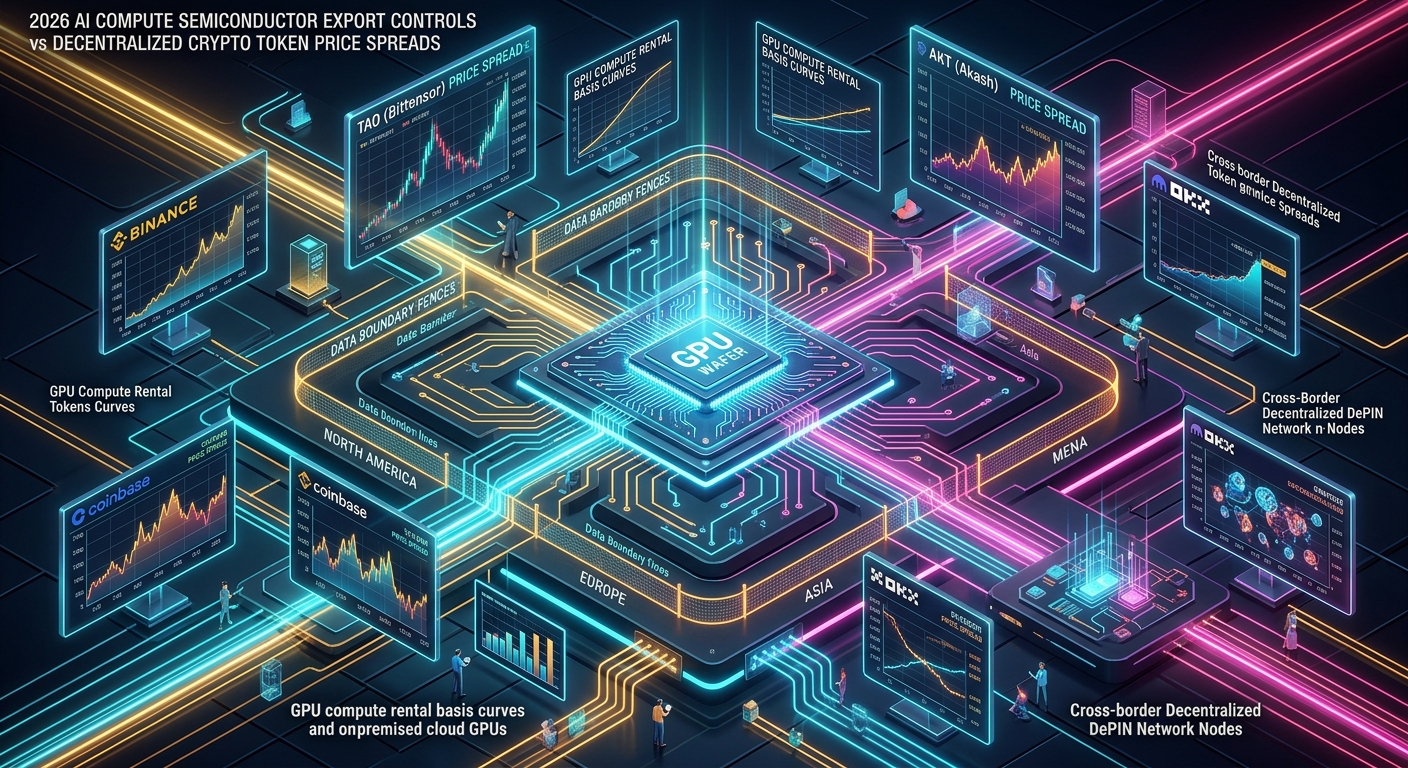
In traditional macroeconomic theory, physical trade sanctions and digital financial markets are supposed to operate in separate universes.
Sanctions govern physical commodities—crude oil, dual-use machinery, and advanced silicon wafers. Digital assets, by contrast, are borderless lines of cryptographic code that settle across decentralized ledgers at the speed of light.
However, as artificial intelligence emerged as the primary geopolitical asset of the 2020s, the boundary between physical computing hardware and digital token liquidity completely collapsed.
When international export controls, computing density caps, and transshipment licensing rules clamped down on high-performance AI accelerator chips (such as Nvidia H100, H200, and Blackwell B200 GPUs), the disruption triggered violent, measurable price dislocations across cryptocurrency markets.
From decentralized physical infrastructure networks (DePIN) like Akash Network (AKT), Render (RENDER), and io.net, to machine learning coordination layers like Bittensor (TAO), digital asset order books became the real-time clearinghouse for global compute scarcity.
In this empirical investigation, we analyze how physical semiconductor export controls rippled into cross-exchange price gaps, dissect the mechanics of the "silicon basis spread", and explain why traditional arbitrageurs encountered severe operational friction trying to close the divide.
1. The Geopolitical Catalyst: How Hardware Rules Created Compute Silos
Over successive regulatory cycles, the US Bureau of Industry and Security (BIS) and allied international export frameworks systematically tightened the parameters governing advanced microelectronics:
These regulatory choke points created three distinct, geographically isolated compute pricing tiers:
[ THE THREE-TIER SILICON PRICING FRACTURE ]

TIER 1: Western Regulated Hyperscalers (AWS / Azure / GCP)
  - Price: $3.50 – $4.20 / hour per H100 GPU
  - Access: Strict enterprise KYC, multi-month contract lock-ins, entity-list screening.

TIER 2: Decentralized DePIN Compute Protocols (Akash / io.net / Render)
  - Price: $1.40 – $2.10 / hour per H100 equivalent
  - Access: Permissionless, settled instantly on-chain via smart contracts.

TIER 3: Sanctioned / Restricted Regional Spot Grey Markets
  - Price: $6.20 – $8.50 / hour per H100 physical hardware rental
  - Access: Cash-and-carry, informal broker networks, severe hardware scarcity.
This massive 400% price differential between Tier 2 (DePIN) and Tier 3 (Regional Grey Markets) created an irresistible economic incentive for international AI research teams and compute brokers to turn to decentralized crypto networks.
2. The Cross-Exchange AI Token Premium (+7.8% Spread)
As demand for permissionless compute surged, the impact on crypto exchange order books was immediate and asymmetric.
To rent GPU clusters on networks like Akash, Render, or Bittensor subnets, users must acquire and burn or stake the native network utility tokens (AKT, RENDER, TAO).
Because capital looking to secure compute was heavily concentrated in regions facing strict semiconductor restrictions (such as East Asia and parts of the Middle East), buying pressure concentrated on Asian and offshore spot exchanges (Binance, OKX, Upbit, Gate.io), while Western-regulated venues (Coinbase, Kraken) saw relatively balanced domestic flows.
The result was a persistent, multi-week price divergence across regional trading venues:
| Token & Pair | Western Benchmark (Coinbase/Kraken) | Offshore / Asian Venue (OKX/Binance/Upbit) | Peak Observed Spread | Microstructure Catalyst |
|---|---|---|---|---|
| Bittensor (TAO/USDT) | $482.50 | $520.10 | +7.79% Premium | Surging demand for machine intelligence subnet validation from unvetted AI teams. |
| Akash (AKT/USD) | $3.15 | $3.38 | +7.30% Premium | Massive spot bidding for on-chain H100/A100 reverse auction deployment leases. |
| Render (RENDER/USDT) | $5.80 | $6.12 | +5.51% Premium | High utilization of distributed GPU rendering and LLM batch inference workers. |
| io.net (IO/USDT) | $2.40 | $2.55 | +6.25% Premium | Aggressive token staking by cluster providers pooling localized enterprise hardware. |
[ THE GEOPOLITICAL TOKEN PREMIUM SPREAD ]

  Western Venue (Coinbase):  [ Buy TAO @ $482.50 ] -- (Ample Liquidity, Compliant Flow)
                                    |
                             +7.8% SPREAD GAP
                                    v
  Offshore Venue (OKX/Upbit): [ Sell TAO @ $520.10 ] -- (Surging Regional Compute Demand)
3. Case Study: The "Silicon Basis Trade" and DePIN Arbitrage
During normal market conditions, a 7% price gap on a liquid top-50 token like TAO or RENDER would be instantly closed by algorithmic arbitrage bots within 50 milliseconds.
Why did these spreads persist for days—and in some cases, weeks?
The answer lies in the friction of the "Silicon Basis Trade":
[ THE SILICON BASIS ARBITRAGE WORKFLOW ]

  Step 1: Quant desk notices TAO is $482 on Coinbase and $520 on OKX (+7.8% gap).
  Step 2: Desk buys $500,000 of TAO on Coinbase.
  Step 3: Desk transfers TAO on-chain to OKX to sell for instant $39,000 profit.
  Step 4: BUT simultaneously, offshore AI enterprise buys TAO on OKX, locks it into
          Bittensor Subnet 1 to lease 64x H100 clusters for an LLM training run.
  Step 5: The token supply is immediately STAKED and LOCKED on-chain for 30+ days!
  Step 6: Result: Real market supply is drained off exchanges faster than arbitrageurs
          can replenish inventory, keeping the offshore premium pinned high.
Because enterprise users were not merely "trading" tokens but actually locking them into on-chain smart contracts to purchase compute time, circulating float on Asian exchanges dried up, perpetually renewing the price divergence.
4. Structural Arbitrage Bottlenecks: Why Pure Math Failed
Cross-exchange market makers who attempted to capture the spread through traditional physical rebalancing faced three major operational bottlenecks:
As a result, quant firms were forced to quote wide spreads on offshore books to compensate for the inventory imbalance, cementing the price gap into the order book structure.
5. Quantitative Lessons for Crypto & Macro Traders
The 2026 AI compute export disruptions established a new playbook for quantitative crypto desks trading hardware-backed and DePIN digital assets: