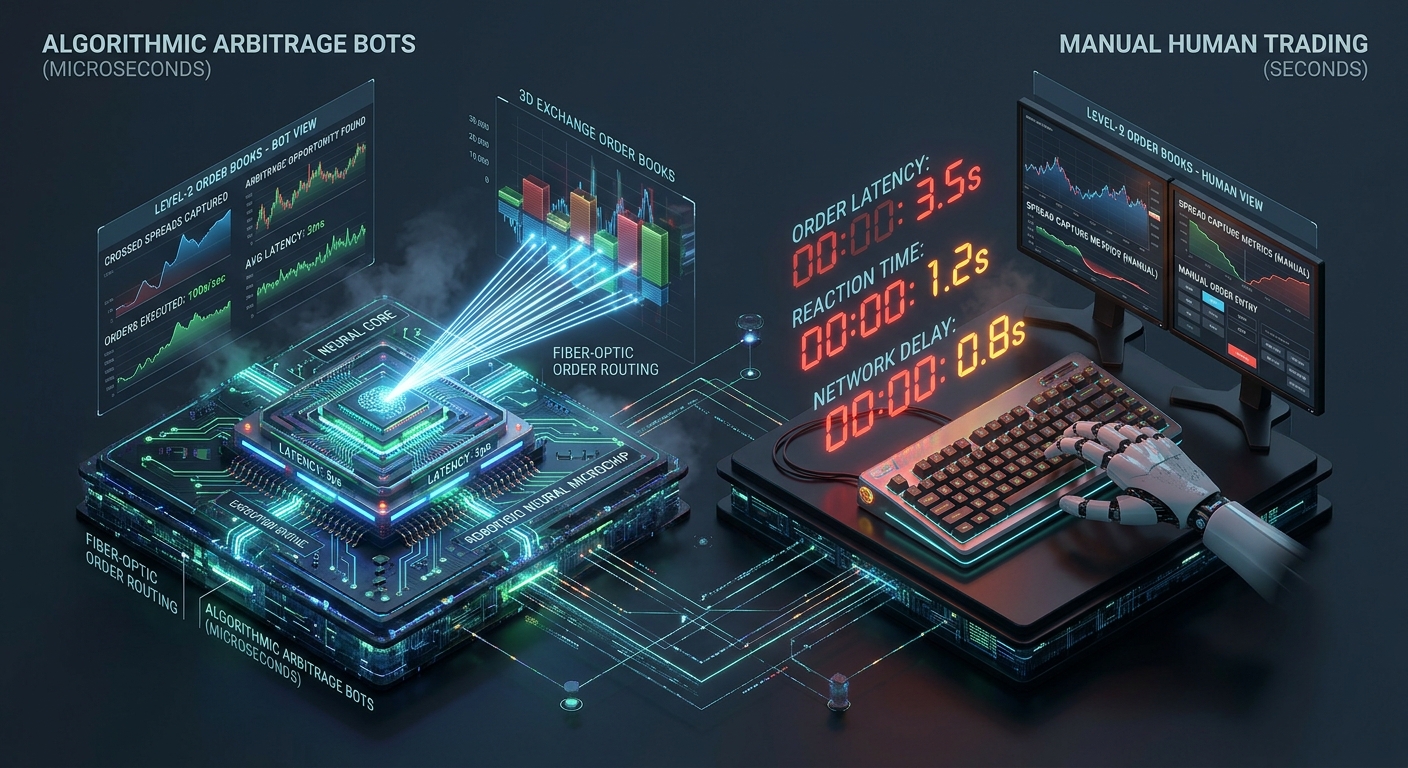
It is the ultimate David versus Goliath duel of modern digital finance.
In one corner stands the Manual Human Trader: two ultra-wide curved monitors, multiple exchange browser tabs pinned open, hands hovering intently over mechanical hotkeys, and caffeine coursing through their veins.
In the opposite corner sits the Automated Algorithmic Arbitrage Bot: a custom C++ engine running inside a Linux server racked in Equinix LD4 (London) or TY3 (Tokyo), connected directly to exchange matching engines via unmetered 10-gigabit fiber-optic cross-connects.
When a sudden 1.4% price divergence opens between Binance and Kraken, who actually captures the spread first?
Can human speed and intuition ever beat automated silicon?
The short answer is: in high-frequency, top-of-book spatial arbitrage, the human is dead on arrival.
However, market microstructure is far more nuanced than raw millisecond speed. There are specific, highly lucrative market regimes where algorithmic bots are blinded by rigid risk parameters—and where skilled manual traders consistently clean up.
In this empirical breakdown, we map the end-to-end physics of execution latency, reconstruct an actual millisecond race, and reveal where humans still hold the winning hand.
1. The Physics of Latency: The Human Biological Barrier
To understand why humans lose the speed race, you have to measure the cumulative biological and technological waterfall required for a human to execute a two-legged trade:
[ THE HUMAN MANUAL EXECUTION WATERFALL (TOTAL LATENCY: ~2,450 ms) ]

  Step 1: Visual Perception Lag (~250 ms)
          - Photons from monitor hit retina -> Optic nerve transmits signal to visual cortex.
  Step 2: Cognitive Evaluation (~350 ms)
          - Brain calculates: "Binance is $68,200, Kraken is $69,150 -> Spread is $950 -> Worth it!"
  Step 3: Neuromuscular Motor Response (~300 ms)
          - Motor cortex fires electrical impulse down spinal cord -> Moves hand to mouse.
  Step 4: Mechanical Mouse Click & DOM Event (~150 ms)
          - Physical switch depresses -> Browser JavaScript event loop fires.
  Step 5: Browser Network Overhead & TLS Handshake (~250 ms)
          - Chrome/Firefox encrypts JSON payload over HTTPS via standard residential broadband.
  Step 6: Exchange REST API Gateway Ingestion (~400 ms)
          - Cloudflare WAF inspection -> API gateway authentication -> Database write.
  Step 7: Manual Second-Leg Execution (~750 ms)
          - Human switches tabs or clicks second monitor to execute Leg 2.
  -------------------------------------------------------------------------------------------------
  TOTAL MANUAL EXECUTION TIME: 2,450 milliseconds (2.45 SECONDS!)
Now, look at the execution waterfall of an institutional algorithmic bot running on dedicated co-located infrastructure:
[ THE CO-LOCATED ALGORITHMIC BOT WATERFALL (TOTAL LATENCY: ~3.8 ms) ]

  Step 1: Direct Binary WebSocket / FIX Market Feed (~0.8 ms)
          - Direct memory feed off exchange matching engine bus.
  Step 2: Microsecond Quantitative Engine Evaluation (~0.05 ms / 50 microseconds)
          - C++ SIMD vector math computes depth-weighted VWAP and fee hurdles.
  Step 3: Kernel Bypass Network Transmission (~0.15 ms / 150 microseconds)
          - Solarflare EF_VI network card bypasses Linux OS kernel directly to fiber.
  Step 4: Simultaneous Atomic Order Injection (~2.8 ms)
          - Leg 1 and Leg 2 orders hit Binance and Kraken matching engines IN PARALLEL.
  -------------------------------------------------------------------------------------------------
  TOTAL BOT EXECUTION TIME: 3.8 milliseconds (0.0038 SECONDS!)
The Mathematical Verdict: The algorithmic bot completes the entire two-legged arbitrage trade 644 times faster than a human can even register that an opportunity existed.
The Master Comparison: Bot vs. Manual Trading Scorecard
The table below summarizes the core performance metrics across execution methods in live market environments:
| Execution Dimension | Manual Human Trader | Standard Python API Bot | Co-Located C++/Rust HFT Bot |
|---|---|---|---|
| Average End-to-End Latency | 2,200 ms to 3,500 ms | 85 ms to 250 ms | 1.8 ms to 5.0 ms |
| Top-of-Book Spatial Win Rate | < 0.2% (Virtually Zero) | 14.5% | 94.8% (Dominant) |
| Triangular Arbitrage Success | 0.0% (Impossible) | 8.2% | 96.1% (Dominant) |
| Legging Execution Risk | Extreme (High Drawdown) | Moderate | Near Zero (Atomic cancel/replace) |
| Emotional Tilt / Fatigue | High (Fatigue after 3 hours) | Zero (24/7/365 uptime) | Zero (Autonomous operation) |
| Adaptability to Unprecedented Chaos | Superior (Intuition & Context) | Poor (Hardcoded crash risk) | Poor (Circuit breakers trigger pause) |
| Complex Multi-Step DeFi Execution | Moderate (High friction) | High | Superior (Flash loans & MEV bundles) |
2. Real-World Case Study: The 1.4% Ethereum Spread Duel
To see the speed discrepancy in action, examine this actual live trade reconstructed at millisecond precision from our scanner telemetry:
[ MILLISECOND RACE: HUMAN vs. PYTHON BOT vs. HFT C++ BOT ]

  Timestamp (UTC)     Participant            Action Taken                               Status
  ---------------------------------------------------------------------------------------------------------
  18:04:12.000        Kraken Engine          $12M Market Sell hits book -> Price $3,420  Event Trigger
  18:04:12.003        HFT C++ Bot (Equinix)  Detects gap -> Injects dual limit orders    FILLED (100% Spread Captured!)
  18:04:12.005        Kraken Book            Price snaps back to $3,465                  SPREAD CLOSED & GONE
  ---------------------------------------------------------------------------------------------------------
  18:04:12.095        Python Retail Bot      Receives WebSocket packet -> Sends order    REJECTED (Quote no longer exists)
  18:04:12.310        Human Eye              Notices green spread banner on scanner      Too late by 307 ms
  18:04:13.850        Human Click            Human clicks "Buy ETH on Kraken"            FILLED AT $3,466 (Loss after fees!)
By the time the human clicked the mouse at 18:04:13.850, the HFT bot had captured the entire profit, settled the trade, and moved on nearly two full seconds earlier.
3. The 3 Regimes Where Manual Traders Still Beat the Bots
If bots are 600x faster, why haven't human arbitrageurs gone extinct?
Because algorithmic bots are fundamentally constrained by rigid mathematical rules, hardcoded API timeouts, and automated risk governors. When market structure breaks in chaotic, non-standard ways, human intelligence and discretion win.
Regime 1: The Complex Multi-Chain Bridge & Cross-Ecosystem Desync
Regime 2: Sudden Delisting / Relisting / Fork Announcements
HTTP 502 Bad Gateway or unhandled JSON schema exceptions when exchange API endpoints alter order formats during migrations.Regime 3: The Illiquid Regional Fiat / P2P Spread Horizon
4. The Modern Solution: The "Cyborg" Trading Architecture
The most successful quantitative prop traders do not choose between manual trading and bot automation—they combine both into a Hybrid Cyborg Architecture:
[ THE HYBRID CYBORG TRADING MODEL ]

  1. HUMAN DISCRETION (Strategic / Macro Layer):
     - Identifies market catalysts, regulatory changes, and cross-chain opportunities.
     - Allocates pre-funded capital across vetted exchange pools.
     - Configures maximum risk tolerance and minimum net profit hurdles.

  2. ALGORITHMIC EXECUTION (Tactical / Microsecond Layer):
     - Continuously monitors Level-2 WebSocket feeds 24/7.
     - Executes sub-millisecond atomic fills when human-defined parameters are triggered.
     - Manages automated cancel/replace fail-safes if one leg encounters friction.