It is one of the most common points of confusion for cryptocurrency traders:
You open CoinMarketCap, and Bitcoin is quoted at $64,820.
You switch to CoinGecko, and it displays $64,745.
You open your Binance or Coinbase terminal, and the live top-of-book bid is flashing at $64,910.
Which one of these prices is real? Why do the world’s two largest crypto data portals disagree with each other—and why do both disagree with the price you can actually execute on an exchange right now?
The answer comes down to Data Aggregation Methodology.
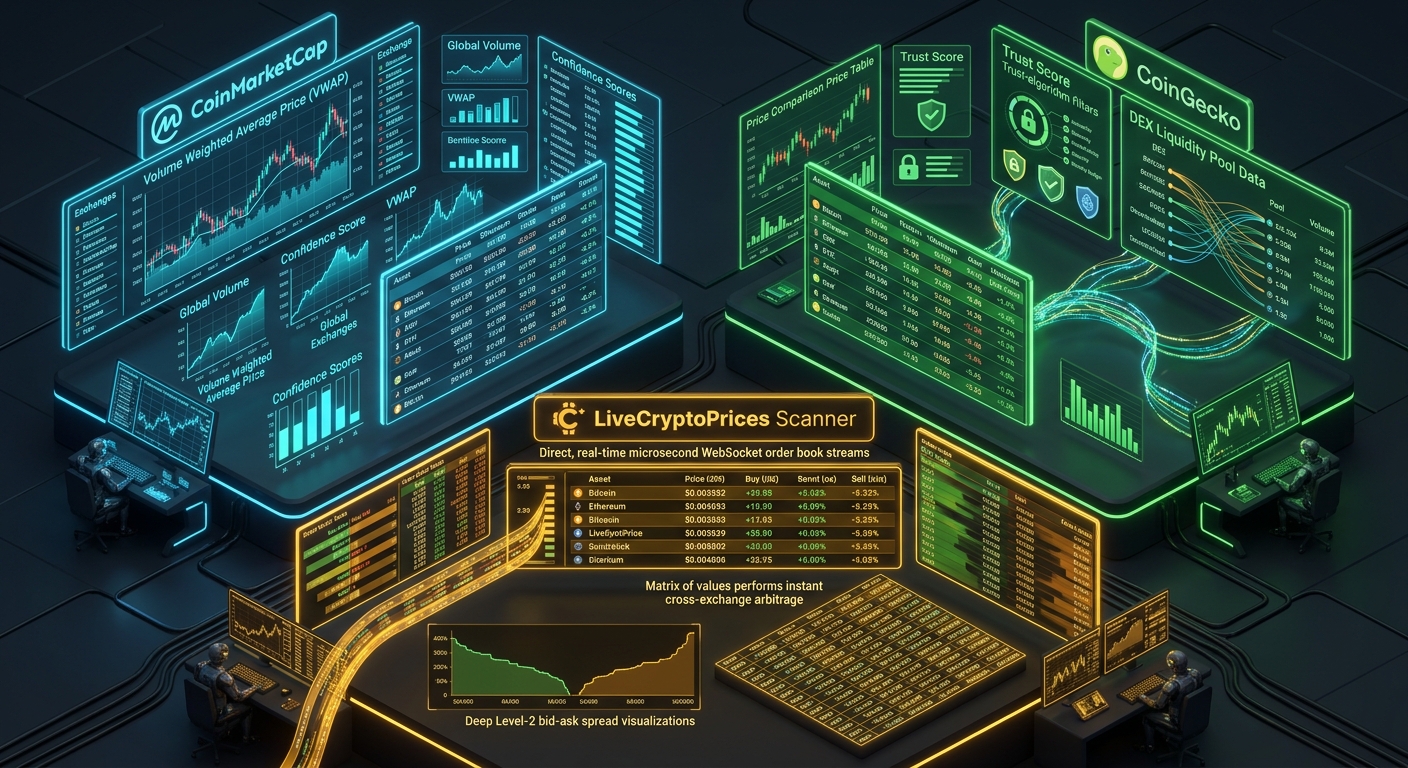
In this forensic breakdown, we pull back the curtain on how CoinMarketCap, CoinGecko, and the LiveCryptoPrices Scanner collect, filter, weight, and compute cryptocurrency prices. You will learn why synthetic global averages fail active traders, how regional premiums distort public feeds, and how real-time WebSocket scanners give quantitative traders an unfair edge.
1. The Core Architecture: Synthetic Averages vs. Executable Order Books
Before comparing individual platforms, we must understand the fundamental divide in financial data architecture:
[ DATA ARCHITECTURE: PASSIVE AGGREGATORS vs. LIVE SCANNERS ]

  PASSIVE GLOBAL AGGREGATORS                  REAL-TIME EXECUTION SCANNERS
  (CoinMarketCap / CoinGecko)                 (LiveCryptoPrices Scanner)
  ┌─────────────────────────────────┐         ┌─────────────────────────────────┐
  │ Ingestion: REST Polling (1-5m)  │         │ Ingestion: Direct WebSockets    │
  │ Metric:    Global VWAP Average  │         │ Metric:    Live Top-of-Book L2  │
  │ Goal:      Informational Index  │         │ Goal:      Instant Execution    │
  │ Pricing:   Synthetic / Delayed  │         │ Pricing:   Raw & Tradable       │
  │ Latency:   60s – 300s           │         │ Latency:   10ms – 50ms          │
  └─────────────────────────────────┘         └─────────────────────────────────┘
CoinMarketCap and CoinGecko were designed as macro informational reference indexes for portfolio tracking, market capitalization rankings, and historical charting.
They do not show a price you can buy or sell at. They show a mathematical composite approximation across hundreds of disparate markets.
2. How CoinMarketCap Calculates Its Headline Price
CoinMarketCap (CMC), owned by Binance, relies on a Volume-Weighted Average Price (VWAP) model combined with machine-learning outlier filtering:
[ COINMARKETCAP VWAP FORMULA ]

  Global Price = Σ (Exchange Price_i × Volume_i) / Σ (Volume_i)

  Filtered by:
    • Outlier Price Detection (Excludes pairs deviating >X% from median)
    • CMC Confidence Score (Penalizes exchanges with low order book depth)
    • Excluded Pairs (Manually flags untracked or wash-traded markets)
Strengths of the CMC Model
Weaknesses of the CMC Model
3. How CoinGecko Approaches Price Discovery
CoinGecko operates as an independent data aggregator with a heavy focus on decentralized finance (DeFi) and verified community metrics.
Rather than relying purely on reported exchange volume (which is notoriously easy to fake via wash-trading API bots), CoinGecko developed its proprietary Trust Score algorithm:
[ COINGECKO TRUST SCORE ARCHITECTURE ]

  Trust Score (1 to 10 Scale) evaluates:
    1. Order Book Liquidity (+/- 2% Depth & Bid-Ask Spread Quality)
    2. Web Traffic Analysis (SimilarWeb real human visitor validation)
    3. API Completeness & WebSocket Coverage
    4. Cybersecurity Audits (CER.live security ratings)
    5. Team & Regulatory Transparency
Strengths of the CoinGecko Model
Weaknesses of the CoinGecko Model
4. The 3 Hidden Traps of Relying on Global Aggregators
For active traders and arbitrageurs, using CoinMarketCap or CoinGecko to make real-time trading decisions introduces three severe risks:
[ THE 3 AGGREGATOR BLIND SPOTS ]

  1. THE KIMCHI PREMIUM DISTORTION (Korean CEXs trade +3% higher, skewing global VWAP)
  2. THE IN-TRANSIT FLASH CRASH LAG (Aggregators take 3 minutes to reflect sudden dumps)
  3. THE PHANTOM ARBITRAGE TRAP (Spotting a gap on CMC that closed 2 minutes ago)
1. The Regional Premium Distortion (The Kimchi Premium)
In South Korea, strict capital controls prevent foreign capital from easily entering or exiting domestic exchanges like Upbit and Bithumb.
During bull runs, Korean retail demand often pushes Bitcoin 3% to 7% higher on Upbit than on Coinbase. Because Upbit does billions in daily volume, CMC and CoinGecko include these elevated prices in their global average.
As a result, the "Global Price" displayed on your screen is $300 higher than what you can actually sell Bitcoin for in the United States or Europe.
2. Flash Crash Polling Lag
During the sudden liquidation cascade of August 5, 2024, Ethereum dropped from $2,700 to $2,150 on Binance in less than 90 seconds.
Traders watching CoinGecko and CMC saw Ethereum slowly tick down to $2,550, then $2,400, lagging the real market by over two minutes.
Anyone attempting to execute based on the aggregator price suffered massive unexpected slippage.
3. The Phantom Arbitrage Trap
New traders frequently look at the "Markets" tab on CoinMarketCap, notice that Exchange X is listing a token at $1.00 while Exchange Y lists it at $1.10, and rush to execute an arbitrage trade.
By the time they register and transfer funds, they discover the price on Exchange Y was actually from a trade that occurred 45 minutes ago, and the order book is completely empty.
5. How LiveCryptoPrices Scanner Works Differently
The LiveCryptoPrices Scanner was built from the ground up for active cryptocurrency traders, quantitative analysts, and arbitrageurs who require actionable, sub-second execution data.
[ LIVECRYPTOPRICES STREAMING PIPELINE ]

  25+ Global Exchanges (Binance, Coinbase, Kraken, Bybit, OKX, Uniswap, Raydium)
                       │ (Direct Low-Latency WebSocket Streams)
                       ▼
  ┌─────────────────────────────────────────────────────────────────┐
  │ Real-Time Order Book Engine (Sub-50ms Microsecond Ticks)        │
  │   • Live Top-of-Book Bids & Asks (True Executable Prices)       │
  │   • Depth-of-Market (Order Book Slippage Simulation)            │
  │   • Fee-Adjusted Net Arbitrage Spread Matrix                    │
  │   • Cross-Exchange Transfer Status & Network Gas Cost Overlay   │
  └─────────────────────────────────────────────────────────────────┘
                       │
                       ▼
  Instant Visual Heatmap & Live Arbitrage Alert Stream
Key Differences in LiveCryptoPrices Architecture
6. Head-to-Head Comparison Matrix
| Feature | CoinMarketCap | CoinGecko | LiveCryptoPrices Scanner |
|---|---|---|---|
| Primary Metric | Global VWAP Average | Trust-Weighted VWAP | Raw Level-2 Bid/Ask Quotes |
| Update Latency | 60s – 300s (REST Polling) | 60s – 120s (REST Polling) | 10ms – 50ms (Live WebSockets) |
| Tradable Execution | No (Theoretical index) | No (Theoretical index) | Yes (Direct live order book prices) |
| DEX Pool Integration | Moderate | Deep (GeckoTerminal) | Real-Time On-Chain AMM Pools |
| Cross-Venue Spreads | Static Markets Tab | Static Tickers Tab | Dynamic Multi-Exchange Matrix |
| Fee-Adjusted Profit | Not Supported | Not Supported | Automated Net Yield & Break-Even |
| Best Used For | Macro Market Cap Rankings | Long-Tail Token Discovery | Active Arbitrage & Trade Execution |
7. Strategic Summary: Which Tool Should You Use?
Every tool has its place in a professional crypto trader’s workflow:
Explore live real-time price spreads and discover actionable arbitrage windows across 25+ exchanges right now on our Live Arbitrage Scanner.