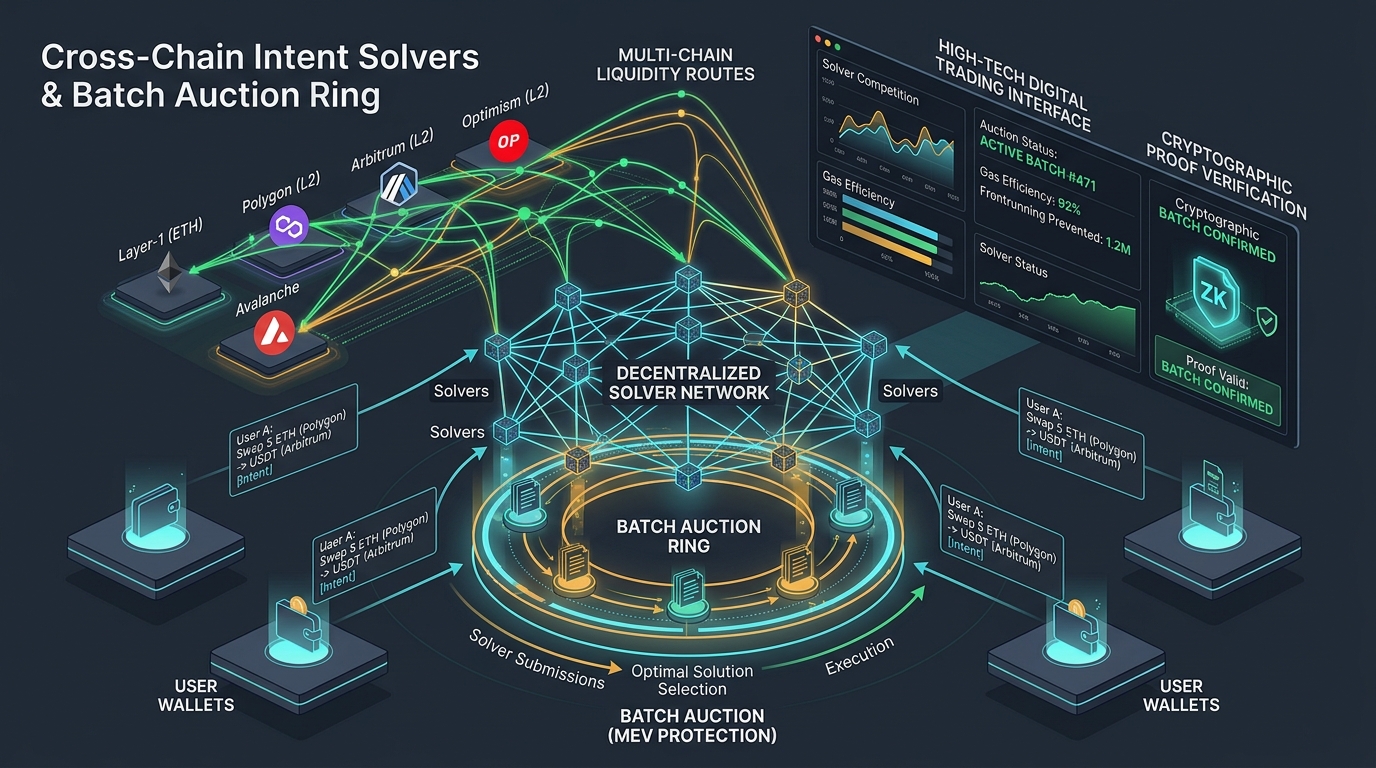
For years, executing a large cryptocurrency trade on a decentralized exchange felt like walking through a predatory financial gauntlet.
A trader wanting to swap 50 ETH into USDC on Ethereum mainnet would configure a slippage tolerance, sign a raw transaction, and broadcast it to the public mempool. Within milliseconds, predatory maximal extractable value (MEV) searcher bots would detect the pending swap, calculate the exact price impact, and execute a classic sandwich attack—bribing block validators via priority gas fees (PGA) to frontrun the buyer, push the price up, and immediately backrun the trade to pocket guaranteed risk-free profit.
Even worse, moving that capital across rollups (such as from Arbitrum to Base or Optimism) required lock-and-mint bridges with multi-minute delays, high native gas tolls, and constant counterparty smart-contract vulnerabilities.
Today, the DeFi paradigm has undergone its most profound architectural revolution since the invention of the constant product automated market maker (AMM): the transition from transaction-based execution to intent-based execution.
In this exhaustive technical guide, we break down the inner mechanics of cross-chain intent solvers, explore how batch auctions neutralize multi-million dollar MEV extraction vectors, analyze solver game theory, and show how cross-venue price discrepancies are identified in modern markets.
1. What Are Intents? The Paradigm Shift Explained
To understand why intents represent a generational leap, we must compare the traditional imperative execution model with the modern declarative intent architecture.
In the Traditional Transaction Model (Imperative), the user dictates the exact recipe for how the trade must occur. You tell the blockchain: "Call Uniswap v3 pool address 0x88e6... swap token A for token B through the 0.05% fee tier with 1.0% maximum slippage, and spend up to 25 Gwei on gas." If the market moves by 1.1% while the block is building, the transaction reverts, burning the user’s gas fee entirely. If the market moves in the user’s favor, the excess surplus is captured by frontrunning MEV bots rather than returned to the trader.
In the Intent-Based Model (Declarative), the user dictates only the desired economic outcome. You sign a signed message (EIP-712 permit) stating: "I have 10 ETH on Arbitrum. I want at least 34,500 USDC deposited into my wallet on Base. The filler may keep any surplus, but my signature is invalid if I receive one penny less." The user pays zero upfront gas, cannot suffer a reverted transaction fee, and outsources the computational and routing burden entirely.
2. The Anatomy of an Intent Auction: How Solvers Compete
Once an intent is signed, it is broadcast to an off-chain network of specialized institutional market makers known as Solvers (or Relayers / Fillers).
These solvers participate in high-speed algorithmic auctions to win the right to fulfill the user’s order. The auction architecture typically takes one of two primary forms:
- Batch Auctions (CoW Protocol Model): Orders are collected over a fixed discrete time window (e.g., a 15-second batch). The protocol’s solver competition evaluates all orders simultaneously. If Alice wants to sell ETH for USDC, and Bob wants to sell USDC for ETH, the solver matches them directly peer-to-peer at a single uniform clearing price. This is known as a Coincidence of Wants (CoW). Because the trade occurs directly between users, zero liquidity pool fees are paid, zero price impact occurs, and MEV bots have no order flow to sandwich.
- Dutch Auctions & RFQ (UniswapX Model): The order begins offering an attractive starting price (above market) and gradually decays over a discrete timeframe according to a predetermined decay curve until a solver finds it profitable to fill. The most competitive solver with the lowest capital costs and fastest private routing executes the trade immediately, passing price improvement back to the user.
3. Solving the Cross-Rollup Liquidity Fragmentation Crisis
Before intent-based cross-chain bridges, moving liquidity between Ethereum Layer-2s was plagued by the Optimistic Rollup Seven-Day Challenge Window or custodial multi-sig bridge risk.
Protocols like Across Protocol and UniswapX Cross-Chain revolutionized this workflow through optimistic filler rebalancing:
- When a user creates an intent to transfer 5,000 USDC from Arbitrum to Base, the solver does not wait for a bridge. The solver immediately disburses 5,000 USDC of their own native inventory on Base to the user within 2 seconds.
- The solver then files an optimistic repayment claim against the protocol’s liquidity pool on the origin chain (Arbitrum).
- The protocol’s decentralized verification layer (using UMA’s optimistic oracle or zero-knowledge state proofs) validates that the user indeed received their funds on the destination chain, and subsequently reimburses the solver along with a small basis-point liquidity fee.
This shifts cross-chain bridging risk entirely away from retail users and onto sophisticated institutional entities with dedicated balance-sheet liquidity across 20+ chains.
4. Why Toxic MEV Is Systematically Eradicated
Traditional public mempools are hotbeds for toxic value extraction. Research shows that over $1.4 billion has been extracted from retail traders in sandwich attacks and frontrunning since 2020.
Intent architectures neutralize toxic MEV through three architectural barriers:
- Private Off-Chain Order Flow: Intent signatures are transmitted via secure peer-to-peer gossiping networks or private RPC endpoints, keeping them entirely invisible to public mempool searchers until the final settlement transaction is bundled and submitted via Flashbots Protect or MEV-Blocker.
- Uniform Clearing Prices: In batch auctions, all trades executed within the same block clear at the exact same price, making it mathematically impossible for a bot to execute a profitable frontrun.
- Surplus Sharing: If a solver finds an optimized routing path through a centralized exchange or private dark pool that yields more tokens than the user requested, modern intent protocols enforce surplus-sharing rules, returning 50% to 90% of the positive slippage directly to the trader.
5. The Economics of Solver Profitability & Cross-Exchange Hedging
How do solvers make money, and why are major quantitative market makers (such as Wintermute, Barter, and Keyrock) heavily invested in solver infrastructure?
A solver’s profit is determined by the spread between the user’s signed minimum limit price and the actual marginal cost to source and deliver the liquidity:
Solver Net Alpha = Intent Value Sourced - Fulfillment Cost - Gas Overhead - Hedging Slippage
Solvers achieve high margins through several proprietary execution vectors:
- Internalization of Order Flow: Market makers with large balance sheets match incoming intents against their internal market-making inventory without paying any external taker fees.
- CEX-DEX Hedging: When a user submits an intent to sell 100 SOL on-chain, the solver can fill the order with on-chain stablecoins and simultaneously short 100 SOL on Binance or Bybit perpetual futures to lock in a risk-free basis spread.
- Complex Multi-Hop Routing: Solvers utilize proprietary off-chain graph routing algorithms that evaluate hundreds of liquidity sources simultaneously—including Uniswap v3/v4, Curve stableswap, Balancer pools, and centralized OTC desks—discovering optimal routes far too computationally expensive to execute purely inside an EVM smart contract.
6. Where the Arbitrage Edge Lives for Quantitative Desks
While intent solvers have streamlined retail trading, they have created brand-new structural price discrepancies across venues:
- Solver Inventory Rebalancing Gaps: When massive one-directional intent flow occurs (for instance, massive capital fleeing an alt-L1 into Ethereum), solvers accumulate heavy one-sided inventory on the origin chain, creating temporary 20 to 60 basis point discounts on decentralized liquidity pools as solvers dump excess tokens.
- Off-Chain vs. On-Chain Latency Gaps: Because solvers hedge their risk on centralized exchanges, sudden volatility on centralized spot order books causes on-chain intent fill prices to lag by several hundred milliseconds, offering rapid triangular arbitrage opportunities.
- Monitoring Cross-Exchange Gaps in Real Time: Quantitative desks track these live price divergences across centralized and decentralized venues using our Live Arbitrage Scanner to pinpoint actionable execution windows before solvers rebalance their books.
7. How to Trade and Execute in the Intent Era
- Always Prioritize Intent-Based Aggregators: When trading on-chain, use intent-native interfaces (such as CoW Swap, UniswapX, or 1inch Fusion) to ensure zero slippage losses and complete MEV protection.
- Account for Total Net Cost: Always factor in maker/taker fees, gas allowances, and cross-chain rebalancing friction by modeling your strategy with our Profit & Break-Even Calculator.
- Monitor Order Book Depth: Examine real-time bid/ask liquidity on major CEXs using our Bitcoin Order Book Depth and Ethereum Order Book Depth monitors to anticipate where solver hedging pressure will land.