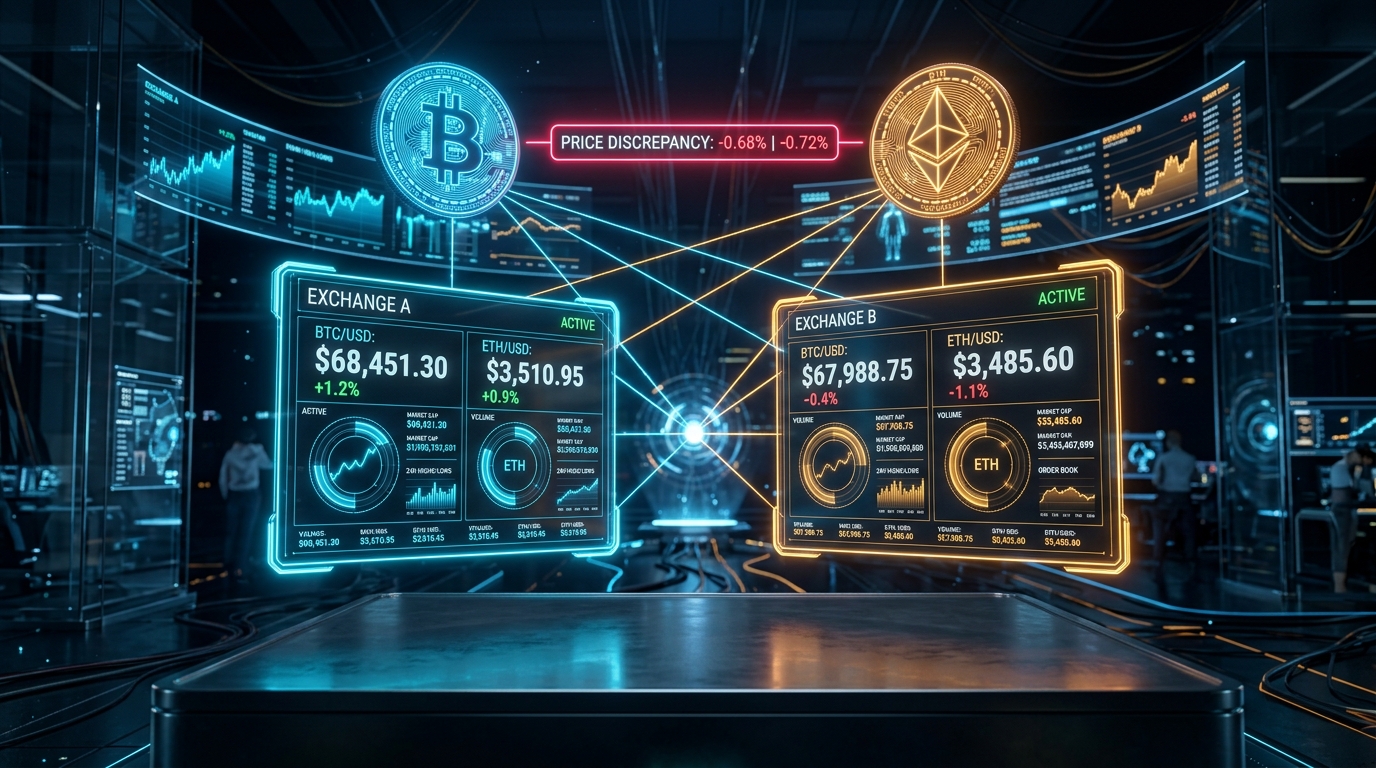
If you glance at two synchronized atomic clocks located in New York and London, they will display the exact same microsecond. But if you open Coinbase in New York and Binance in London at that exact same microsecond, you will almost never see the same price for Bitcoin, Ethereum, or Solana.
Sometimes the difference is negligible—a couple of dollars or 0.05%. Other times, during market panics or regulatory disruptions, the price discrepancy can blow out to 5%, 10%, or even 20%.
To someone accustomed to traditional stock markets where unified pricing is legally mandated, this discrepancy feels like a system failure. In cryptocurrency, however, price discrepancies are the fundamental heartbeat of a decentralized, multi-jurisdiction market.
In this deep dive, we will explore the structural forces that create crypto exchange price discrepancies, analyze historical real-world case studies, and explain how smart traders navigate these pricing variations.
1. The Core Cause: The "Private Room" Auction Model
The primary reason price discrepancies exist is that cryptocurrency exchanges do not share a single order book.
In the United States equity markets, all registered stock exchanges feed into the Securities Information Processor (SIP) under the SEC’s National Market System (Reg NMS). If an investor in California buys Apple shares on Robinhood, their order is routed to the best available bid or ask across all US exchanges nationwide.
Cryptocurrency has no SIP and no global regulator. Each exchange operates as an independent private auction room:
The price you see on an exchange chart is simply the price of the last matched trade inside that specific private room. Unless participants constantly move capital between rooms, the prices will naturally wander apart.
2. Case Study: The May 2023 Australian Binance -20% Discrepancy
One of the most dramatic price discrepancies in crypto history occurred in Australia in May 2023.
What Happened?
Binance Australia’s third-party payment provider abruptly severed connections to the Australian banking network (PayID / Osko), announcing that AUD fiat withdrawals would be permanently suspended in five days.
Australian users holding Australian Dollars on Binance rushed to convert their fiat into Bitcoin and Ethereum so they could withdraw their funds to personal hardware wallets.
The Resulting Price Discrepancy:
BTC/AUD pair as users dumped crypto to get their fiat out before the banking window shut!For several days, Bitcoin traded at an astonishing -21% discount on Binance Australia. International arbitrageurs could not step in to buy the cheap Bitcoin because they had no way to deposit Australian dollars into the severed banking rail.
3. The Three Microstructural Drivers of Price Discrepancies
Aside from extreme banking crises, daily price discrepancies are driven by three continuous market mechanisms:
A. Asymmetric Order Flow Shocks
When a hedge fund executes a $50,000,000 TWAP buy order on Coinbase Prime, Coinbase’s ask order book gets swept upwards. For several minutes, Coinbase’s price will trade $50 to $200 higher than Binance or Bybit until market makers re-hedge on other venues.
B. Stablecoin Peg Micro-Deviations
Cryptocurrency pairs are quoted in different baseline currencies:
BTC / USD (Real fiat US Dollars)BTC / USDT (Tether)BTC / USDC (Circle USD)If Tether (USDT) trades at $0.997 against the dollar, a Bitcoin worth $64,000 in cash will mathematically quote at 64,192 USDT. This creates a $192 price discrepancy that is purely an optical illusion caused by the stablecoin denominator.
C. The Friction & Fee Barrier (The "No-Arbitrage Band")
Why don’t automated high-frequency trading bots instantly eliminate every 0.10% discrepancy? Because closing a price gap costs real money:
Minimum Arbitrage Threshold = Taker_Fee_Venue_A + Taker_Fee_Venue_B + Slippage + Gas_AmortizationFor a standard institutional desk, executing on both sides costs between 0.06% and 0.15%. Any price discrepancy smaller than this cost band is economically unprofitable to close, allowing minor discrepancies to persist all day long.
4. How to Use Price Discrepancies to Your Trading Advantage
Price discrepancies are not just fascinating market mechanics—they provide actionable advantages for smart investors:
Conclusion
Crypto exchange price discrepancies reflect the decentralized reality of global digital asset markets. By understanding the banking rails, order book physics, and fee dynamics behind these differences, traders can make smarter execution decisions and spot genuine market opportunities.