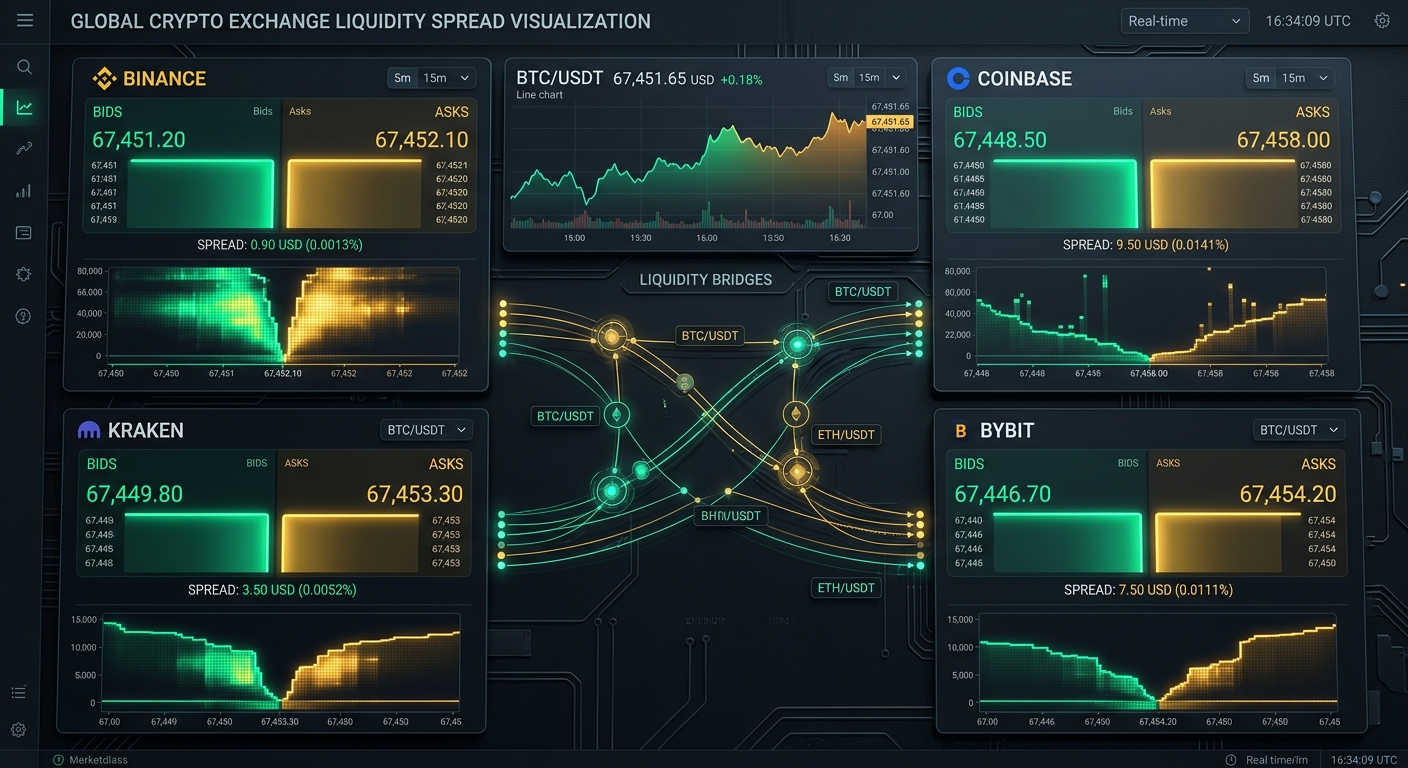
Every active crypto trader knows the sting of market commissions. You scrutinize the fee schedule: 0.10% taker fee, 0.05% maker fee. You calculate your breakeven. But when you look at your filled orders, you realize you lost significantly more capital than commission fees alone can explain.
The culprit is the crypto exchange spread—the quiet, relentless toll booth built into every decentralized liquidity pool and centralized order book in the world.
On a calm Tuesday afternoon, buying 5 Bitcoin on Binance might cost you a negligible $10 spread. But attempt to buy that same 5 Bitcoin on a smaller regional exchange during an overnight volatility spike, and the spread alone can silently deduct $1,200 from your trade.
Understanding how crypto exchange spreads work, why they vary so dramatically across platforms, and how to measure and exploit them is one of the most critical skills separating amateur retail traders from seasoned market operators. In this comprehensive guide, we will deconstruct crypto exchange spreads from the ground up.
Section 1: The Two Dimensions of Crypto Exchange Spreads
When traders discuss "exchange spreads," they are usually referring to one of two distinct market microstructure phenomena:
Dimension 1: The Intra-Exchange Bid-Ask Spread (The Price of Immediacy)
The Bid-Ask Spread is the internal gap between the highest price a buyer is willing to bid and the lowest price a seller is willing to accept on a single exchange:
Bid-Ask Spread ($) = Best Ask Price - Best Bid PriceSpread Percentage (%) = ((Best Ask - Best Bid) / Mid-Price) * 100This spread represents the profit margin demanded by market makers in exchange for providing instant liquidity and taking on inventory risk. If you want to buy or sell immediately using a market order, you must cross this spread.
Dimension 2: The Inter-Exchange Price Spread (Cross-Venue Dispersion)
The Cross-Exchange Spread is the price differential for the exact same cryptocurrency across two competing exchanges at the same moment:
Cross-Exchange Spread ($) = Price(Exchange B) - Price(Exchange A)Relative Cross Spread (%) = ((Price(Exchange B) - Price(Exchange A)) / Price(Exchange A)) * 100This spread exists because cryptocurrency exchanges operate as independent, fragmented liquidity silos. Unlike traditional US equities, which are unified by the National Market System (NMS) and Securities Information Processor (SIP), crypto has no central order book. Every exchange matches orders within its own isolated database.
Section 2: Why Exchange Spreads Vary Wildly Across Platforms
Why does Bitcoin trade with a 0.005% spread on Binance, a 0.02% spread on Coinbase, and a 0.45% spread on smaller exchanges? Five core structural forces drive spread width:
1. Market Maker Density and Competition
On premier global venues (Binance, Coinbase, OKX, Bybit), dozens of institutional quantitative trading firms (such as Wintermute, Flow Traders, and Jane Street) run automated algorithmic market-making bots. These algorithms engage in fierce sub-millisecond price competition, tightening the bid-ask spread to the minimum possible tick size ($0.01 or $0.10).
On tier-2 and tier-3 exchanges with fewer active market makers, the lack of competition allows resting liquidity providers to maintain wide, highly profitable spreads.
2. Fiat Banking Rails vs. Offshore Stablecoins
Exchanges operating direct fiat banking on-ramps (USD, EUR, GBP via SWIFT, FedNow, or SEPA) cater to institutional capital and regulated retail flow. However, fiat settlement takes days, and banking compliance costs are high.
Offshore exchanges operating purely in USDT or USDC experience frictionless 24/7 digital settlement. This friction disparity frequently causes fiat exchange spreads and stablecoin exchange spreads to decouple during market stress.
3. Maker-Taker Fee Incentive Architectures
An exchange’s fee schedule directly dictates market maker behavior. Exchanges that offer negative maker fees (rebates where the exchange pays the market maker 0.005% for placing limit orders) incentivize market makers to quote razor-tight spreads.
Conversely, exchanges that charge high maker fees force liquidity providers to widen their bid-ask quotes to ensure their trading remains profitable after exchange deductions.
4. Order Flow Toxicity and Adverse Selection
Market makers widen their spreads when they fear "toxic order flow"—orders from informed traders (such as institutional whales with material non-public information or fast latency advantages).
If an exchange has a reputation for hosting aggressive latency arbitrage bots, market makers widen their resting bid-ask cushions to protect themselves from getting picked off on fast price moves.
5. Capital Fragmentation and Geographic Fencing
Regulatory restrictions (such as geo-blocking US residents from offshore derivatives venues, or South Korea’s strict foreign exchange controls) isolate capital pools. When capital cannot flow freely between two countries or platforms, the cross-exchange spread widens and can persist for days or weeks.
Section 3: Real-World Case Studies in Extreme Exchange Spreads
To understand how exchange spreads behave during market dislocations, let us analyze three landmark historical events:
Case Study 1: The Silicon Valley Bank USDC De-Peg (March 2023)
On Friday night, March 10, 2023, Circle revealed that $3.3 billion of USDC reserves were held at Silicon Valley Bank (SVB), which had just been placed into FDIC receivership.
Over the weekend, US banking rails were completely offline. Decentralized Uniswap USDC/USDT pools crashed to $0.88. On centralized exchanges, the spread between Coinbase (which had paused 1:1 fiat redemptions) and Kraken blew out to over 4.5% ($4,500 on a $100k trade).
Traders who understood that the Fed would guarantee uninsured deposits stepped in, buying discounted USDC at $0.90 on wide DEX spreads and holding until Monday morning when banking rails reopened and the peg restored to $1.00.
Case Study 2: The Ripple XRP SEC Ruling Relisting (July 2023)
When Judge Analisa Torres ruled that programmatic sales of XRP did not constitute securities transactions, US exchanges (Coinbase, Kraken, Gemini) rushed to relist XRP after years of delisting.
In the first 30 minutes of trading, retail demand on Coinbase was so overwhelming that the XRP/USD bid-ask spread exploded to over 8.0%, with XRP trading at $0.92 on Coinbase while Binance offshore traded at $0.78 (an 18% cross-exchange spread).
Automated arbitrage bots that held pre-positioned balances on both platforms captured tens of millions in risk-free spread profits within two hours as the gap steadily compressed.
Case Study 3: The Sunday Night Liquidity Void (The Weekend Effect)
Every week, cryptocurrency market spreads exhibit a predictable rhythmic pattern. Between Friday 9:00 PM UTC and Sunday 10:00 PM UTC, traditional banking systems are closed, and Western institutional market-making desks operate at reduced risk limits.
Historical order book data shows that the average bid-ask spread across mid-cap altcoins widens by 35% to 80% on Sunday nights compared to Tuesday mornings during the London-New York session overlap. Traders executing large market orders on Sunday night pay a severe liquidity penalty.
Section 4: The True Mathematical Cost of Crossing the Spread
Let us quantify the exact financial impact of the exchange spread on an active trader’s portfolio.
Assume a crypto trader starts with $50,000 in capital and executes 4 round-trip swing trades per week (208 trades per year) with market orders:
In Scenario B, the trader paid more than their entire starting capital ($72,800 vs. $50,000) purely in spread costs over 12 months! This mathematical reality explains why choosing exchanges with tight spreads and deep order books is the single highest-ROI decision a trader can make.
Section 5: The Quantitative Trader’s Guide to Beating Exchange Spreads
Professional quantitative trading firms do not pay the spread—they harvest it. Here are four battle-tested techniques to protect your capital and turn spreads in your favor:
1. The "Post-Only" Maker Order Rule
Never use market orders unless executing an emergency stop-loss. By submitting Post-Only Limit Orders, you guarantee that your order enters the order book as a maker quote:
2. Spread-Aware Smart Order Routing (SOR)
If you need to execute a large order (e.g., $100,000 of Ethereum), never dump the entire order into a single exchange. Use a live multi-exchange comparison tool like LiveCryptoPrices to inspect real-time order book depth ladders.
Splitting the order across three exchanges (e.g., 50% Binance, 30% Coinbase, 20% Kraken) prevents your order from sweeping deep into the order book, keeping your effective execution spread ultra-tight.
3. Exploiting Cross-Exchange Spread Arbitrage
When you spot a significant cross-exchange spread between two venues (e.g., Bitcoin trading $200 higher on Exchange B than Exchange A):
4. The Time-of-Day Execution Filter
Schedule non-urgent portfolio rebalancing and large spot acquisitions during peak global liquidity windows: Tuesday through Thursday between 1:00 PM and 4:30 PM UTC (when London, New York, and European financial centers are all actively trading). Avoid executing during low-liquidity weekend windows.
Section 6: Actionable Checklist Before Every Trade
Before clicking submit on your next crypto trade, run through this 30-second checklist:
Conclusion: Mastery of Spreads is Mastery of the Market
In cryptocurrency trading, alpha is hard to find, but execution drag is easy to eliminate. Crypto exchange spreads represent the single largest controllable cost in your trading operations.
By looking past nominal prices, mastering the mechanics of bid-ask and cross-venue spreads, and leveraging real-time multi-exchange analytics, you can protect your hard-earned capital, eliminate unnecessary execution friction, and trade with institutional-grade efficiency.