Have you ever executed a cryptocurrency trade, checked your account balance seconds later, and wondered why you received fewer tokens than the screen promised?
You saw Bitcoin quoted at $95,000.00. You clicked "Buy" for $25,000 worth. Yet your confirmation receipt shows an average fill price of $95,210.00. You just lost $55.26 to a silent financial phenomenon known as Slippage.
In decentralized finance (DeFi) and fast-moving centralized exchange order books, slippage is the invisible tax that eats into trading profits, breaks automated arbitrage bots, and ruins swing trade risk-to-reward ratios.
While exchange trading fees are prominently displayed in tenths of a percent, slippage can easily cost you 1%, 3%, or even 10%+ on a single trade if you do not understand how order books and Automated Market Maker (AMM) liquidity pools function under the hood.
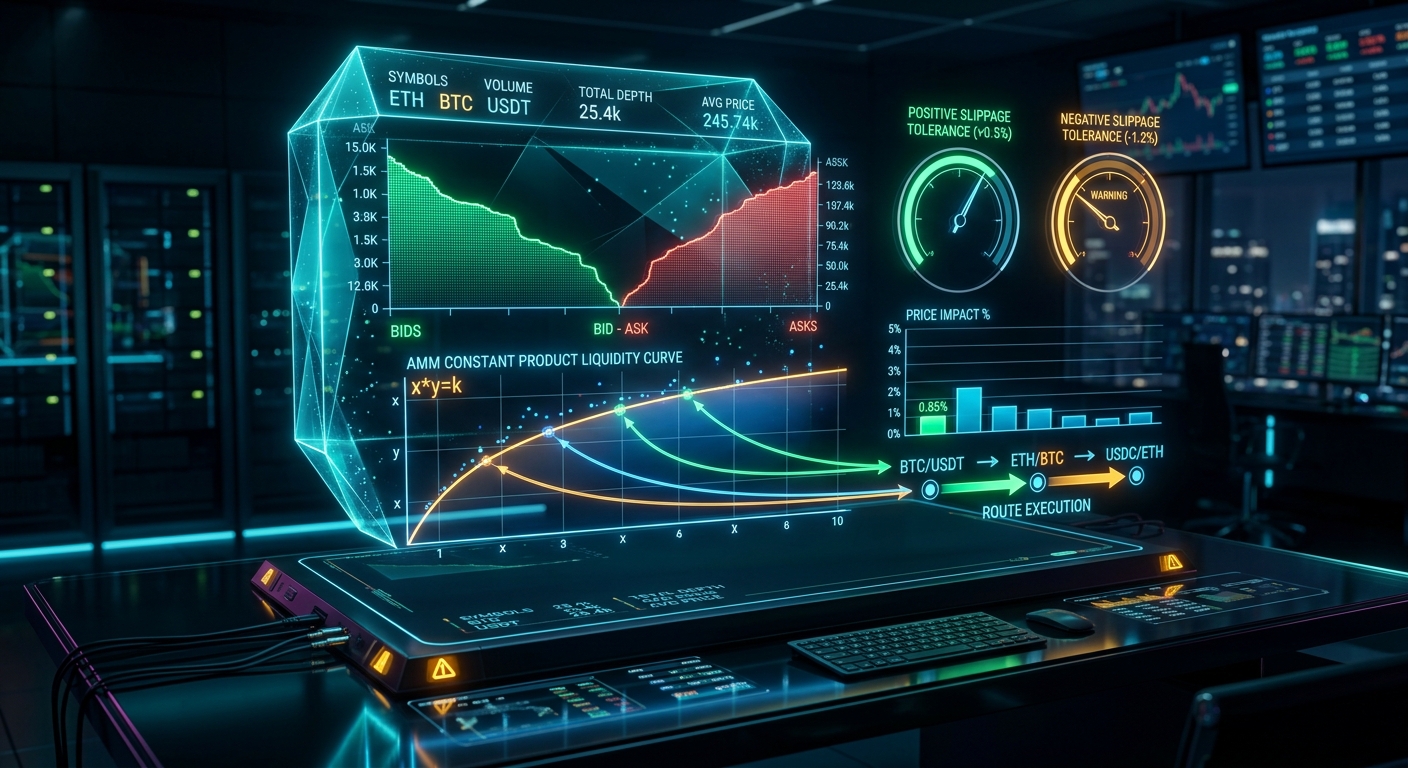
In this comprehensive guide, we provide the ultimate Crypto Slippage Calculator Guide, breaking down the mathematical models behind order book depth sweeping, AMM constant-product liquidity mechanics ($x · y = k$), positive vs. negative slippage, and four unique real-world numerical calculation walkthroughs.
The Anatomy of Slippage: Slippage vs. Price Impact vs. Spread
Before calculating slippage, it is vital to distinguish between three terms that traders frequently confuse:
1. The Bid-Ask Spread
The static difference between the highest price a buyer is willing to bid and the lowest price a seller is willing to ask at any given millisecond. This is the structural cost of immediacy.
2. Price Impact
The deterministic, mathematical price shift caused directly by the sheer volume of your own trade. When you inject a large order into an order book or liquidity pool, your order consumes available supply, shifting the marginal equilibrium price.
3. Execution Slippage
The total divergence between your expected execution price at the moment you clicked the button and the final Volume-Weighted Average Price (VWAP) at settlement. Slippage incorporates price impact, order book depth sweeping, network latency delays, and competing transactions that entered the block or order queue before you.
The Two Financial Engines: Where Slippage Happens
Crypto trades settle across two fundamentally different execution architectures, each generating slippage through unique mathematical mechanics:
Engine A: Centralized Central Limit Order Books (CLOBs)
On exchanges like Binance, Coinbase, and Kraken, orders sit in discrete price queues (Level-2 Order Book). When a market order arrives, the matching engine fills from the top of the book downwards:
Engine B: Decentralized Constant-Product AMMs ($x \cdot y = k$)
On DEXs like Uniswap v2/v3, Curve, and Raydium, trades execute against a smart contract pool containing reserves of Token X ($x$) and Token Y ($y$). The pool enforces the invariant formula:
x · y = kWhen you deposit $Δ x$ to extract $Δ y$, the internal ratio of tokens changes continuously throughout the swap. The larger your swap relative to total pool reserves, the exponentially worse your average execution rate becomes.
The Core Mathematical Formulas
1. Basic Nominal Slippage Percentage
Slippage (%) = ((|Actual Execution Price - Expected Quote Price|) / Expected Quote Price) × 1002. Order Book Volume-Weighted Average Price (VWAP)
VWAP = Σ (Fill Price_i × Volume_i) / Total VolumeOrder Book Slippage ($) = Total Volume × (VWAP - Best Top-of-Book Price)3. AMM Constant-Product Price Impact Formula
For a pool with $x$ base tokens and $y$ quote tokens, swapping $Δ x$ yields:
Δy = (y · Δx) / (x + Δx)Price Impact (%) = (1 - (Δy / (Δx · P_initial))) × 100 = (Δx / (x + Δx)) × 100Now, let us examine how these formulas behave across four unique real-world trading examples.
Unique Calculation Example 1: The $100,000 High-Volume CEX Order Book Sweep (Ethereum)
Imagine a crypto trader executing a $100,000 market buy order for Ethereum (ETH) on an exchange when the top-of-book quoted price is $3,200.00.
Let us examine the live Level-2 Ask Order Book Depth at that instant:
| Order Book Level | Ask Price ($/ETH) | Volume Available (ETH) | Level Dollar Value | Cumulative Dollar Value |
|---|---|---|---|---|
| Level 1 (Best Ask) | $3,200.00 | 6.25 ETH | $20,000.00 | $20,000.00 |
| Level 2 | $3,208.00 | 9.35 ETH | $29,994.80 | $49,994.80 |
| Level 3 | $3,220.00 | 10.00 ETH | $32,200.00 | $82,194.80 |
| Level 4 | $3,235.00 | 12.00 ETH | $38,820.00 | $121,014.80 |
Let us calculate how the $100,000 order sweeps through the four levels:
The Final Execution Ledger:
Negative Slippage Rate = (($3,215.03 - $3,200.00) / $3,200.00) × 100 = +0.4697%Total Dollar Slippage Drag = $467.46The trader lost $467.46 in hidden slippage, which dwarfed their 0.075% VIP exchange fee ($75.00) by more than 6 times.
Unique Calculation Example 2: AMM Constant-Product Slippage ($20,000 Swap into a $200k Pool)
Now let us enter the decentralized world of Uniswap v2 / Raydium constant-product AMM pools.
Suppose a trader wants to swap $20,000 USDC into SOL on a decentralized AMM pool.
Pool Reserves Before Trade:
Let us calculate the exact tokens received after applying the constant product formula:
Let us analyze the Slippage & Price Impact:
Actual Price Impact = ((119,940 / 100,000) - 1) × 100 = +19.94% Post-Trade Marginal Price ShiftEffective Execution Slippage = (($239.88 - $200.00) / $200.00) × 100 = +19.94% Slippage DragBecause the trader dumped $20,000 into a pool with only $100,000 in liquidity (a 20% pool size ratio), they forfeited nearly 20% of their principal purely to AMM curve slippage. This is why DEX liquidity depth matters.
Unique Calculation Example 3: Positive Slippage (The Trader’s Best Friend)
Slippage is not always negative. Positive slippage occurs when your final execution price is more favorable than your initial quoted price.
How Positive Slippage Happens:
The Mathematical Example:
Positive Slippage = ((3.2385 - 3.2250) / 3.2250) × 100 = +0.4186% Positive Alpha Gain (+$41.85 Bonus)Unique Calculation Example 4: The Sandwich Attack (Exploiting Loose Slippage Tolerance)
What happens when a retail trader sets an overly generous slippage tolerance on a DEX?
Suppose a trader swaps $10,000 USDC into a trending token (PEPE) on Uniswap with their slippage tolerance set to 5.0% (a dangerous default on some decentralized frontends).
An MEV (Maximal Extractable Value) searcher bot detects the pending transaction sitting in the public Ethereum mempool and constructs a 3-part Sandwich Attack:
| Phase | Actor | Action | Impact on Price | Capital Shift |
|---|---|---|---|---|
| 1. Front-Run | MEV Bot | Bribes validator with a high priority fee to buy $25,000 PEPE directly ahead of victim | Pushes PEPE price up by +4.85% (just below victim’s 5.0% tolerance limit) | Bot enters at low price |
| 2. Victim Swap | Retail Trader | Victim’s $10,000 swap executes at the artificially inflated top price | Pushes price up another +1.90% | Victim receives minimum guaranteed tokens |
| 3. Back-Run | MEV Bot | Bot immediately sells all PEPE in the exact same block behind victim | Price drops back to equilibrium | Bot extracts +$465.00 pure profit |
The Devastating Outcome:
The Recommended Slippage Tolerance Matrix for 2026
To protect yourself from sandwich attacks and execution drift, use these battle-tested slippage tolerance thresholds:
| Asset Tier | Market / Venue | Typical Liquidity Depth | Recommended Slippage Tolerance | MEV Protection Required? |
|---|---|---|---|---|
| Ultra-Liquid Majors (BTC, ETH, SOL) | Tier-1 CEXs (Binance, Coinbase) | $10M+ within 1% depth | 0.05% - 0.10% | Standard API routing |
| Major DeFi Tokens (UNI, AAVE, LINK) | Uniswap v3 / Deep DEX Pools | $500k - $5M pool depth | 0.20% - 0.50% | Recommended (Flashbots/MEV-Blocker) |
| Mid-Cap Altcoins ($50M - $500M Cap) | Hybrid CEX / DEX | $50k - $250k pool depth | 0.50% - 1.00% | Highly Recommended |
| New DEX Token Launches / Meme Coins | Low Liquidity AMMs (<$50k pool) | Highly volatile & fragmented | 1.50% - 2.50% | MANDATORY Private RPC |
| Dangerous / Exploitable Threshold | Any DEX or CEX | Any depth | > 3.00% | ❌ Extreme Risk of Sandwich Attack |
5 Golden Rules to Eliminate Crypto Slippage
rpc.mevblocker.io). This routes your transaction directly to builders, bypassing the public mempool where searcher bots lurk.Summary Checklist: Mastering Your Execution
Next time you prepare to execute a trade, run through this 5-point checklist:
By taking control of slippage, you protect your trading edge, eliminate hidden losses, and preserve every basis point of your hard-earned capital.