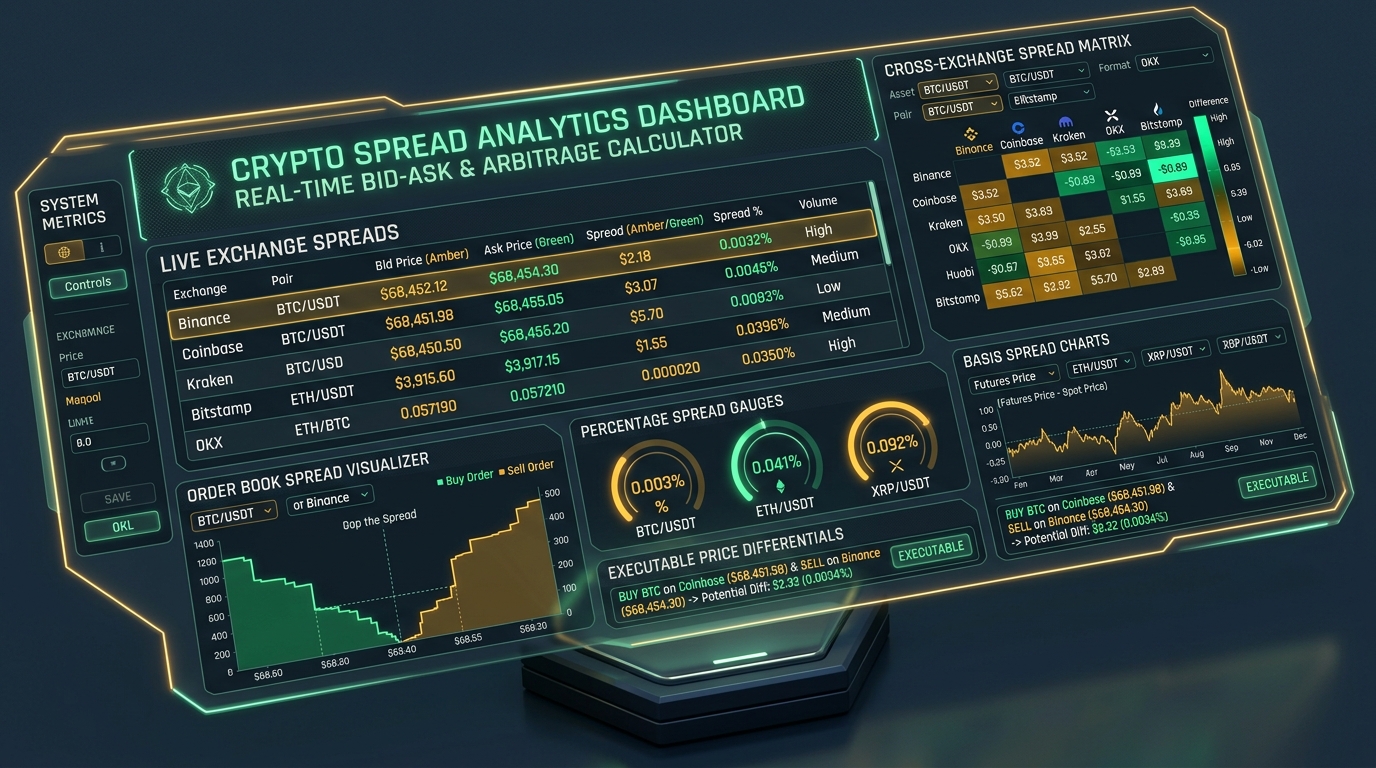
In financial markets, every transaction has a toll collector. In cryptocurrency trading, that toll collector is rarely just the exchange commission fee—it is the bid-ask spread.
Consider an active crypto day trader executing 50 trades per month with an average position size of $25,000. If that trader enters and exits market orders on an asset with an average 0.35% bid-ask spread, they surrender $87.50 per round trip to market makers purely through the spread. Across 50 trades, that is $4,375 per month ($52,500 per year) in invisible friction—frequently exceeding the trader’s entire net trading profit!
Whether you are scalping volatile meme coins, swing-trading Bitcoin breakouts, or running delta-neutral basis trades across perpetual contracts, using a Crypto Spread Calculator is the difference between operating in the dark and executing with mathematical precision.
What exactly is a crypto spread calculator? What are the key mathematical formulas that govern quoted, effective, and cross-venue basis spreads? And how can you leverage real-time spread calculations to drastically cut your execution costs and capture high-probability market opportunities? Let us dive into the microstructure.
Section 1: The Four Types of Spreads Every Trader Must Calculate
Novice traders treat "the spread" as a single number. Professional quantitative analysts categorize spreads into four distinct metrics, each answering a critical execution question:
1. Quoted Bid-Ask Spread (Nominal and Percentage)
The Quoted Spread is the immediate difference between the lowest price a seller is willing to accept (Best Ask) and the highest price a buyer is willing to pay (Best Bid) on a central limit order book (CLOB):
Nominal Spread ($) = Best Ask - Best BidRelative Percentage Spread (%) = ((Best Ask - Best Bid) / Mid_Price) * 100Where Mid_Price = (Best Ask + Best Bid) / 2.
On high-liquidity pairs like Binance BTC/USDT, the relative spread is often a razor-thin 0.005% ($5 on a $96,000 asset). On secondary altcoin pairs or during overnight illiquidity, relative spreads routinely widen to 0.40% to 1.80%.
2. Effective Spread (The Real Cost of Market Orders)
When an aggressive market order punches into an order book, the average execution price is rarely identical to the top-of-book quote. The Effective Spread measures the actual execution price relative to the pre-trade mid-price:
Effective Spread ($) = 2 * |Execution_Price - Pre_Trade_Mid_Price|Effective Spread (%) = (Effective Spread ($) / Pre_Trade_Mid_Price) * 100If Bitcoin’s mid-price is $96,000, and your $50,000 market buy order fills at a Volume-Weighted Average Price (VWAP) of $96,120, your effective spread was 0.25% ($240 round-trip equivalent), even if the top-of-book quoted spread was only 0.01%.
3. Realized Spread (Market Maker Profitability & Toxic Flow)
The Realized Spread measures the profitability of a trade after a short time horizon (e.g., 5 seconds, 1 minute, or 5 minutes), comparing the execution price to the future mid-price:
Realized Spread ($) = 2 * (Execution_Price - Future_Mid_Price) * Direction(where Direction is +1 for buy and -1 for sell). If the realized spread is negative, the market maker lost money to informed, aggressive "toxic order flow." A widening realized spread indicates that liquidity providers are widening cushions to protect against directional momentum.
4. Cross-Venue Basis Spread (Inter-Exchange & Derivative Gaps)
The Cross-Venue Spread measures the price differential of the same asset across two separate exchanges or market structures (Spot vs. Spot, Spot vs. Perpetual, or Spot vs. Quarterly Futures):
Cross-Exchange Spread (%) = ((Price_Venue_B - Price_Venue_A) / Price_Venue_A) * 100When applied to quarterly futures, this spread is annualized into the Basis Yield: Annualized Basis (%) = (Cross-Venue Spread (%) / Days_to_Maturity) * 365.
Section 2: Real-World Scenarios: How Spread Miscalculations Destroy Capital
To appreciate the practical power of a crypto spread calculator, let us examine three definitive real-world trading breakdowns.
Scenario A: The Illiquid Altcoin Breakout Scalper Trap
A momentum trader spots a sudden 2.0% 5-minute green breakout candle on a trending AI altcoin token (TOKEN_X). The token’s last traded price is $4.00. The trader fires a $15,000 market buy order.
What the trader failed to calculate:
A real-time spread calculator would have instantly highlighted the 2.0% quoted spread, warning the trader that the asset’s hurdle rate was far too high for a short-term scalp.
Scenario B: The Delta-Neutral Perpetual Funding Spread Harvest
During a raging crypto bull market, perpetual futures funding rates on Bybit and Binance surge to +0.06% per 8-hour period (+65.7% annualized).
A quantitative trader uses a crypto spread calculator to structure a cash-and-carry basis trade:
By calculating the exact cross-venue spread and daily funding rate multiplier, the trader locks in double-digit annualized yield without exposing a single dollar to directional Bitcoin volatility.
Scenario C: Spot Bitcoin ETF Fixing Window Spread Expansion (3:30–4:00 PM EST)
Every trading day between 3:30 PM and 4:00 PM Eastern Time, authorized participants and market makers execute multi-million dollar basket rebalances for US spot Bitcoin ETFs (IBIT, FBTC).
During this 30-minute window, the Coinbase BTC/USD spread compresses to an ultra-tight 0.002% due to massive institutional depth, while offshore retail platforms (Binance BTC/USDT, OKX) frequently experience spread volatility of ±0.15% due to quote currency peg adjustments.
Smart algorithmic routers use spread calculators to direct spot orders to Coinbase during US market close, saving institutional clients tens of thousands in execution drag.
Section 3: The Complete Mathematical Formula Matrix of a Spread Calculator
A full-featured spread calculator executes the following systematic mathematical operations:
1. Spread-Adjusted Round-Trip Cost (SAR)
SAR ($) = Capital * (Taker_Fee_Entry + Taker_Fee_Exit + Quoted_Spread_Entry + Quoted_Spread_Exit)If you enter and exit via market orders on a pair with a 0.15% spread and 0.10% commission fees, your minimum round-trip hurdle is: 0.10% + 0.10% + 0.15% + 0.15% = 0.50%. Any price move less than 0.50% results in negative net P&L.
2. Maker vs. Taker Spread Savings Differential
When you switch from an aggressive market order (crossing the spread) to a passive limit order (placing bids inside the spread), you capture the spread instead of paying it:
Savings ($) = Capital * (Quoted_Spread_Percentage + (Taker_Fee_Rate - Maker_Fee_Rate))On a $100,000 position with a 0.20% spread, switching to a limit order saves $200 in spread plus $150 in fee differentials = $350 in pure execution alpha per trade.
3. Cross-Exchange Synthetic Currency Spread
When comparing Venue A (BTC/USD) against Venue B (BTC/USDT), the calculator normalizes the quote currency via the secondary stablecoin market:
Normalized_Price_Venue_B = Raw_Price_Venue_B * (USDT_USD_Rate)True_Spread (%) = ((Normalized_Price_Venue_B - Price_Venue_A) / Price_Venue_A) * 100This prevents traders from confusing stablecoin de-peg discounts with genuine crypto price discrepancies.
Section 4: Advanced Strategy: Using Spread Calculations for High-Probability Limit Placement
Spread calculations are not just defensive tools for calculating costs—they are offensive weapons for precision order entry:
1. "Spread-Skimming" Inside the Order Book
When an asset’s quoted spread is wide (e.g., Bid: $10.00, Ask: $10.20; spread = $0.20), placing a limit buy order at $10.01 puts you at the front of the queue without paying the full $10.20 ask price.
If impatient market sell orders hit your $10.01 bid, and you place a limit sell at $10.19, you capture an +$0.18 (+1.79%) spread profit with zero market movement.
2. Adverse Selection Buffer Threshold
Why don’t market makers always quote tight spreads? Because informed traders (whales with news or massive flow) cause adverse selection.
A spread calculator helps passive traders determine the minimum spread width required to avoid getting "run over" by directional order flow during high-volatility news events.
Section 5: Step-by-Step Trader’s Playbook: How to Calculate Spreads in Real Time
Follow this four-step checklist before placing any spot or derivatives trade:
Conclusion: Precision Spread Calculation is the Core of Trading Edge
In digital asset trading, amateur traders focus entirely on predicting direction, while professional quantitative operators obsess over minimizing execution friction and capturing structural spreads.
By integrating a Crypto Spread Calculator into your daily trading routine, you demystify the true cost of market orders, identify lucrative cross-venue basis yields, and turn hidden exchange tolls into sustainable trading profits.