In financial trading, there is an unspoken law that separates institutional desks from unprofitable retail accounts: Amateurs obsess over picking tops and bottoms, while professionals obsess over transaction friction and fee drag.
Imagine buying $10,000 worth of Bitcoin, watching the chart surge by 2.0%, and selling your position for a $200 gross gain—only to check your account balance and realize you made less than $80, or worse, broke even after round-trip platform charges.
Every time you enter a position, exit a trade, transfer funds across blockchains, or take liquidity from an order book, the exchange collects a toll. Over hundreds of trades each year, these fractional percentages compound into thousands of dollars in lost yield.
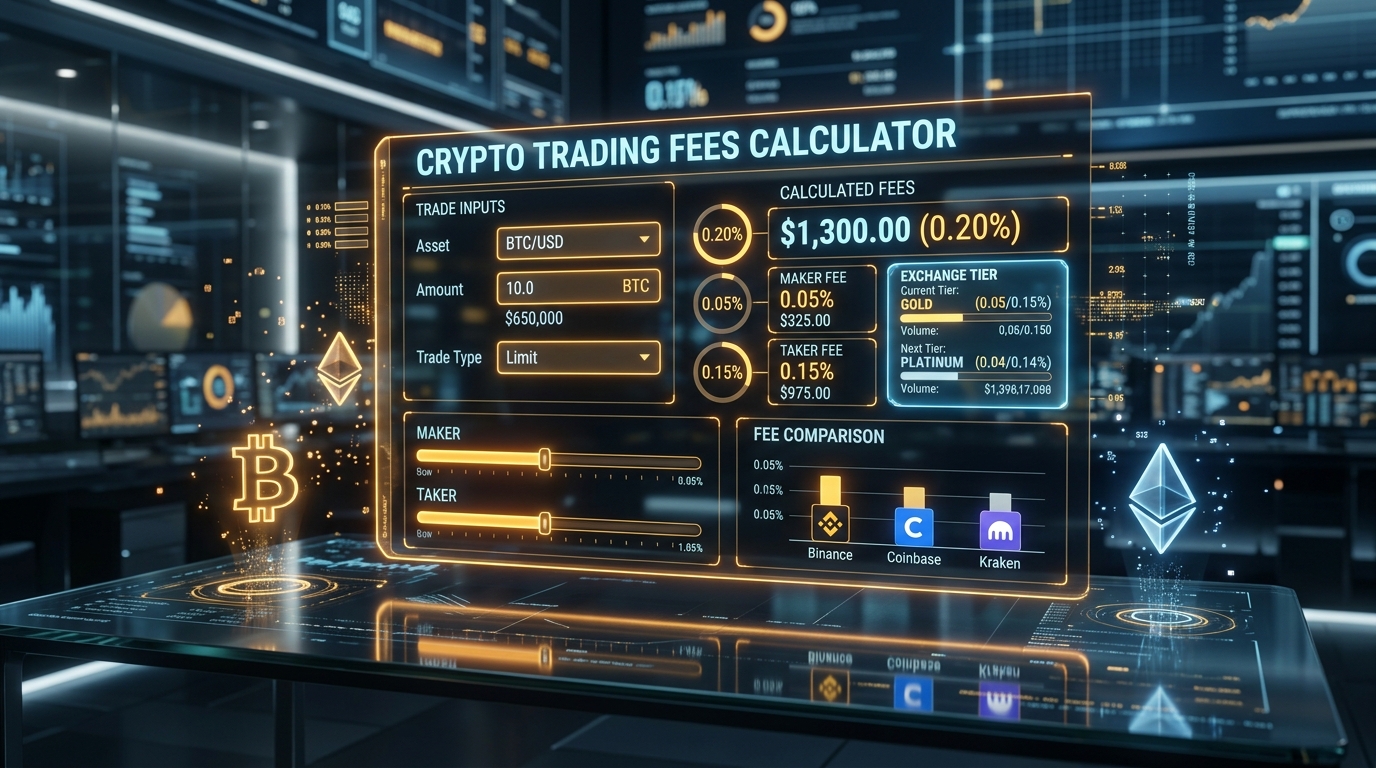
Understanding how a Crypto Trading Fees Calculator works—and mastering the mathematics behind maker fees, taker fees, slippage, and breakeven thresholds—is essential for every serious trader.
The 4 Core Components of Crypto Trading Costs
Before running any calculation, you must identify where your capital is actually being deducted. Crypto trading costs fall into four primary categories:
1. Maker Fees (Adding Liquidity)
A Maker is a trader who places a Limit Order that does not immediately match against an existing order in the Central Limit Order Book (CLOB).
By resting your order on the bid or ask ladder, you provide liquidity to the platform. Exchanges reward makers with the lowest fee tier, ranging from 0.00% to 0.10%, with some institutional tiers even providing maker rebates (paying you to trade).
2. Taker Fees (Removing Liquidity)
A Taker is a trader who submits a Market Order (or an aggressive limit order) that matches instantly against an existing order resting in the book.
Because takers deplete order book depth, exchanges charge higher taker fees, typically between 0.04% and 0.60% depending on the exchange and VIP level.
3. Bid-Ask Spread & Order Book Slippage
If you market buy at the Best Ask and immediately market sell into the Best Bid, you incur the Bid-Ask Spread. In illiquid pairs, wide spreads and cascading order book depth create slippage that dwarfs published exchange fees.
4. Deposit, Withdrawal, & Network Gas Fees
Moving crypto off an exchange or between venues incurs fixed or dynamic blockchain transaction fees (e.g. $0.05 on Arbitrum or Solana vs. $5.00 to $25.00 during Ethereum mainnet congestion).
The Mathematical Formulas Behind a Crypto Fee Calculator
A robust crypto fee calculator executes the following mathematical models:
Single Trade Fee ($) = Trade Volume ($) × Fee Rate (%)Gross Profit ($) = (Exit Price - Entry Price) × Asset QuantityTotal Round-Trip Fees ($) = (Entry Volume × Entry Fee Rate) + (Exit Volume × Exit Fee Rate)Net Realized Profit ($) = Gross Profit - Total Round-Trip Fees - Network / Withdrawal FeesThe Breakeven Formula: Exactly How Much Must the Price Move?
Many traders mistakenly believe that if their entry fee is 0.10% and exit fee is 0.10%, the asset only needs to rise by 0.20% to break even. Because fees apply to the total exited volume (which is larger if the price rises), the exact mathematical breakeven formula is:
Breakeven Exit Price = Entry Price / ((1 - Entry Fee Rate) × (1 - Exit Fee Rate))Let us see this formula in action across different exchange tiers.
Practical Example 1: The Swing Trader (Coinbase Standard vs. Binance VIP)
Let us examine Trader Sarah, who swings $10,000 USDT into Bitcoin at an entry price of $90,000 and exits at $92,000 (a +2.222% gross move).
| Metric | Scenario A: High Fee Venue (0.60% Taker) | Scenario B: Standard Exchange (0.10% Taker) | Scenario C: Post-Only Maker (0.02% Maker + BNB Discount) |
|---|---|---|---|
| Entry Position Size | $10,000.00 | $10,000.00 | $10,000.00 |
| Bitcoin Purchased | 0.11111 BTC | 0.11111 BTC | 0.11111 BTC |
| Entry Fee Paid | $60.00 (0.60%) | $10.00 (0.10%) | $1.50 (0.015%) |
| Exit Volume at $92,000 | $10,222.22 | $10,222.22 | $10,222.22 |
| Exit Fee Paid | $61.33 (0.60%) | $10.22 (0.10%) | $1.53 (0.015%) |
| Gross Trading Profit | $222.22 | $222.22 | $222.22 |
| Total Round-Trip Fees | $121.33 | $20.22 | $3.03 |
| Net Realized Profit | $100.89 (+1.01%) | $202.00 (+2.02%) | $219.19 (+2.19%) |
| Fee Drag (% of Profit) | 54.6% of Profit Eaten! | 9.1% of Profit Eaten | 1.36% of Profit Eaten |
In Scenario A, the trader gave up over half of their hard-earned profit purely to standard platform taker fees. In Scenario C, utilizing maker orders and token discounts preserved 98.6% of gross earnings.
Practical Example 2: The Scalper’s Nightmare (High-Frequency Friction)
Consider Scalper Leo, who executes 20 trades per day with a $5,000 position size, targeting rapid 0.40% scalps on Ethereum.
Over a 30-day trading month (600 total round-trip trades):
Monthly Fee Savings by Switching to Maker Execution = $3,607.20 - $901.80 = $2,705.40 in pure retained cashFor active day traders, switching order execution strategies from market orders to maker limits is often the single most profitable adjustment they will ever make.
Practical Example 3: Spatial Arbitrage Net Profitability Ledger
In cross-exchange arbitrage, capturing a price spread requires executing two distinct trades and frequently transferring capital.
Suppose an arbitrage scanner identifies a $30.00 price gap on Solana (SOL):
Here is the complete accounting ledger generated by our trading fee calculator:
Gross Arbitrage Profit = $18,300.00 - $18,000.00 = $300.00 (+1.67%)Total Execution Friction = $28.80 + $1.80 + $13.73 = $44.33Net Arbitrage Profit = $300.00 - $44.33 = $255.67 (+1.42% Net Yield)Without a dedicated fee calculator, traders might attempt trades where the gross spread is 0.30%, only to discover that the combined taker fees of 0.35% result in a guaranteed net loss.
Major Crypto Exchanges Fee Comparison Benchmark (2026)
The baseline spot fee structures for the world’s top cryptocurrency exchanges compare as follows:
| Exchange | Baseline Maker Fee | Baseline Taker Fee | Native Token Discount | 30-Day Volume Tier Threshold |
|---|---|---|---|---|
| Binance | 0.100% | 0.100% | 25% discount with BNB (0.075%) | Drops to 0.012% / 0.024% at higher tiers |
| Coinbase Advanced | 0.400% | 0.600% | None | Drops to 0.000% / 0.050% above $50M volume |
| Kraken Pro | 0.160% | 0.260% | None | Drops to 0.000% / 0.040% above $10M volume |
| OKX | 0.080% | 0.100% | Up to 20% discount with OKB | Drops to -0.005% (rebate) / 0.020% |
| Bybit | 0.100% | 0.100% | VIP & MNT discounts available | Drops to 0.000% / 0.020% at VIP 5 |
| KuCoin | 0.100% | 0.100% | 20% discount with KCS (0.080%) | Drops to -0.005% / 0.025% at Level 12 |