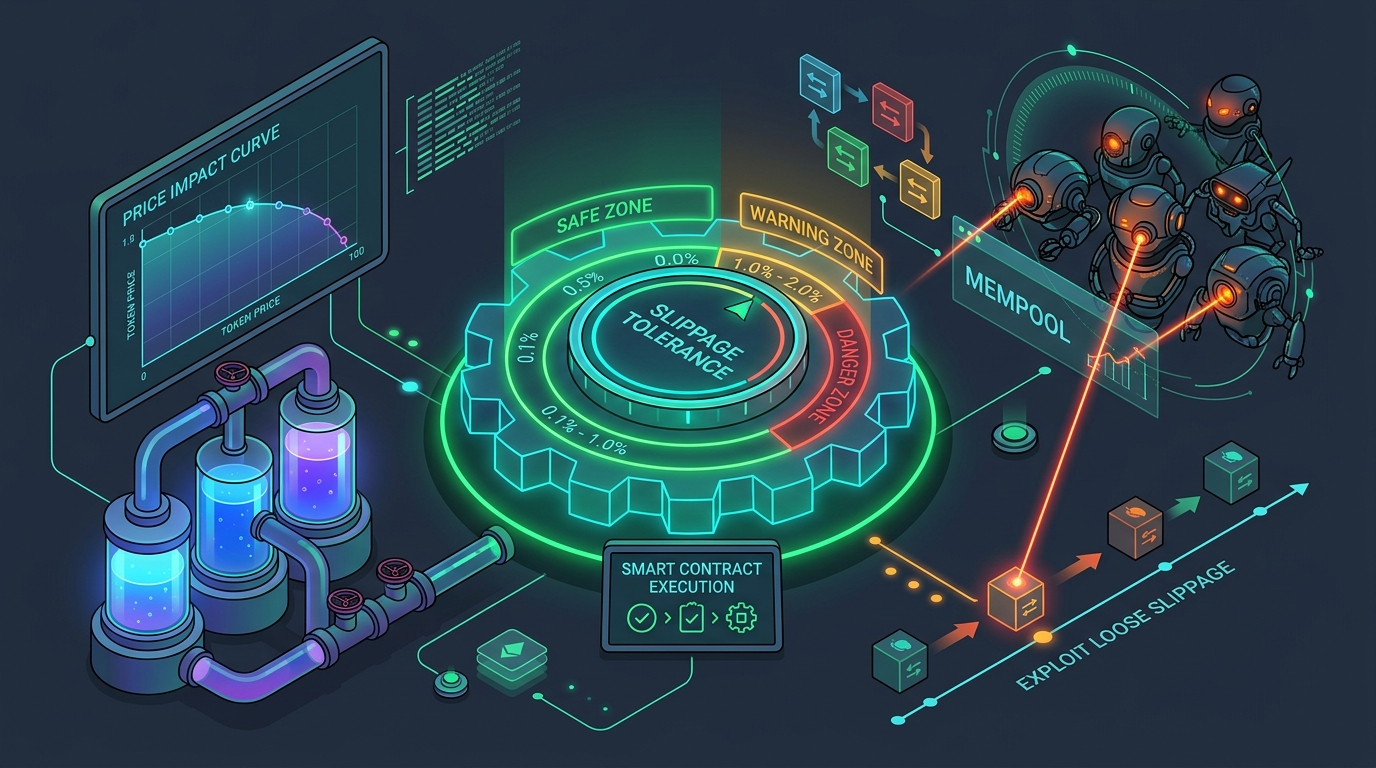
It is a tiny, innocuous button that hides inside the settings menu of every decentralized exchange on Earth:
A small gray gear icon labeled "Slippage Tolerance", followed by options like 0.1%, 0.5%, 1.0%, or Custom.
To most retail traders, it looks like a cosmetic preference—perhaps an estimate of how much the app thinks prices might wiggle while you wait for a confirmation.
In reality, slippage tolerance is the most financially dangerous setting in all of DeFi.
If you set it just 2% too wide, an automated MEV bot lurking in the Ethereum mempool will legally drain hundreds or thousands of dollars from your transaction in less than twelve seconds.
If you set it 0.2% too tight, your transaction will fail, and the network will burn $50 in gas fees without giving you a single token.
In this forensic guide, we examine what happens when you adjust slippage tolerance at the smart contract level, reveal how predatory sandwich bots hunt loose slippage parameters, and provide an institutional blueprint for setting optimal slippage on every trade.
1. What Slippage Tolerance Actually Does at the Smart Contract Level
When you click "Swap" on Uniswap or PancakeSwap, the frontend interface does not just submit your trade—it calculates a cryptographic lower bound called amountOutMinimum:
[ THE EXACTINPUTSINGLE SOLIDITY CALL ]

  ISwapRouter.ExactInputSingleParams({
      tokenIn:            0xA0b86991c6218b36c1d19D4a2e9Eb0cE3606eB48, // USDC
      tokenOut:           0xC02aaA39b223FE8D0A0e5C4F27eAD9083C756Cc2, // WETH
      fee:                3000,                                       // 0.3% pool
      recipient:          0x71C...YourWalletAddress,
      deadline:           block.timestamp + 1200,
      amountIn:           10,000 * 1e6,                               // 10,000 USDC
      amountOutMinimum:   2.8215 * 1e18                               // <── SLIPPAGE TOLERANCE LIMIT!
  });
Here is what that amountOutMinimum line means to the Ethereum Virtual Machine (EVM):
> "I am sending 10,000 USDC to this pool. If this swap yields anything less than 2.8215 ETH at the exact moment this block is mined, REVERT THE ENTIRE TRANSACTION and undo the trade."
Slippage tolerance is not a target. It is a hard, immutable floor. You are telling the blockchain: I am willing to accept any terrible price down to this exact number.
2. Price Impact vs. Slippage: The Crucial Difference
Many traders confuse Price Impact with Execution Slippage, but they are fundamentally different forces:
[ PRICE IMPACT vs. EXECUTION SLIPPAGE ]

  PRICE IMPACT (Deterministic & Instant):
  • Caused by: YOUR own trade size relative to the pool's constant product invariant (x · y = k).
  • Known in advance: Yes, displayed on screen BEFORE you sign.
  • Example: Swapping $100k in a $200k liquidity pool shifts the curve by 15% immediately.

  EXECUTION SLIPPAGE (Probabilistic & In-Mempool):
  • Caused by: OTHER traders and market moves between transaction broadcast and block confirmation.
  • Known in advance: No, depends on mempool competition and block timing.
  • Example: Bitcoin drops 0.4% during the 12 seconds your swap is waiting in the queue.
Slippage tolerance is designed to protect you only from execution slippage (mempool price drift). It does not protect you from price impact, because price impact is already factored into the quoted baseline.
3. The Anatomy of an MEV Sandwich Attack
When you broadcast a swap with a loose slippage tolerance (such as 3.0% or 5.0%) to the public mempool, you create a guaranteed risk-free profit opportunity for Maximal Extractable Value (MEV) searcher bots.
Here is the exact step-by-step anatomy of how a sandwich bot attacks your loose slippage setting:
[ THE THREE-STEP SANDWICH ATTACK ]

  YOU BROADCAST: Swap $10,000 USDC for ETH (Expected: 2.85 ETH | Slippage: 5.0% | Minimum: 2.7075 ETH)
  ─────────────────────────────────────────────────────────────────────────────────────────────
  STEP 1: THE FRONT-RUN (Bot Transaction A)
          MEV bot detects your transaction in public mempool.
          Bot pays a higher priority gas fee to execute BEFORE you in the block.
          Bot buys ETH from the pool, pushing the ETH price up to your exact $10,000 minimum limit.

  STEP 2: YOUR VICTIM SWAP (Your Transaction B)
          Your transaction executes at the artificially inflated top price.
          You receive exactly 2.7075 ETH (your absolute worst-case slippage floor).

  STEP 3: THE BACK-RUN (Bot Transaction C)
          In the very next microsecond of the same block, the bot sells the ETH back to the pool.
          Bot captures the price difference: +$142.50 in pure risk-free profit extracted from YOU!
By setting 5% slippage, you didn’t give yourself "room to breathe"—you handed $142.50 of free money to an MEV bot.
4. The 4-Tier Safe Slippage Matrix
To prevent both sandwich attacks and failed transaction fees, use this battle-tested parameter matrix:
| Token Archetype | Example Pairs | Recommended Slippage | Route Protection |
|---|---|---|---|
| Blue-Chip Majors | ETH/USDC, WBTC/USDT | 0.10% – 0.30% | Standard Public RPC |
| Liquid Mid-Caps ($10M+ TVL) | UNI, LINK, ARB, SOL | 0.50% – 0.80% | Standard Public RPC |
| Volatile / Long-Tail Assets | Micro-caps, Memecoins | 1.50% – 3.00% | Private RPC (Flashbots Protect) |
| Tokens with Transfer Taxes | Reflection tokens (e.g. 5% tax) | Tax % + 0.50% | Private RPC (MEVBlocker) |
5. High-Stakes Real-World Disaster: The $2.04M Fat-Finger Depeg Swap
During the March 2023 Silicon Valley Bank collapse and subsequent USDC depeg, a cryptocurrency user attempted to swap $2,044,000 in USDC for USDT on a decentralized exchange.
Panicking, the user left their slippage tolerance at a wide default setting and routed through a low-liquidity pool without MEV protection.
An automated MEV searcher bot saw the pending transaction, bribed the block builder with $45 in gas, front-ran the trade, and sandwiched the user out of $2,043,995.
The user received exactly $0.05 USDT for their $2.04 million in USDC.
This single transaction remains the most catastrophic slippage error in cryptocurrency history.
6. The Ultimate Defense: How to Trade with Zero Sandwich Risk
If you frequently trade on decentralized exchanges, implement these three mandatory security habits: