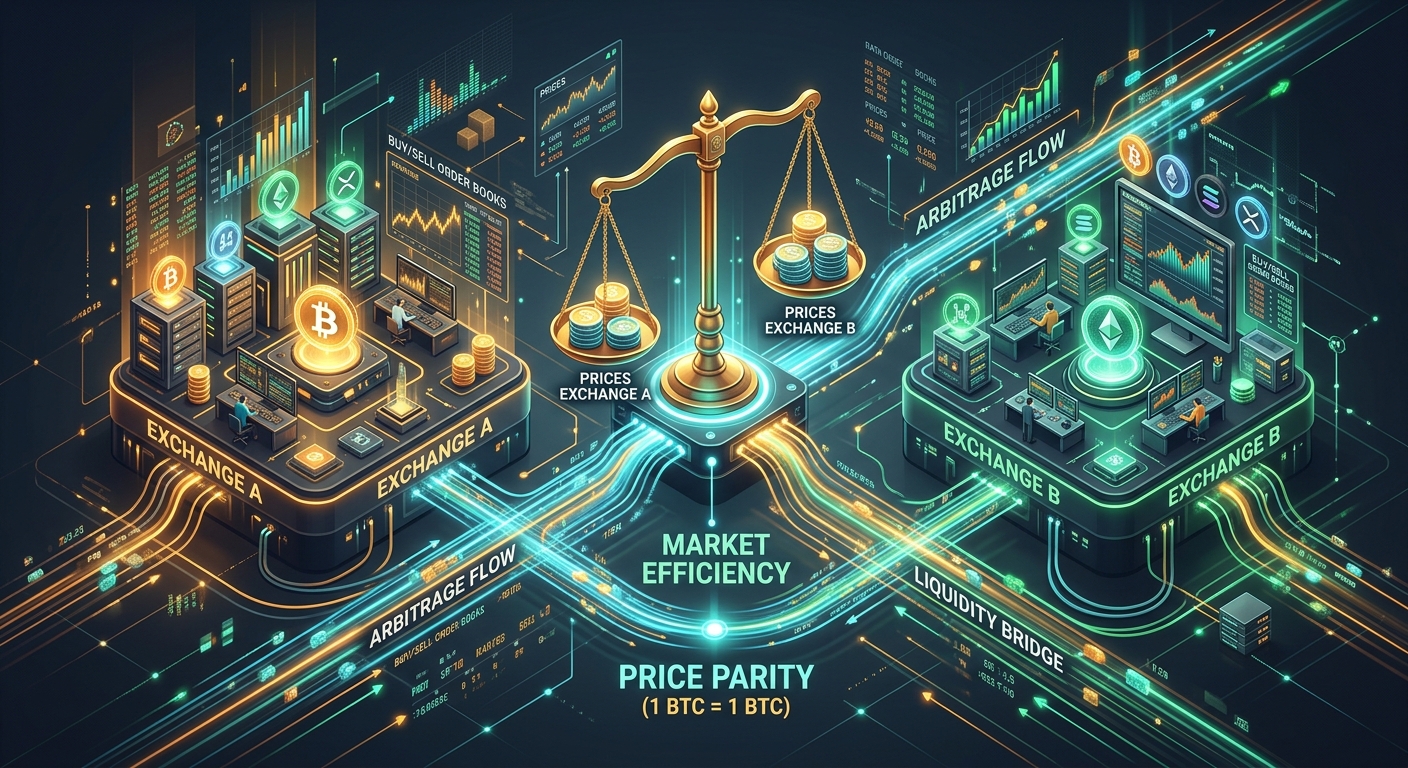
In the public imagination and populist crypto Twitter discourse, arbitrageurs occupy a deeply ambivalent moral space.
To their critics, arbitrage traders and MEV bots are financial parasites: algorithmic rent-seekers who sit between exchanges, extract riskless profits from honest retail orders, drive up on-chain gas fees with relentless priority auctions, and produce nothing of tangible value.
To economic theorists and institutional market architects, however, arbitrageurs are the unsung janitors of the global financial system—the tireless economic nervous system whose relentless pursuit of micro-profits glues hundreds of fragmented order books into a coherent, liquid worldwide marketplace.
So which is it? Does crypto arbitrage actually make markets more efficient, or does it merely introduce toxic latency games that penalize everyday participants?
In this essay, we step back from trading tactics to examine the macro-structure, game theory, and economic philosophy of cryptocurrency arbitrage. We will explore the Law of One Price in a decentralized cosmos, test the Grossman-Stiglitz Paradox against live exchange data, weigh positive vs. negative externalities, and deliver a definitive verdict on whether arbitrage makes our financial ecosystem stronger.
1. The Fragmented Cosmos: Why Crypto Needs Arbitrage More Than Any Asset Class
To understand why arbitrage is crucial in cryptocurrency, one must first appreciate how radically crypto market architecture differs from traditional finance (TradFi):
[ TRADITIONAL FINANCE (US EQUITIES) vs. CRYPTOCURRENCY MICROSTRUCTURE ]

TRADFI (US Equities - NYSE, NASDAQ, BATS):
  [All 16 Exchanges] ---> [SEC Reg NMS / Consolidated Tape (SIP)] ---> Universal National Best Bid & Offer (NBBO)
  * Single centralized regulatory umbrella
  * Broker legally required to route your order to the best national price
  * Universal clearinghouse (DTCC / NSCC)

CRYPTO (Decentralized & Fragmented Cosmos):
  [Binance]   [Coinbase]   [Kraken]   [Bybit]   [OKX]   [Uniswap v3]   [Raydium]   [Curve]
     |            |            |         |        |          |             |          |
     +------------+------------+---------+--------+----------+-------------+----------+
                                      |
                     NO CENTRAL CONSOLIDATED TAPE
                     NO REGULATORY ROUTING MANDATE
                     NO UNIVERSAL CLEARINGHOUSE
                                      |
                 [ ARBITRAGEURS: THE ONLY GLUE HOLDING PRICES TOGETHER ]
In US equities, the SEC's Regulation National Market System (Reg NMS) legally mandates that all stock exchanges route customer orders to the National Best Bid and Offer (NBBO). If Apple is quoting $220.10 on Nasdaq and $220.15 on the New York Stock Exchange, regulatory plumbing prevents a retail order from getting filled at an inferior price.
Crypto has no Reg NMS. There is no global consolidated tape. There is no universal clearinghouse.
If an institution dumps $100,000,000 of Bitcoin onto Coinbase, Coinbase's price could theoretically plummet to $55,000 while Binance trades at $65,000. Without an economic incentive to bridge the two, these exchange silos would remain permanently disconnected.
Arbitrageurs are the sole operational bridge that buys the cheap BTC on Coinbase and sells the expensive BTC on Binance, injecting liquidity where it was depleted and restoring global equilibrium within milliseconds.
2. The Grossman-Stiglitz Paradox: Why Perfect Efficiency Is a Myth
In 1980, Nobel laureate economists Sanford Grossman and Joseph Stiglitz published a foundational paper proving that perfectly efficient markets are mathematically impossible.
The Grossman-Stiglitz Paradox can be summarized in three steps:
[ THE DYNAMIC EQUILIBRIUM OF ARBITRAGE EFFICIENCY ]

   (1) Market Volatility Shock occurs (e.g. CPI Release)
             |
             v
   (2) Price Divergence Emerges (+0.80% spread across venues)
             |
             v
   (3) Arbitrageurs detect profit opportunity and execute capital
             |
             v
   (4) Spreads Compress down to the Friction Floor (+0.05% to +0.12%)
             |
             v
   (5) Market reaches "Constrained Micro-Efficiency" until the next shock
This insight completely reframes arbitrage. Spreads and price gaps are not "market failures"—they are the economic fuel that pays for the continuous real-time synchronization of the financial network.
3. The Positive Externalities: How Arbitrage Benefits Everyday Users
What tangible benefits do non-arbitrage participants (retail investors, long-term hodlers, merchants) receive from arbitrage activity?
| Economic Mechanism | How Arbitrage Operates | Real-World Benefit to Retail & Market Users |
|---|---|---|
| 1. Law of One Price Enforcement | Eliminates geographic and venue-based price discrimination. | A retail user buying ETH on a regional exchange in Germany pays the exact same fair global price as a hedge fund buying on Binance Tokyo. |
| 2. Stablecoin Peg Preservation | Arbitrageurs buy depegged USDC/USDT at $0.992 and redeem at $1.00 for a profit. | Anchors the entire $200B+ decentralized economy to the US dollar without requiring centralized interventions. |
| 3. Cross-Venue Liquidity Transfer | Transports liquidity from surplus order books to deficit order books. | Prevents localized flash crashes. A massive market sell on one exchange is absorbed by global liquidity rather than decimating a single book. |
| 4. Narrower Retail Bid-Ask Spreads | Market makers can quote tighter spreads because they can hedge their inventory risk instantly via arbitrage. | Retail traders lose less money to transaction friction on everyday spot trades. |
4. The Dark Side: The Negative Externalities of the Latency Arms Race
Intellectual honesty requires acknowledging that arbitrage is not without economic costs. When arbitrage competition shifts from information discovery to a pure zero-sum speed race, several harmful side-effects emerge:
5. The Feudal Counterfactual: What If Arbitrage Ceased to Exist?
To evaluate whether arbitrage is net-positive, consider the thought experiment: What happens to crypto if all arbitrage bots and cross-exchange traders vanish tomorrow?
[ THE FEUDAL CRYPTO MARKETPLACE (A WORLD WITHOUT ARBITRAGE) ]

1. VENUE ISOLATION:
   - Binance BTC:  $68,000 (Dominated by Asian retail buying momentum)
   - Coinbase BTC: $61,200 (Dominated by US institutional tax-loss selling)
   - Kraken BTC:   $64,500 (Balanced European flow)
   - Uniswap BTC:  $57,000 (A single whale swapped 2,000 WBTC, crashing the pool by 20%)

2. CATASTROPHIC CONSEQUENCES:
   * No merchant could accept Bitcoin because "Which Bitcoin price?" has no answer.
   * Stablecoins would lose their pegs within hours as DEX pool imbalances remain uncorrected.
   * Lending protocols (Aave, Compound) would experience cascading bad debt due to liquidated
     collateral clearing on fractured, stale oracle prices.
   * Global crypto trading volume would collapse as capital fragments into tiny, illiquid puddles.
Without arbitrage, the entire cryptocurrency ecosystem would degenerate into an archipelago of isolated feudal fiefdoms. Arbitrage is the economic connective tissue that transforms hundreds of isolated databases into a singular global asset class.
6. The Verdict: The Essential Janitors of Decentralized Finance
Arbitrage is neither pure altruism nor predatory parasitism. It is the purest manifestation of Adam Smith's "Invisible Hand" in modern algorithmic markets: self-interested actors seeking profit who inadvertently perform an indispensable public service.
By identifying and eliminating price discrepancies across the globe, arbitrageurs ensure that capital flows where it is needed most, that asset prices reflect all available global information, and that everyday users can trade at fair valuations regardless of which exchange they choose.
7. Inspect Real-Time Market Convergence Yourself
You don't have to take economic theory on faith—you can watch the mechanics of global price convergence unfold live in front of your eyes: