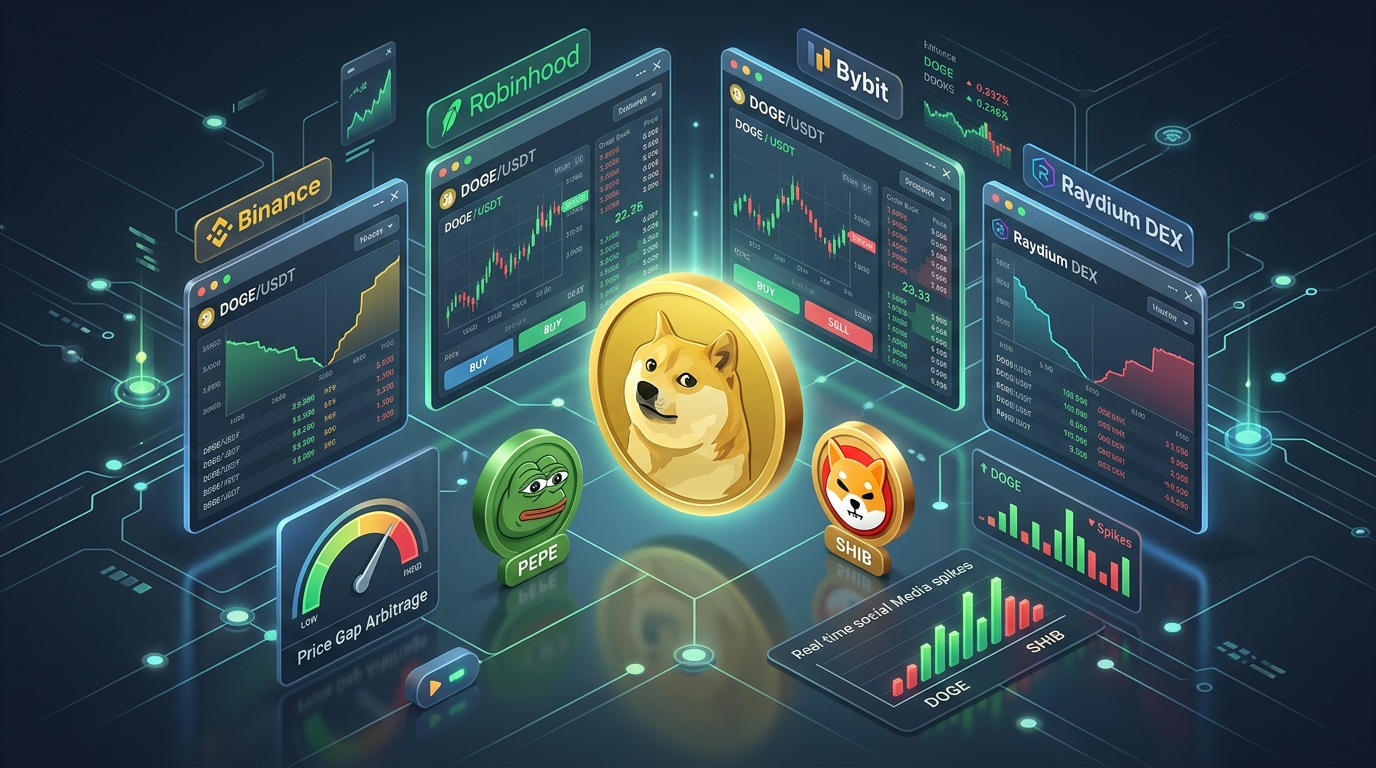
In the entire cryptocurrency ecosystem, no asset class defies conventional financial physics quite like Dogecoin (DOGE) and the broader meme coin sector (Shiba Inu, Pepe, Dogwifhat, Bonk, and Floki).
While institutional assets like Bitcoin and Ethereum maintain tight basis parity across tier-1 exchanges, meme coins frequently experience wild, volatile price discrepancies ranging from 2% to over 20% between exchanges.
During a breaking viral event or social media frenzy, a live multi-exchange scanner might show:
Why do meme coin prices fragment so aggressively across exchanges? Why can’t market makers keep them aligned? Where do retail investors lose the most money, and how do quantitative arbitrageurs extract millions from these viral surges?
In this market microstructure investigation, we deconstruct the mechanics of Dogecoin and meme coin price gaps, analyze the "Robinhood retail island effect," evaluate DEX-to-CEX listing dynamics, and dissect four real-world trading case studies.
Meme Coin Multi-Venue Microstructure Benchmark
| Exchange / Trading Venue | Key Meme Coins Traded | Order Book Depth (DOGE/PEPE) | Base Retail Pro Fees | Execution Mechanism | Microstructure Role in Meme Cycles |
|---|---|---|---|---|---|
| Binance / Bybit | DOGE, SHIB, PEPE, WIF, BONK, FLOKI | $10M – $25M (Deepest Globally) | 0.0750% (with BNB) | Central Limit Order Book & High-Leverage Perps | Global price discovery engine; where momentum breakouts originate |
| Coinbase Advanced | DOGE, SHIB, PEPE, BONK (Curated) | $4M – $10M | 0.400% Maker / 0.600% Taker | US Regulated Spot CLOB | Primary US institutional and compliant fiat on-ramp |
| Robinhood / Revolut | DOGE, SHIB, PEPE | Synthetic Broker Quotes | 0.00% Commission + (1.5%–2.5% Spread) | Payment for Order Flow (PFOF) / Market Maker Routing | Epicenter of viral retail FOMO; retail users buy at marked-up prices |
| Kraken Pro | DOGE, SHIB, PEPE, WIF | $3M – $7M | 0.160% Maker / 0.260% Taker | European & US Spot CLOB | Deepest native Euro (EUR) and GBP meme coin books |
| Uniswap / Raydium (DEXs) | 100,000+ Meme Coins (Pump.fun / Raydium) | Dynamic AMM Bonding Curves | 0.05% – 1.00% Pool Fee + Network Gas | Automated Market Maker (AMM) Smart Contracts | Birthplace of all meme coins; maximum volatility and DEX sniping venue |
1. The 4 Fundamental Drivers of Meme Coin Price Gaps
A. Viral Social Catalysts and Retail Herd Psychology
Unlike Bitcoin—which trades on macroeconomic data, ETF net flows, and interest rate expectations—meme coins are powered almost exclusively by viral attention velocity.
When an influential figure (like Elon Musk) posts a meme on X (formerly Twitter), or a token goes viral on TikTok:
B. The "Robinhood Retail Island" & PFOF Execution Markup
Millions of mainstream retail investors trade Dogecoin exclusively through zero-commission brokerage apps like Robinhood or Revolut.
However, these platforms do not connect users directly to an open public Level-2 order book. Instead, they route orders to internal market makers (such as Citadel Securities or Wintermute) under Payment for Order Flow (PFOF) or market maker quote agreements.
C. The Tier-1 CEX Listing Announcement Explosion (DEX-to-CEX Gap)
Every major meme coin (from SHIB to PEPE to WIF) started as an on-chain smart contract on Uniswap (Ethereum/Base) or Raydium (Solana) before listing on centralized exchanges.
When Binance or Coinbase officially tweets a new meme coin listing announcement:
D. Sub-Penny Pricing & Fractional Tick Precision
Many meme coins trade at fractions of a cent (e.g. PEPE at $0.00000850 or SHIB at $0.00001850).
Real-World Case Study 1: The Elon Musk Tweet Flash Pump on Dogecoin ($10,000 Test)
At 11:15 AM EST on a Tuesday, Elon Musk posted a humorous Dogecoin meme on X:
Quantitative Arbitrage Execution:
A quantitative trading fund running automated news-feed scrapers and pre-funded accounts:
By second 18, cross-exchange market makers had normalized both books back to $0.1620, closing the window.
Real-World Case Study 2: The Tier-1 Listing DEX-to-CEX Sniping (PEPE on Binance)
When Binance announced the official spot listing of PEPE:
On-Chain Bot Arbitrage Execution:
Real-World Case Study 3: The Retail Brokerage Hidden Spread Trap ($2,500 DOGE Buy)
A retail investor decided to invest $2,500 in Dogecoin across three different platforms during an active trading session:
| Platform / Interface | Quoted Spot DOGE Price | Actual Fill Execution Price | Trading Fee / Spread Markup | Net DOGE Delivered | Real Value Received |
|---|---|---|---|---|---|
| Binance Pro (Limit Maker) | $0.1600 | $0.1600 | 0.075% ($1.88) | 15,613.25 DOGE | $2,498.12 (Best Value) |
| Coinbase Advanced (Limit) | $0.1600 | $0.1600 | 0.400% ($10.00) | 15,562.50 DOGE | $2,490.00 |
| Robinhood / Consumer App | $0.1600 | $0.1632 (+2.00% markup) | $0.00 explicit fee | 15,318.62 DOGE | $2,450.98 (-$49.02 Loss) |
The Financial Takeaway: The "commission-free" app cost the user 294.63 fewer Dogecoins ($49.02 lost) compared to using a professional order book interface due to hidden spread markups.
Real-World Case Study 4: The 20% "Honeypot" Arbitrage Trap (A Cautionary Lesson)
A retail trader spotted a massive 22% price discrepancy on a trending micro-cap meme coin:
What Went Wrong:
The trader bought $5,000 of the token on MEXC and attempted to withdraw it to Uniswap to sell at the higher price:
The Rule: If a meme coin spread looks too good to be true (>15%), it is almost always blocked by withdrawal pauses, transfer taxes, or honeypot contract code.
Summary Breakdown: Where Should You Trade Meme Coins?
| Trading Objective | Recommended Platform | Why It Gives You the Best Price |
|---|---|---|
| Mega-Cap Meme Trading (DOGE, SHIB, PEPE) | Binance / Bybit | Multi-million dollar order book depth ($15M+), 0.075% fees, minimal slippage on market orders |
| US Regulated Fiat Purchases | Coinbase Advanced / Kraken Pro | Direct USD/EUR bank clearing, zero hidden retail app spreads, full regulatory security |
| Newly Minted / Low-Cap Meme Coins | Raydium / Uniswap (via Phantom/Metamask) | Immediate Day-1 token access, no centralized listing delays, 100% self-custody |
| Avoiding Execution Drag | Avoid Simple Retail Apps | Eliminates 1.5%–2.5% hidden spread markups on consumer apps |