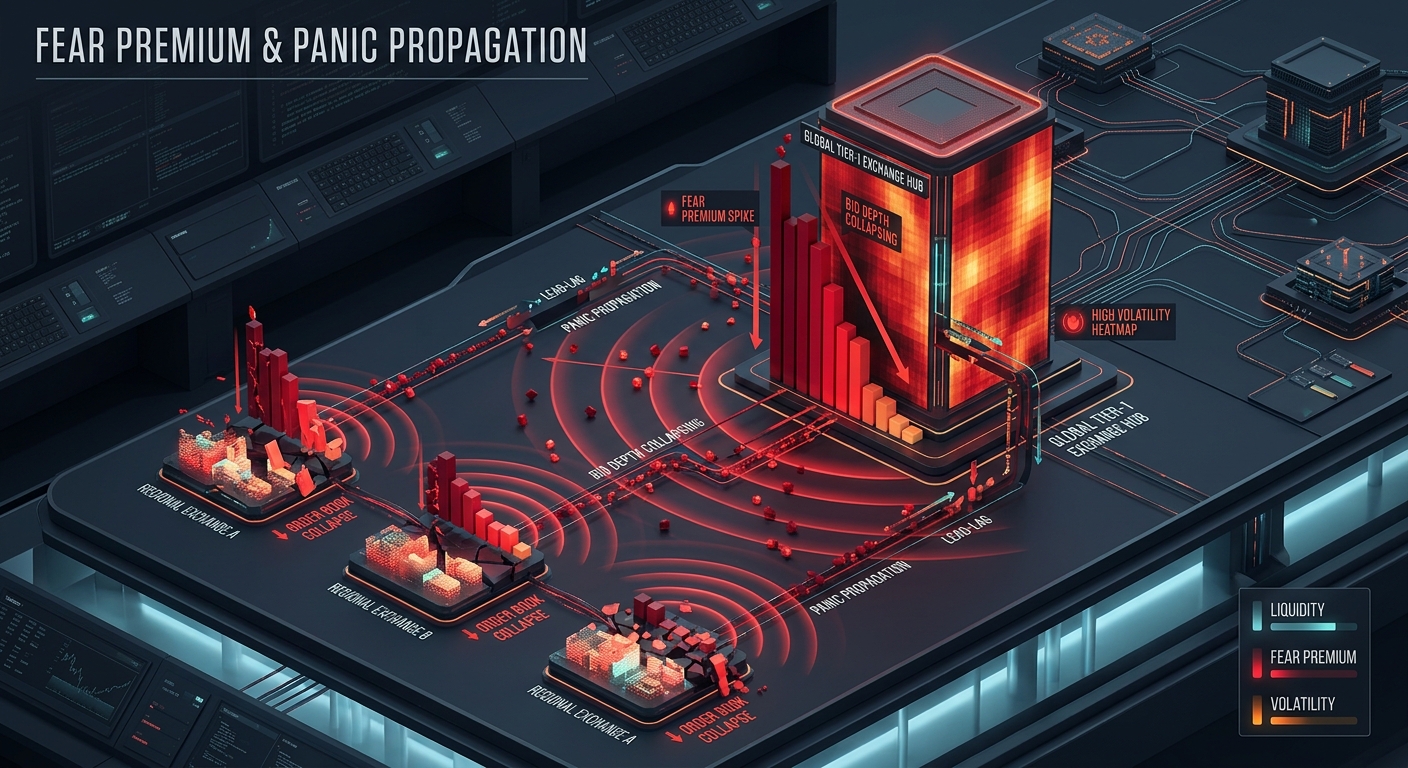
When an earthquake strikes deep in the ocean, the tsunami does not hit every coastline at the exact same second.
The shockwave travels across the water, crushing shallow harbors and fragile shorelines long before it reaches deep-water open oceanic trenches.
In the cryptocurrency markets, panic works in the exact same way.
Most traders assume that when catastrophic news hits—a regulatory ban, an emergency central bank rate hike, or an algorithmic stablecoin collapse—the price of Bitcoin plunges simultaneously across all exchanges worldwide.
It does not.
Long before the multi-million-dollar institutional order books on Binance, Coinbase, and OKX budge by more than a fraction of a percent, the market's earliest screams echo across smaller regional exchanges, second-tier offshore platforms, and localized automated market maker (AMM) liquidity pools.
This structural phenomenon is known in quantitative market microstructure as the "Fear Premium" (or the Panic Liquidity Void).
In this quantitative masterclass, we map the anatomy of how panic travels through the global crypto exchange mesh, examine second-by-second Level-2 order book depletion, and analyze four real-world historical market crashes.
1. The Physics of the Fear Premium: Why Shallow Books Move First
To understand why smaller exchanges crash first, you must compare the mechanical resistance of a Tier-1 Institutional Order Book against a Tier-2 Regional Order Book:
[ THE DEPTH RESISTANCE PARADOX DURING SUDDEN PANIC ]

  TIER-1 VENUE (Binance / Coinbase Pro):
  ------------------------------------------------------------------------------------
  - 1% Order Book Bid Depth: $35,000,000+
  - Market Maker Ingress: Algorithmic HFT market makers continuously refresh resting bids.
  - Absorption Capacity: A $2,000,000 market sell order moves the price by only 0.04%.
  - Reaction Speed: High inertia; prices move smoothly.

  TIER-2 REGIONAL VENUE (Shallow / Local Fiat Exchange):
  ------------------------------------------------------------------------------------
  - 1% Order Book Bid Depth: $180,000 - $450,000
  - Market Maker Ingress: Few HFT desks; mostly retail limit orders and passive grid bots.
  - Absorption Capacity: A $2,000,000 panic sell dumps through ALL resting bids down -6.5% instantly!
  - Reaction Speed: Zero inertia; prices collapse violently in seconds.
When panic breaks out, retail traders and regional funds on smaller exchanges hit the "Market Sell" button simultaneously. Because the resting bid wall is paper-thin, those market sells instantly vacuum out the top 20 to 50 levels of the order book.
The result? Bitcoin might be trading at $60,000.00 on Binance, but on a smaller regional exchange with hollowed-out bids, the latest trade prints at $57,400.00—a massive -$2,600.00 (-4.33%) Fear Discount.
The 2026 Fear Premium Early-Warning Matrix
The table below ranks the typical speed, order book fragility, and lead-lag characteristics of global trading venues when market panic begins:
| Exchange Type & Sample Venues | Avg. 1% Bid Depth (BTC) | Panic Reaction Speed | Average Lead Time Ahead of Binance | Typical Fear Price Gap |
|---|---|---|---|---|
| 1. Regional Korean / Japanese Exchanges (Bithumb, Coincheck, bitFlyer) | $350,000 - $800,000 | Ultra-Violent (Retail Herd Panic) | 15 - 45 seconds FAST | -2.5% to -5.0% (Overshoot) |
| 2. Latin American / Emerging Fiat Exchanges (Bitso, Indodax, Luno) | $120,000 - $300,000 | Extreme (Thin local banking rails) | 30 - 90 seconds FAST | -3.5% to -8.0% (Severe) |
| 3. Low-Cap AMM Pools & DEXs (Raydium, Uniswap v2 Pairs) | $50,000 - $250,000 | Deterministic (Constant Product AMM) | 10 - 25 seconds FAST | -4.0% to -12.0% (Extreme) |
| 4. Tier-2 Global Offshore Exchanges (MEXC, Poloniex, CoinEx) | $450,000 - $1.2M | Rapid (Retail Leverage Liquidations) | 8 - 20 seconds FAST | -1.5% to -3.5% |
| 5. Tier-1 Global Giants (Binance, OKX, Bybit, Coinbase) | $15M - $35M+ | High Inertia (Deep HFT Liquidity) | Benchmark (0s) | Baseline Global Price |
2. The 3 Phases of Panic Contagion: The 60-Second Cascade
How does a localized price collapse on a smaller platform transform into a global market-wide sell-off?
It follows a strict, predictable three-phase chain reaction:
[ THE 60-SECOND PANIC CONTAGION CASCADE ]

  PHASE 1: THE LOCAL VOID (0 to 15 seconds)
  - Retail sellers overwhelm thin bids on regional exchange.
  - Order book drops 4% below global fair value.
  - Large localized Fear Premium / Discount opens up.

  PHASE 2: THE ARBITRAGE TRANSMISSION (15 to 45 seconds)
  - Cross-exchange quantitative bots detect the +4% spread between Venue A ($57,600) and Binance ($60,000).
  - Arbitrage bots BUY on the cheap exchange and aggressively SHORT/SELL on Binance to lock in the spread.
  - This transmission imports the selling pressure directly into Binance's order book!

  PHASE 3: GLOBAL LIQUIDATION CASCADE (45 to 90 seconds)
  - The massive hedge sells hitting Binance begin triggering leveraged long liquidations.
  - Binance order book absorbs the wave, and global prices equalize downwards at $58,200.
Smaller exchanges do not just move first because they are faster; they act as the catalyst that transmits selling pressure to the mega-exchanges via cross-venue arbitrage hedges.
Real-World Case Study 1: The August 5, 2024 "Black Monday" Yen Carry Trade Panic
On August 5, 2024, the Bank of Japan unexpectedly hiked interest rates, triggering a historic worldwide unwind of the multi-trillion-dollar Yen Carry Trade:
What Happened on Japanese & Korean Venues (bitFlyer & Bithumb):
Real-World Case Study 2: The SVB Bank Run & USDC Depeg (March 2023)
When Silicon Valley Bank collapsed on Friday evening, March 10, 2023, Circle revealed it had $3.3 billion of trapped reserves in SVB:
Real-World Case Study 3: The South Korean "Kimchi Premium" Inversion
South Korea's crypto market usually trades at a positive +3% to +8% "Kimchi Premium" due to strict capital controls (FEMA) preventing easy fiat outflow.
However, during severe market panics, the Kimchi Premium undergoes a violent Negative Inversion:
Real-World Case Study 4: Synthetic Order Book Exhaustion on a Tier-2 Venue ($75,000 Arbitrage)
A quantitative trading firm deployed an early-warning monitor tracking Order Book Depth Velocity ($/sec) across 12 exchanges: