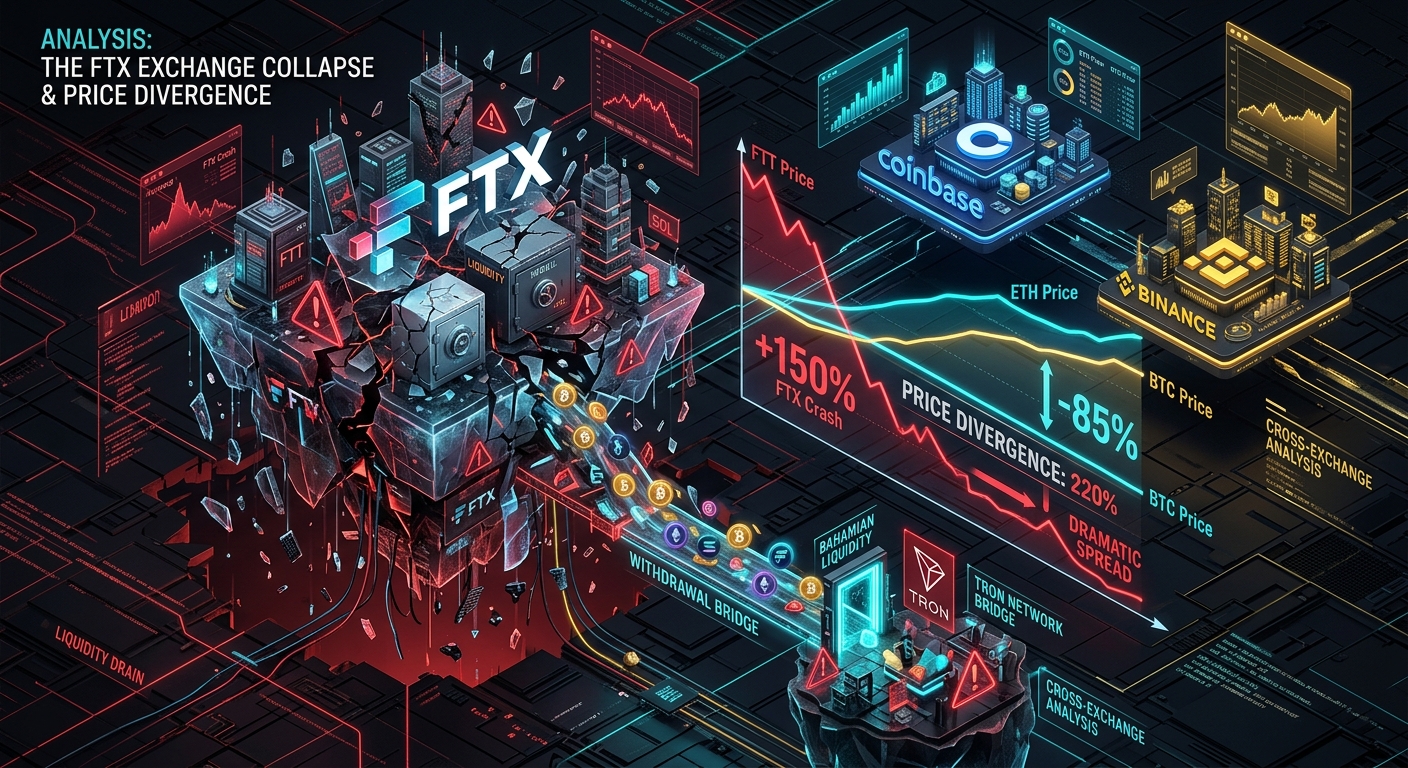
In early November 2022, the cryptocurrency market experienced its most catastrophic liquidity event: the lightning-speed insolvency and implosion of FTX and Alameda Research.
While the mainstream media focused on fraudulent accounting and Bahamas penthouses, market microstructure researchers witnessed something unprecedented:
The complete breakdown of the global Law of One Price across major trading venues.
Within 72 hours, identical digital assets quoted at wildly different valuations depending on whether you looked at FTX, Binance, Coinbase, or decentralized liquidity pools. Bitcoin traded at a 16% discount on FTX; Tron (TRX) surged to an unbelievable +450% premium; and the FTT order book vanished into thin air.
In this forensic case study, we reconstruct the microstructure mechanics of the FTX collapse. We examine how exchange insolvency transforms liquid order books into distressed debt markets, analyze the wild pricing anomalies of the exit portals, and dissect why hundreds of arbitrageurs were wiped out trying to trade the spread.
1. The Insolvency Spread: Why Prices Diverged
Under normal conditions, if Bitcoin is $20,000 on Binance and $19,500 on FTX, arbitrageurs buy on FTX, withdraw to Binance, and sell for an instant $500 profit. This relentless flow forces prices into tight alignment (within 0.02% to 0.05%).
When an exchange halts withdrawals, the entire economic model breaks:
[ THE FORMATION OF AN INSOLVENCY SPREAD ]

NORMAL MARKET STATE:
  1 FTX BTC = 1 Real On-Chain BTC = 1 Binance BTC (100% Fungibility)

INSOLVENCY / WITHDRAWAL HALT STATE:
  1 FTX BTC = 1 Unsecured Bankruptcy Claim on FTX Estate (0% Fungibility)
  1 Binance BTC = 1 Real On-Chain BTC

Result:
  FTX BTC price no longer reflects Bitcoin's global value;
  it reflects: [Global BTC Price] x [Probability of Recovering Funds in Bankruptcy Court]
As soon as withdrawals were throttled on November 8, 2022, users holding fiat or stablecoins on FTX realized that keeping USD on the platform meant receiving pennies on the dollar in future bankruptcy proceedings. They frantically dumped internal USD balances for any asset that had even a theoretical chance of leaving the exchange.
2. The 4 Wildest Price Dislocations During the Collapse
| Asset & Pair | Global Price (Binance/Coinbase) | FTX Internal Price | Peak Spread | Microstructure Catalyst |
|---|---|---|---|---|
| Tron (TRX/USD) | $0.058 | $0.320 | +451.7% Premium | The "Justin Sun Facility" permitted 1:1 external TRX/BTT withdrawals; trapped users bid TRX to astronomical heights to escape. |
| Bitcoin (BTC/USD) | $16,800 | $13,980 | -16.8% Discount | Panicked sellers dumping paper BTC for fiat, followed by a total liquidity freeze. |
| FTX Token (FTT/USD) | $25.50 (Pre-crash) | $1.42 | -94.4% Crash | Alameda's $3.2B paper collateral was wiped out when Binance announced it would liquidate its $580M FTT position. |
| Solana (SOL/USD) | $37.80 | $12.50 | -66.9% Spillover | Contagion dumping across all exchanges due to massive Alameda treasury holdings and locked staking balances. |
3. Case Study #1: The Tron (TRX) "Escape Hatch" (+450% Premium)
On November 10, 2022, Justin Sun announced a special arrangement with FTX allowing users to withdraw Tron-ecosystem tokens (TRX, BTT, JST, SUN, HT) off FTX at a 1:1 ratio with external on-chain reserves.
What followed was the most extreme flight-to-liquidity price squeeze in modern financial history:
[ THE TRON ESCAPE HATCH MECHANISM ]

  1. Trapped User has $100,000 in FTX USD (worth ~$0 on the street).
  2. FTX announces TRX withdrawals are OPEN, but all other withdrawals are CLOSED.
  3. Trapped User buys TRX on FTX at ANY PRICE ($0.10 -> $0.20 -> $0.32).
  4. Trapped User withdraws TRX to external self-custody wallet.
  5. Trapped User dumps TRX on Binance at global market price ($0.058).
  6. Outcome: User recovered ~$18,000 in real cash from a $100,000 trapped balance
     (Accepting an 82% haircut was better than a 100% total loss!).
For 48 hours, TRX on FTX traded like a high-yield distressed debt claim with an implied 18-cent recovery value, detached entirely from Tron's underlying tokenomics.
4. Case Study #2: The FTT Order Book Evaporation
The root cause of FTX's insolvency was Alameda Research borrowing billions in customer deposits against illiquid FTT tokens marked at $22.00 to $25.00 on their balance sheet.
When Binance CEO Changpeng Zhao announced on Twitter that Binance would dump its $580M FTT stash, Alameda CEO Caroline Ellison famously tweeted: "If you're looking to minimize the market impact on your FTT sales, Alameda will happily buy it all from you today at $22!"
Microstructure Reality:
5. The Arbitrageur's Graveyard: The Death of Pure Math
During the collapse, hundreds of retail quants and smaller prop trading firms looked at their screens and saw what appeared to be the trade of a lifetime:
"Bitcoin is $14,000 on FTX and $17,000 on Binance! That is a guaranteed 21.4% arbitrage spread! I will buy BTC on FTX, wire fiat in, and profit!"
Every single trader who took this trade lost 100% of their capital.
[ THE ARBITRAGE TRAP OF AN INSOLVENT EXCHANGE ]

  Step 1: Trader wires $50,000 USD to FTX.
  Step 2: Trader buys 3.57 BTC on FTX at the discounted price of $14,000.
  Step 3: Trader hits "Withdraw BTC to Binance".
  Step 4: Status: "Pending..." -> "Processing..." -> "WITHDRAWALS SUSPENDED".
  Step 5: Chapter 11 Bankruptcy Declared.
  Step 6: Realized Outcome: -$50,000 (Funds locked in bankruptcy court for 3+ years).
This historic event cemented a permanent rule in cryptocurrency quantitative finance: A price gap on an exchange that cannot process withdrawals is not an arbitrage opportunity—it is the market pricing in the probability of total default.
6. Lessons for Modern Crypto Traders
How can you protect your capital and identify when a wide spread is a genuine trading opportunity versus an exchange solvency death spiral?