Here is a scenario almost every crypto trader has experienced:
You glance at your phone. Your favorite portfolio tracker or widget brightly announces that Bitcoin is at $64,200.
Excited to lock in a quick gain, you open your Coinbase or Kraken app, tap the sell button, and stare in utter disbelief. The execution price on your screen is $63,850—a full $350 lower than what your phone just showed you.
Did your portfolio app glitch? Is Coinbase charging you a sneaky hidden fee? Or did Bitcoin just flash-crash in the five seconds it took you to unlock your phone?
The answer is usually none of the above.
You have just collided head-on with one of the most fundamental, yet widely misunderstood realities of digital asset markets: There is no such thing as "The Bitcoin Price."
Unlike traditional equity markets like the NYSE or NASDAQ—where a single centralized securities depository handles matching—cryptocurrency trades across hundreds of independent, fragmented exchanges worldwide.
In this forensic deep dive, we pull back the curtain on how crypto index prices are actually calculated, examine why different platforms show contradictory numbers, and explain how understanding index mathematics can save you thousands of dollars in slippage and liquidation risk.
1. The Island Market Metaphor: Why Crypto Has No Single Price
Think of cryptocurrency exchanges not as branches of a single global bank, but as independent physical farmers markets located in different cities across the world.
[ THE INDEPENDENT ISLAND MARKET REALITY ]

  ┌───────────────────────┐       ┌───────────────────────┐
  │   Coinbase (US/USD)   │       │  Binance (Global/USDT)│
  │ Buyer Bid:  $63,850   │       │ Buyer Bid:  $64,120   │
  │ Seller Ask: $63,855   │       │ Seller Ask: $64,125   │
  └───────────────────────┘       └───────────────────────┘
              ▲                               ▲
              │                               │
              └───────── 2 DIFFERENT ─────────┘
                         ORDER BOOKS!
On Coinbase, the price you see is determined purely by the buyers and sellers currently connected to Coinbase's servers in Virginia.
On Binance, the price is determined by traders swapping USDT in Tokyo, Singapore, and Frankfurt.
Because they are separate databases with separate order books, their prices are never identical. Arbitrage bots work 24/7 to buy on the cheaper exchange and sell on the more expensive one, keeping the gap small (often less than 0.05%), but during periods of high volatility or network congestion, the gap can blow out to hundreds of dollars.
2. How Index Calculators Synthesize "The Global Price"
If every exchange has its own price, how do portfolio apps, news sites, and financial portals display a single number?
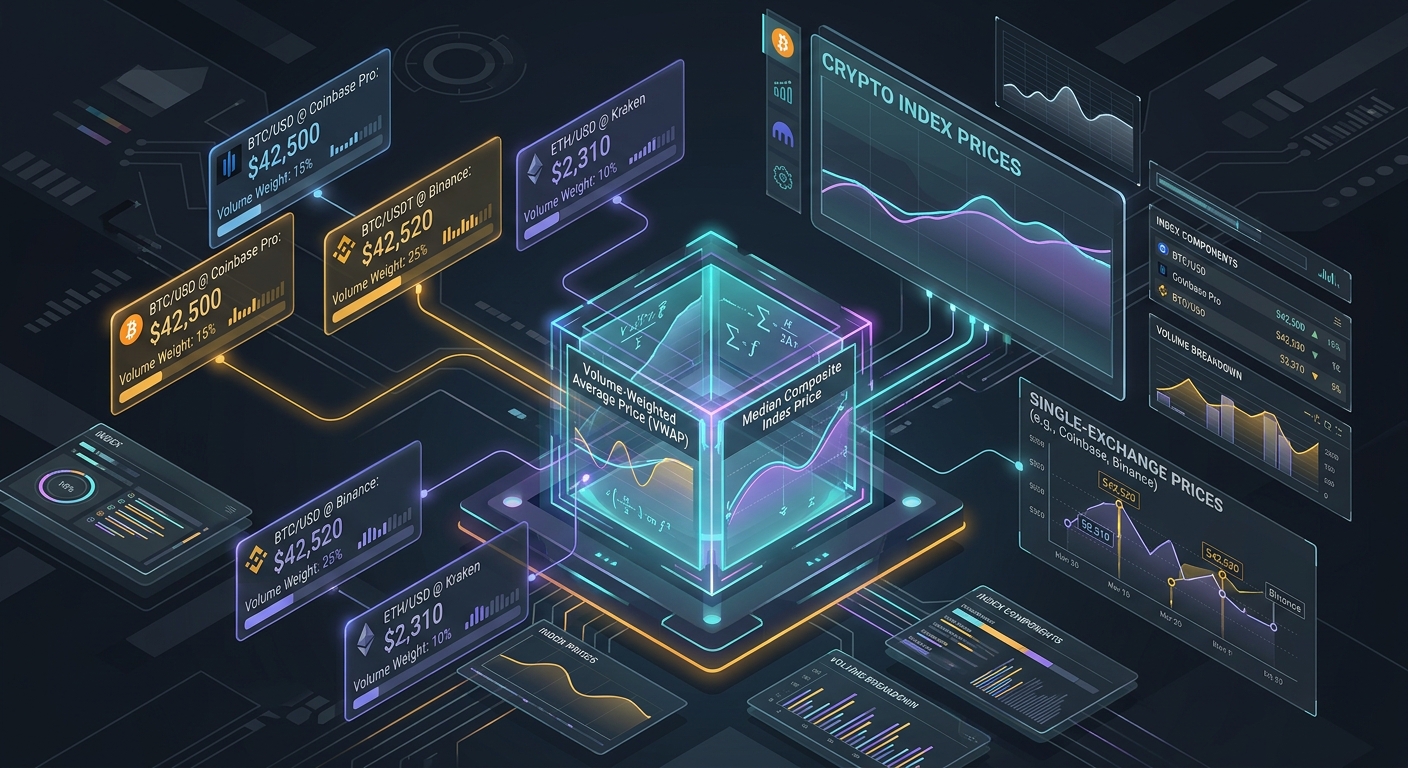
They construct an Index Price—a synthetic composite mathematically calculated from multiple underlying exchange feeds.
However, not all index formulas are created equal. Here are the three primary mathematical methodologies used across the industry:
Model A: Volume-Weighted Average Price (VWAP)
Most major aggregators (like CoinGecko and CoinMarketCap) use a Volume-Weighted Average Price (VWAP). Instead of treating every exchange equally, they give more weight to exchanges with the highest trading volume:
[ VWAP INDEX FORMULA ]

  Index Price = Σ (Price_i × Volume_i) / Σ (Volume_i)

  Example Calculation for Bitcoin:
    • Binance (Global):  $64,100  | 24h Volume: 20,000 BTC  | Weight: 66.7%
    • Coinbase (US):      $63,850  | 24h Volume:  7,000 BTC  | Weight: 23.3%
    • Kraken (EU):        $63,900  | 24h Volume:  3,000 BTC  | Weight: 10.0%

  Aggregated Index Price = ($64,100 × 0.667) + ($63,850 × 0.233) + ($63,900 × 0.100)
                         = $64,021.50
The Problem: If you are trading on Coinbase, the aggregated index ($64,021) is $171 higher than the actual executable price on Coinbase ($63,850)! The index reflects where the global volume is (Binance), not what your local exchange will pay you.
Model B: Outlier-Filtered Medianization (The CME & Pyth Standard)
Institutional indices (such as the CME CF Bitcoin Reference Rate used to settle Bitcoin futures contracts) cannot afford to be skewed by wash trading on unregulated offshore exchanges.
They use Median-Based Robust Aggregation:
3. The 4 Big Reasons Your App's Price Doesn't Match Coinbase
If your phone app shows a different number than your brokerage or exchange, it is almost always caused by one of these four structural factors:
[ THE 4 ROOTS OF PRICE DISCREPANCIES ]

  1. AGGREGATOR CACHING LAG: Free API updates every 60s vs. WebSocket millisecond feed.
  2. CURRENCY PAIR MISMATCH: USD (Fiat) vs. USDT (Tether) vs. USDC (Circle).
  3. BID-ASK SPREAD & DEPTH: Mid-market index price vs. Top-of-book executable bid.
  4. REGIONAL CAPITAL SILOS: The Korean Kimchi Premium & localized fiat barriers.
1. The API Caching Delay (The 60-Second Stale Wick)
Free portfolio apps (and widgets on iOS/Android) do not maintain direct sub-millisecond WebSocket connections to exchange order books. Doing so would drain your phone’s battery and cost millions in server infrastructure.
Instead, they query public REST API endpoints that are cached on Content Delivery Networks (CDNs) for 30 to 120 seconds. If Bitcoin suddenly drops $300 on Coinbase in 10 seconds, your portfolio app won't reflect the drop until its next refresh cycle.
2. USD vs. USDT (The Stablecoin Premium)
Coinbase primarily trades in pure fiat US Dollars (BTC/USD).
Binance, Bybit, and OKX primarily trade in Tether (BTC/USDT).
If Tether trades at $0.998 on secondary markets (a slight 0.2% discount), the BTC/USDT pair on Binance will trade higher in nominal dollar terms than the BTC/USD pair on Coinbase to compensate. A $64,000 USDT price is only worth $63,872 in real US fiat!
3. Mid-Market Price vs. Executable Bid Price
Most tracking apps display the Mid-Market Price (the exact mathematical midpoint between the highest buyer and lowest seller).
However, when you place a market sell order on Coinbase, you do not receive the mid-price—you sell to the highest existing bid, minus any retail taker fees. On large orders, if the order book is thin, your order eats through multiple price levels (slippage), executing even lower.
4. The Regional Outlier Problem (The Kimchi Premium)
In January 2018 and April 2024, South Korean exchanges (Upbit, Bithumb) traded Bitcoin at a +5% to +15% premium over global markets due to domestic retail mania and capital controls.
When global aggregators factored Korean volume into their standard formulas, it created an artificial spike. In response, providers like CoinMarketCap famously instituted automatic regional outlier exclusion filters to strip non-arbitrageable markets from global indices.
4. Why Perpetual Futures Depend on "Mark Price" vs. "Index Price"
Nowhere is index calculation more critical than in crypto derivatives (Perpetual Futures on Binance, Bybit, dYdX, and Hyperliquid).
In derivatives markets, exchanges distinguish between three distinct prices:
| Price Type | Definition | Purpose |
|---|---|---|
| Last Traded Price | The price of the most recent trade executed on that specific derivatives order book. | Visualizing chart candlesticks. |
| Index Price | The volume-weighted average spot price across a basket of external major spot exchanges (Coinbase, Kraken, Binance, OKX). | Anchoring the contract to real-world underlying spot value. |
| Mark Price | Index Price + a decaying Exponential Moving Average (EMA) of the basis spread. | Determining account margin, unrealized PnL, and LIQUIDATION triggers. |
[ WHY MARK PRICING SAVES TRADERS FROM SCAM WICKS ]

Scenario: A rogue whale dumps $50M on Bybit futures order book.
  • Bybit Last Traded Price instantly flash-crashes from $64,000 to $58,000 for 1 second.
  • Spot exchanges (Coinbase, Kraken) are completely unaffected ($64,000 spot price).
  • Bybit Index Price remains steady at $64,000.
  • Bybit Mark Price remains steady at $63,980.

Outcome: Long positions on Bybit ARE NOT LIQUIDATED because liquidations trigger off
         the Mark Price, not the manipulated single-exchange Last Price!
By tying liquidations to a robust multi-exchange Index Price rather than the local futures book, modern crypto exchanges prevent malicious actors from hunting stop-losses and triggering artificial liquidation cascades.
5. Summary & Best Practices for Execution
The next time you notice a price discrepancy between your apps, remember these golden rules of market microstructure: