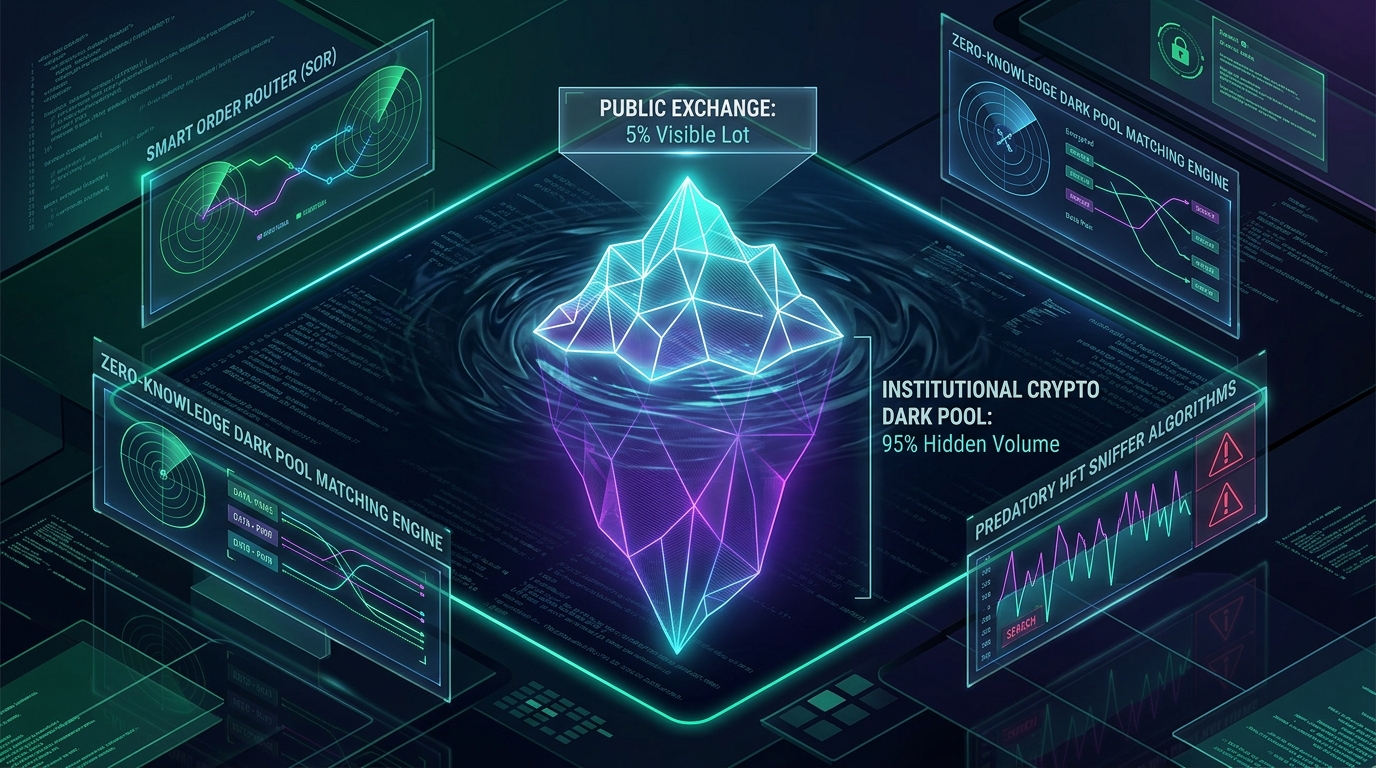
In high-stakes financial markets, information is the ultimate currency.
If you walk onto the floor of an exchange and publicly announce, "I need to purchase $50,000,000 worth of Bitcoin in the next thirty minutes," what happens?
Every seller instantly pulls their asks off the book and re-quotes them 2% higher. Proprietary trading firms rush ahead of you to buy up every cheap coin on the market, waiting to dump them back onto you at an inflated markup. You end up paying millions of dollars in self-inflicted adverse price movement.
This fatal mistake is known in quantitative finance as Order Signaling (Information Leakage).
In 24/7 crypto markets—where public order books update in microseconds and on-chain mempools are constantly surveilled by predatory MEV searchers—institutional players must act like ghosts.
How do hedge funds, crypto venture funds, and algorithmic market makers buy and sell nine-figure positions without leaving a footprint? In this comprehensive institutional execution breakdown, we pull back the curtain on Iceberg orders, Dark Pools, Smart Order Routing (SOR), and Zero-Knowledge execution engines.
1. The Cost of Signaling: Adverse Selection & Front-Running
When a trader places a visible large limit order on Binance, Coinbase, or Bybit, the order immediately broadcasts across thousands of WebSocket subscribers worldwide:
[ THE ORDER SIGNALING FEEDBACK LOOP ]

  1. WHALE PLACES VISIBLE 500 BTC BUY ORDER ($32,500,000)
     │ (Visible on public Level-2 / Level-3 order books)
     ▼
  2. HFT SNIFFER ALGORITHMS DETECT MASSIVE BUY WALL
     │ (Bots instantly calculate imbalance ratio: 94% Bids vs 6% Asks)
     ▼
  3. MARKET MAKERS CANCEL OPPOSING ASKS (Spread Widens)
     │ (Sellers pull cheap liquidity from $65,000 up to $65,800)
     ▼
  4. PREDATORY PROP DESKS FRONT-RUN THE WHALE
     │ (Algorithms aggressively buy top-of-book at $65,005 to $65,100)
     ▼
  5. WHALE SUFFERS MASSIVE ADVERSE SELECTION
     │ (Whale is forced to chase higher prices or get left behind)
By signaling their intent, the trader created their own competition. The visible order acted as a guaranteed price floor, giving low-risk front-running opportunities to high-frequency bots.
2. Deconstructing the Iceberg Order
The most fundamental tool for disguising large orders on centralized exchanges is the Iceberg Order.
An iceberg order splits a parent order into a tiny Visible Display Amount (The Peak) and a large Hidden Reserve Amount (The Submerged Mass):
[ ANATOMY OF A 1,000 ETH ICEBERG BUY ORDER ]

  PARENT ORDER: Buy 1,000 ETH @ $3,500.00 ($3,500,000 total)
  DISPLAY LOT:  25 ETH (2.5% visible) | HIDDEN LOT: 975 ETH (97.5% concealed)

  PUBLIC ORDER BOOK VIEW:                EXCHANGE MATCHING ENGINE REALITY:
  ┌─────────────────────────┐            ┌────────────────────────────────────────┐
  │ BID: 25 ETH @ $3,500.00 │            │ ACTIVE PEAK:     25 ETH @ $3,500.00    │
  │ (Looks like tiny retail)│            │ HIDDEN QUEUE:   975 ETH @ $3,500.00    │
  └─────────────────────────┘            └────────────────────────────────────────┘
               │                                              │
               ▼                                              ▼
  Seller fills the 25 ETH.               Engine instantly decrements reserve to 950 ETH
                                         and posts a fresh 25 ETH peak to the order book!
To external market observers watching the Depth-of-Market (DOM), it appears as though hundreds of different traders are casually buying 25 ETH blocks at $3,500, when in reality it is a single institutional entity absorbing sell pressure.
The Vulnerability: How HFT Bots "Sniff" Icebergs
Iceberg orders are powerful, but they are not invisible to sophisticated algorithmic desks.
High-frequency quantitative bots use Liquidity Pinging to detect hidden icebergs:
3. Centralized vs. Decentralized Crypto Dark Pools
When an institutional order is simply too massive for public exchange order books (e.g., $20M+ in an altcoin), trading desks move off the public tape entirely into Dark Pools.
A dark pool is an alternative trading venue where order books are completely concealed from the public. Orders sit in invisible matching queues, and prices/sizes are only published to the tape after the transaction has already cleared.
[ PUBLIC ORDER BOOK vs. CRYPTO DARK POOL ]

  PUBLIC ORDER BOOK (Lit Market - Binance / Coinbase):
  • Pre-Trade Transparency:  100% VISIBLE (Bids, Asks, Sizes, Queue Depth)
  • Pre-Trade Market Impact: HIGH (Traders react before order fills)
  • Execution:               Continuous double auction

  CRYPTO DARK POOL (Paradigm / Kraken Dark / Renegade ZK):
  • Pre-Trade Transparency:  0% INVISIBLE (Zero quotes, zero size shown)
  • Pre-Trade Market Impact: ZERO (Market does not know order exists)
  • Execution:               Mid-point matching / Request-for-Quote (RFQ)
1. Institutional RFQ Networks (Paradigm, Wintermute RFQ)
Rather than posting limit orders, institutions submit Request-For-Quote (RFQ) inquiries privately to top market making firms simultaneously.
The market makers return two-way firm quotes with guaranteed zero slippage. The entire negotiation occurs off-exchange, settling atomically via institutional custody APIs (Fireblocks, Copper ClearLoop).
2. Zero-Knowledge Dark Pools (Renegade, Railgun)
On public blockchains, traditional dark pools were impossible because every transaction and storage state is visible on Etherscan.
Next-generation DEXs like Renegade utilize Zero-Knowledge Multi-Party Computation (ZK-MPC) and cryptographic commitments:
4. Smart Order Routing (SOR) & Algorithmic Shredding
When an institution must execute across public markets, they deploy a Smart Order Router (SOR).
An SOR connects simultaneously to 20+ liquidity venues—centralized exchanges, perpetual swap books, and on-chain automated market maker (AMM) pools:
[ SMART ORDER ROUTING (SOR) DISPERSAL ]

                       INSTITUTIONAL PARENT ORDER
                      [$10,000,000 BUY SOLANA (SOL)]
                                     │
                         SMART ORDER ROUTER (SOR)
                                     │
     ┌────────────────┬──────────────┼──────────────┬────────────────┐
     ▼                ▼              ▼              ▼                ▼
  BINANCE CEX     COINBASE       BYBIT PERP     RAYDIUM AMM      KRAKEN DARK
  $3.2M (TWAP)    $2.1M (Iceberg)$2.5M (Basis)  $1.2M (CoW Swap) $1.0M (Midpoint)
By distributing child slices across non-correlated liquidity pools and staggering execution times based on historical Poisson probability distributions, the SOR absorbs massive volume with virtually undetectable market footprint.
5. Tactical Comparison: Stealth Execution Strategies
| Execution Method | Visibility | Market Impact | Best Sizing | Primary Risk |
|---|---|---|---|---|
| Standard Limit Order | 100% Public | Extreme (Signals book) | < $25,000 | Front-running, adverse selection |
| Exchange Iceberg | 2% – 5% Public | Low to Moderate | $50,000 – $500,000 | HFT sniffer pinging & queue detection |
| Algorithmic TWAP/VWAP | Sliced Micro-Orders | Low | $100,000 – $5,000,000 | Market trend drifting during execution window |
| Institutional OTC / RFQ | 0% (Private Bilateral) | Zero | $500,000 – $50,000,000+ | Counterparty settlement risk |
| ZK Dark Pools (On-Chain) | 0% (Cryptographic Proofs) | Zero | $50,000 – $2,000,000 | Limited initial liquidity depth |
6. Actionable Takeaways for Quantitative Traders
Whether managing an institutional treasury or personal high-net-worth portfolio, implement these execution rules: