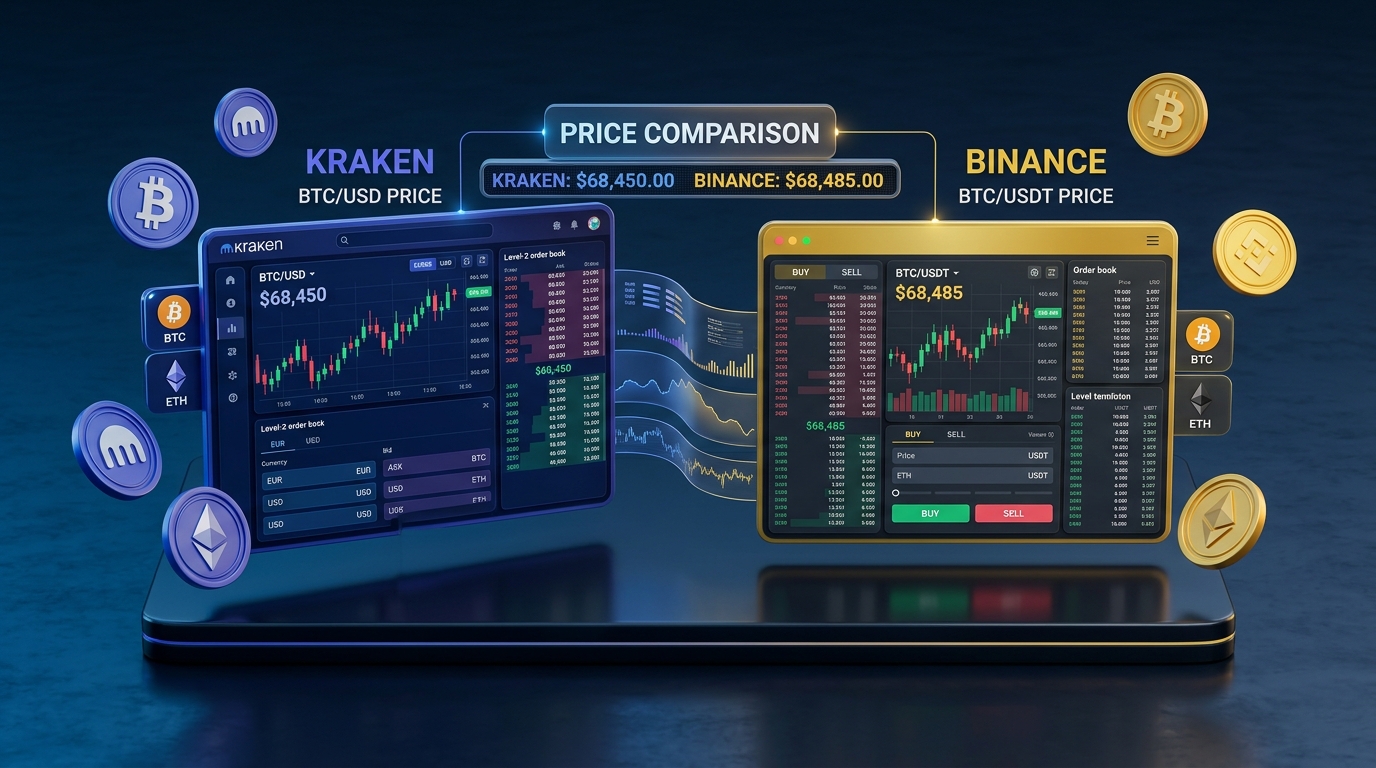
In the global digital asset ecosystem, Binance and Kraken represent two completely different architectural philosophies.
Founded in 2011, Kraken is one of the oldest, most heavily regulated cryptocurrency institutions in the world. Headquartered in the United States, Kraken has built its reputation as the premier bridge between traditional fiat banking systems (SEPA in Europe, Fedwire/ACH in the US, and CHAPS/Faster Payments in the UK) and digital assets.
By contrast, Binance is the world’s largest crypto-native powerhouse, commanding massive international volume denominated predominantly in stablecoins like Tether (USDT) and FDUSD.
Because Kraken’s order books are settled in pure, central-bank-issued fiat (USD, EUR, GBP) while Binance’s order books trade primarily against synthetic digital dollars (USDT), Bitcoin and Ethereum prices between Kraken and Binance are constantly diverging.
In this exhaustive quantitative guide, we dissect the microstructural mechanics of Kraken vs. Binance pricing, examine how fiat forex dynamics create spread opportunities, compare real execution costs (including the dangerous Kraken Instant Buy spread trap), and analyze four real-world numerical case studies.
The Core Structural Difference: Pure Fiat vs. Stablecoin Denomination
The single most important concept to understand when comparing Kraken and Binance is the Quote Currency Microstructure:
Because Tether (USDT) itself fluctuates on secondary markets between $0.9980 and $1.0025, the nominal price of BTC on Binance will naturally trade at a premium or discount to Kraken’s pure USD price:
ext{Nominal Spread} = P_{ ext{Binance (USDT)}} - P_{ ext{Kraken (USD)}}ext{True Realized Discrepancy} = P_{ ext{Binance (USDT)}} imes ext{USDT/USD Peg Rate} - P_{ ext{Kraken (USD)}}If USDT is trading at $0.9985 due to heavy redemption pressure, Bitcoin on Binance might read $64,300 USDT while Kraken reads $64,200 USD. In reality, adjusted for the Tether discount, both exchanges are pricing Bitcoin at the exact same economic value.
Exchange Comparison at a Glance
| Feature / Parameter | Kraken (Kraken Pro) | Binance |
|---|---|---|
| Founding Year & Jurisdiction | 2011 (San Francisco, USA / Global) | 2017 (Global Offshore / Multi-Regional) |
| Dominant Quote Currencies | Pure Fiat (EUR, USD, GBP, CAD, AUD) | Stablecoins (USDT, FDUSD, USDC) |
| European (EUR) Spot Liquidity | #1 Globally (Deepest EUR order books) | Moderate (Subject to MiCA stablecoin rules) |
| Base Retail Pro Trading Fees | 0.160% Maker / 0.260% Taker | 0.100% Maker / 0.100% Taker (0.075% w/ BNB) |
| Instant App / Retail Buy Markup | 1.5% – 2.0% spread fee | 0.5% – 1.0% card/instant fee |
| Regulatory Compliance | MiCA registered, FinCEN, UK FCA, AUSTRAC | Multiple global regulatory jurisdictions |
| Proof of Reserves (PoR) | Cryptographically verified semi-annual audits | Monthly Merkle Tree PoR |
1. Order Book Depth & Liquidity Comparison
Where should you execute your trade? The answer depends entirely on the currency you hold and the asset class you are trading:
Euro (EUR) & British Pound (GBP) Pairs
For European and UK traders, Kraken is unbeatably superior:
If you deposit Euros via SEPA Instant, buying directly on Kraken Pro avoids costly foreign exchange conversion fees and delivers the tightest spot fill in the market.
US Dollar (USD) vs. Tether (USDT) Pairs
For global traders holding stablecoins or trading large-cap altcoins (SOL, AVAX, NEAR, SUI):
2. The Fee Trap: Kraken Instant Buy vs. Kraken Pro vs. Binance
One of the most expensive mistakes novice crypto investors make is using Kraken’s Standard Consumer App (Instant Buy) instead of Kraken Pro:
| Platform / Interface | Order Type | Fee / Spread Surcharge | Cost on a $10,000 BTC Buy |
|---|---|---|---|
| Kraken Consumer App | Instant Buy (Card / Cash) | 1.50% – 2.00% Spread | -$150.00 to -$200.00 |
| Kraken Pro | Limit Maker Order | 0.160% | -$16.00 |
| Kraken Pro | Market Taker Order | 0.260% | -$26.00 |
| Binance (Standard) | Market Taker Order | 0.100% | -$10.00 |
| Binance (with BNB) | Market Taker Order | 0.075% | -$7.50 |
The Practical Rule: Never click "Buy Crypto" on the consumer Kraken dashboard. Always toggle to the Kraken Pro interface to access the Central Limit Order Book and save up to $184 per $10,000 transaction.
3. Flash Crashes & Liquidity Wicks on Thinner Order Books
Because Binance aggregates massive global algorithmic market makers, its order books are exceptionally resilient to isolated cascading selloffs.
Kraken, while highly liquid in BTC and ETH, has experienced historical "flash wicks" on secondary altcoins during extreme market volatility. When leveraged margin long positions on Kraken are liquidated simultaneously, the automated liquidation engine sells market orders directly into the local order book.
If market makers pull their bids momentarily, prices on Kraken can wick 5% to 12% lower than Binance for a matter of 2 to 10 seconds before arbitrageurs instantly buy the dip and restore equilibrium.
Smart traders capitalize on this by keeping resting limit bids 3% to 6% below the market on Kraken, catching deep liquidity wicks during high-volatility flash crashes.
Real-World Case Study 1: The EUR/USD Forex & Tether Spread Divergence
During a Friday afternoon when traditional European forex markets were closing, the following prices were recorded simultaneously across venues:
Discrepancy Breakdown:
A trader looking only at nominal figures sees Binance at $63,450 and Kraken at $63,147 (a theoretical $303 or 0.48% gap).
Real-World Case Study 2: The $50,000 BTC Purchase: True Outlay Comparison
Let us model a trader purchasing $50,000 worth of Bitcoin using market taker orders across three different execution paths:
| Execution Venue | Quoted BTC Price | Slippage Impact | Trading Fee | Net BTC Received | Effective Price per BTC |
|---|---|---|---|---|---|
| Kraken Consumer Instant Buy | $64,000.00 | Built-in 1.5% spread | 1.50% ($750) | 0.7695 BTC | $64,977.25 |
| Kraken Pro (Taker) | $64,000.00 | +$1.20 (0.002%) | 0.26% ($130) | 0.7792 BTC | $64,168.37 |
| Binance (Taker with BNB) | $64,000.00 | +$0.40 (0.0006%) | 0.075% ($37.50) | 0.7806 BTC | $64,048.93 |
The Quantitative Finding: Buying via Kraken Pro yields virtually the same Bitcoin as Binance (a minor $92.50 fee difference), but buying through Kraken Instant Buy costs an astonishing $928.32 more for the exact same asset.
Real-World Case Study 3: The Altcoin Flash Wick Rebound (Polkadot DOT/USD)
During a sudden cascade across derivatives exchanges, automated liquidations triggered on Kraken:
Arbitrage Execution:
A trader with resting limit buy orders at $6.45 on Kraken filled 5,000 DOT ($32,250) at the bottom of the wick.
Real-World Case Study 4: SEPA vs. SWIFT Cross-Exchange Fiat Arbitrage
Consider a European institutional desk managing physical bank balances in Frankfurt:
Comprehensive Feature & Pricing Matrix
| Feature / Microstructure Dimension | Kraken Pro | Binance | Advantage |
|---|---|---|---|
| Euro (EUR) & GBP Liquidity | Deepest in the world | Limited / Fragmented | Kraken (Clear Winner) |
| Global USDT & Altcoin Depth | Moderate | Deepest globally | Binance (Clear Winner) |
| Base Retail Taker Fee | 0.260% | 0.100% (0.075% w/ BNB) | Binance (Cheaper by 0.16%) |
| Fiat Deposit / Withdrawal Speed | Instant SEPA, Fedwire, CHAPS | P2P, Advcash, select bank rails | Kraken (Superior fiat rails) |
| Institutional Regulatory Security | Pristine 13-year track record | High compliance, multi-jurisdiction | Kraken (Maximum regulatory safety) |
| Advanced Conditional Orders | Extensive stop-loss-profit, trailing | Standard limit, market, OCO | Kraken (Superior spot risk tooling) |
| Lightning Network Integration | Fully integrated zero-fee deposits | Integrated for BTC | Tie (Both support Lightning) |
Which Exchange Should You Choose?
Choose Kraken (Kraken Pro) if:
Choose Binance if:
Summary
Neither Kraken nor Binance is inherently "better"—they serve fundamentally different economic functions in the crypto market.
By linking your accounts to real-time multi-exchange price radars and using Kraken Pro for fiat on-ramping and Binance for stablecoin altcoin execution, you can capture the best prices, avoid hidden fee traps, and optimize your overall trading performance.