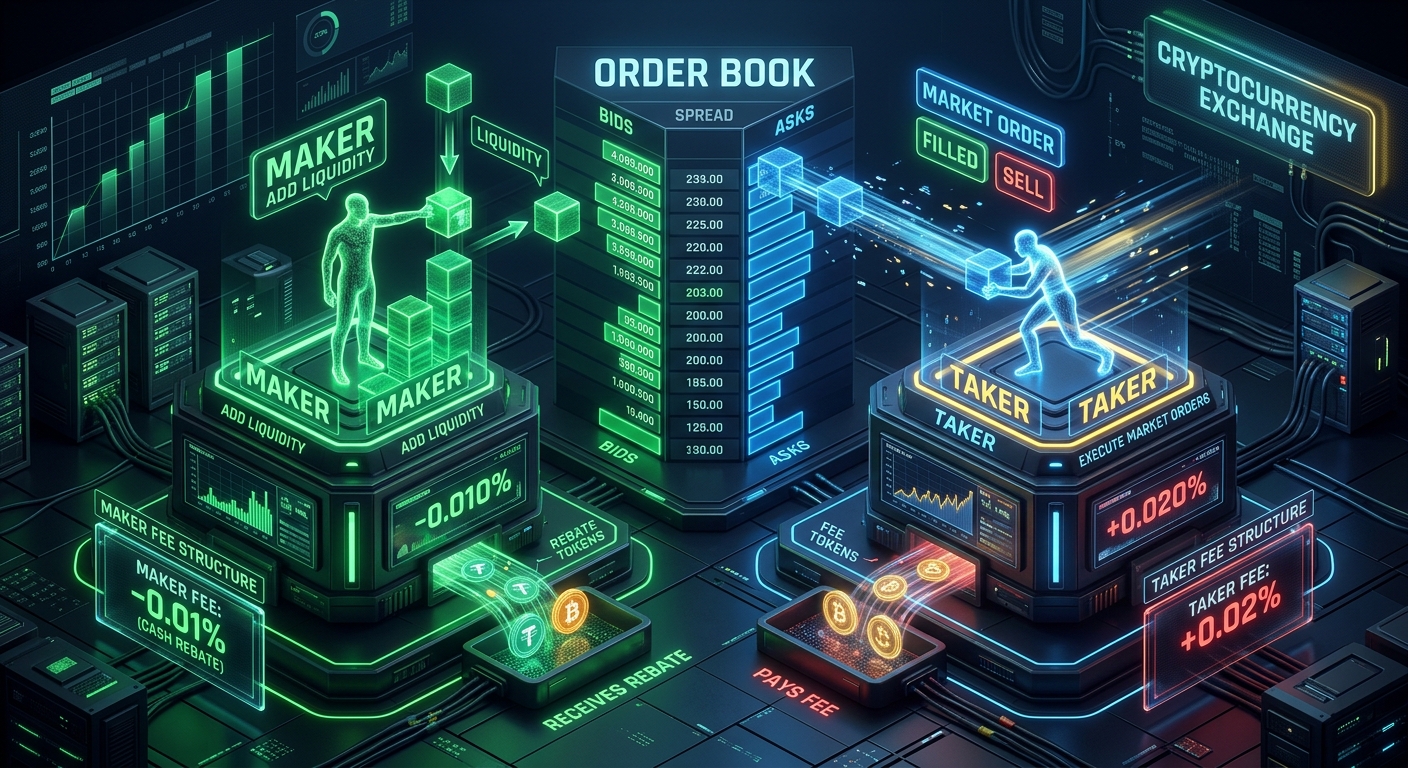
If you have ever traded cryptocurrency on an exchange, you have encountered the terms Maker Fee and Taker Fee.
Most casual traders treat these two numbers as trivial fine print—a minor fraction of a percent deducted quietly from their account balance.
In reality, the distinction between being a Maker and a Taker is the single most decisive factor determining whether an active trader or algorithmic fund remains consistently profitable or slowly bleeds capital over time.
Over the course of a year, the fee differential between aggressive market orders and passive limit orders can represent tens of thousands of dollars—often exceeding a trader’s entire net profit margin.
Why do exchanges charge different rates for the exact same transaction? How do high-frequency market makers get paid cash rebates simply to place orders? And how can you structure your execution to ensure you always pay the lowest possible fee rate?
In this quantitative execution guide, we deconstruct the mechanics of Maker vs. Taker fee models, examine the underlying microstructure of exchange matching engines, analyze comparative fee schedules across top global crypto exchanges, and dissect four real-world numerical case studies.
The Core Conceptual Difference: Liquidity Providers vs. Liquidity Consumers
To understand Maker and Taker fees, imagine a bustling international farmers market:
[ THE ORDER BOOK ECOSYSTEM ]

   1. THE MAKER (Liquidity Provider)          2. THE TAKER (Liquidity Consumer)
   "I will sell apples for $2.00 or            "I need 10 apples RIGHT NOW at whatever
    buy apples for $1.90. I will sit            the current asking price is."
    at my booth and wait for customers."
                 |                                          |
                 v                                          v
      [ Adds Resting Order to Book ]             [ Immediately Matches & Removes Order ]
                 |                                          |
                 v                                          v
Rewarded with LOW FEE / REBATE Charged PREMIUM TAKER FEE for Immediacy1. The Economics of the Maker-Taker Model
Why do crypto exchanges charge Makers less than Takers?
An exchange’s business model depends on liquidity. An exchange with deep order books and tight bid-ask spreads attracts more institutional capital, experiences lower slippage, and generates higher aggregate trading volume.
To build deep liquidity, exchanges operate as economic subsidizers:
The Mathematical Net Spread on Maker vs. Taker Orders:
Exchange Profit = Taker Fee Rate - Maker Fee RateIf an exchange charges a Taker 0.10% and charges the Maker 0.02%, the exchange captures 0.08% net revenue on the matched transaction volume.
2. Standard vs. VIP Maker-Taker Fee Schedules Across Top Venues
| Cryptocurrency Exchange | Base Retail Maker Fee | Base Retail Taker Fee | VIP / Institutional Maker Fee | VIP / Institutional Taker Fee | Maker Discount Advantage |
|---|---|---|---|---|---|
| Binance (Spot) | 0.1000% (0.075% w/ BNB) | 0.1000% (0.075% w/ BNB) | 0.0000% – 0.0120% | 0.0150% – 0.0240% | 50% – 100% cheaper |
| Coinbase Advanced | 0.4000% | 0.6000% | 0.0000% – 0.0500% | 0.0500% – 0.1000% | 33% – 100% cheaper |
| Kraken Pro | 0.1600% | 0.2600% | 0.0000% – 0.0200% | 0.0200% – 0.0600% | 38% – 100% cheaper |
| Bybit (Spot) | 0.1000% | 0.1000% | 0.0000% – 0.0100% | 0.0150% – 0.0300% | 50% – 100% cheaper |
| OKX (Spot) | 0.0800% | 0.1000% | -0.0050% (Rebate!) | 0.0150% – 0.0250% | 100%+ (Paid to trade) |
| Bitfinex | 0.1000% | 0.2000% | -0.0100% (Rebate!) | 0.0200% – 0.0450% | 100%+ (Paid to trade) |
3. What is a "Post-Only" Order and Why is It Critical?
One of the most common pitfalls for traders attempting to capture Maker fee discounts is Accidental Taker Execution.
The Scenario:
The Solution: The "Post-Only" Order Flag
When you select Post-Only on your trading interface or via API (postOnly: true):
Post-Only guarantees 100% Maker status on every single trade.
Real-World Case Study 1: The $10 Million Monthly Volume Impact ($38,400 in Annual Fee Savings)
Consider an active crypto day trader or quantitative strategy executing $10,000,000 in monthly turnover on Kraken Pro:
| Execution Strategy | Maker vs. Taker Mix | Average Fee Rate | Monthly Fee Expense | Annual Fee Expense |
|---|---|---|---|---|
| Strategy A: Pure Market Orders (Taker) | 100% Taker | 0.2600% (Base Taker) | $26,000.00 | $312,000.00 |
| Strategy B: Unoptimized Limit Orders | 50% Maker / 50% Taker | 0.2100% (Blended) | $21,000.00 | $252,000.00 |
| Strategy C: Post-Only Maker Optimized | 100% Maker | 0.1600% (Base Maker) | $16,000.00 | $192,000.00 |
| Strategy D: VIP Maker Tier (Volume Scaling) | 100% Maker (Tier 4) | 0.0200% | $2,000.00 | $24,000.00 |
The Financial Takeaway: By simply migrating execution from 100% Taker (Strategy A) to 100% Maker (Strategy C), the trader saves $10,000 per month ($120,000 per year) on identical trading volume without altering their market entry or exit signals.
Real-World Case Study 2: The Arbitrageur's "Split-Leg" Strategy (Turning Losses into Gains)
In crypto arbitrage, executing both legs with aggressive market orders frequently wipes out tight spreads.
By making the first leg passive, the quantitative bot transformed a losing trade into an institutional profit stream.
Real-World Case Study 3: Negative Maker Fees — How HFT Market Makers Get Paid to Trade
On Tier-1 derivative and institutional spot exchanges (such as OKX, Bitfinex, and Bybit VIP), high-volume market makers enjoy Negative Maker Fees (-0.005% to -0.015%):
The exchange literally pays the market maker $30.01 for supplying liquidity to the order book.
Real-World Case Study 4: When Paying the Taker Fee is Actually the Smart Choice
While Maker fees are cheaper, dogmatic adherence to limit orders can cause catastrophic losses in certain market regimes:
The Quantitative Lesson: Use Maker orders during normal range-bound conditions and planned execution; use Taker market orders when speed and guaranteed execution are required to prevent large drawdowns.