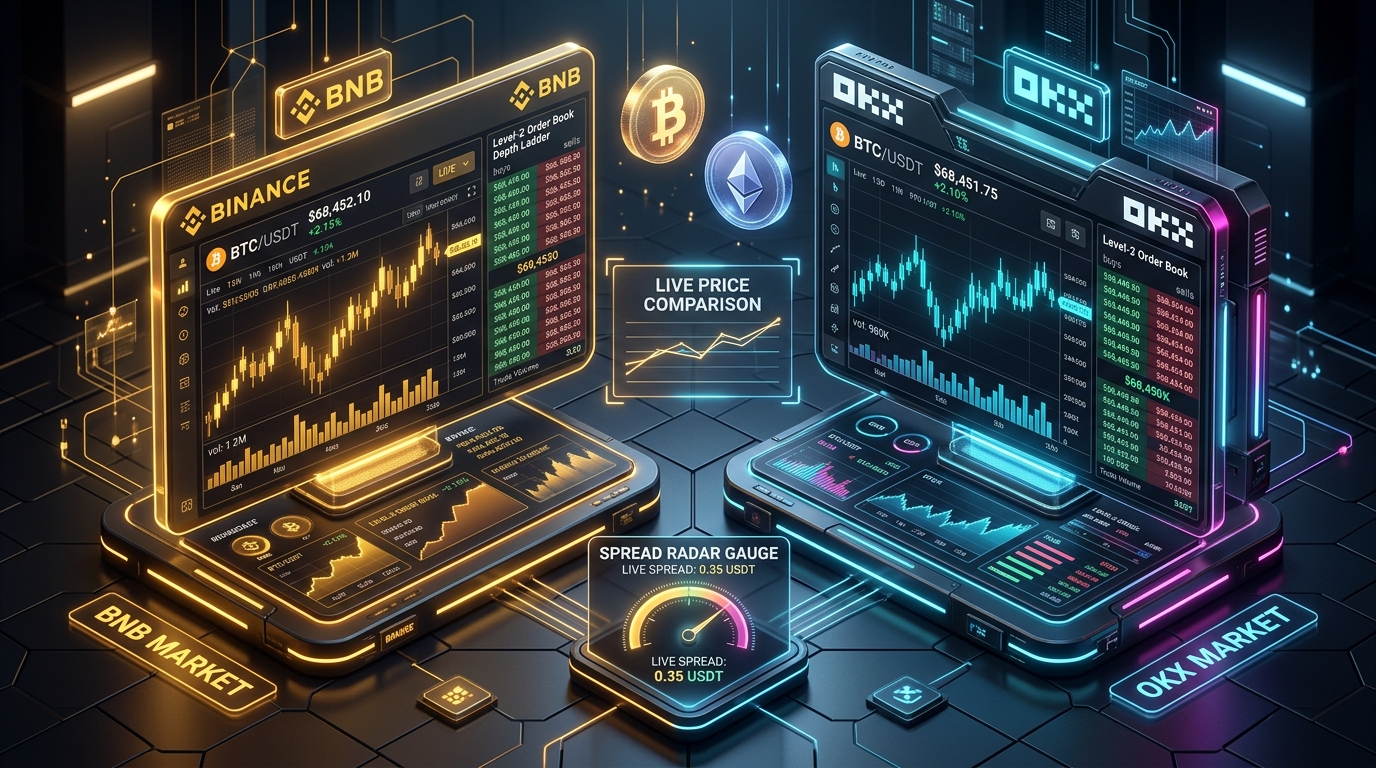
In the global cryptocurrency landscape, Binance and OKX represent the two undisputed heavyweights of international crypto trading. Together, they process tens of billions of dollars in daily spot and derivatives volume, serving millions of retail traders and high-frequency institutional market makers.
To the untrained eye, Bitcoin, Ethereum, and Solana appear to cost virtually the exact same amount on both platforms. Look at your mobile screen, and you might see BTC quoted at $65,420 on Binance and $65,418 on OKX—a trivial $2 difference.
However, when you look beneath the surface into Level-2 Central Limit Order Books (CLOB), examine millisecond-level tick data during sudden market spikes, and account for taker fees and slippage, the story changes dramatically.
In this exhaustive quantitative comparison, we analyze the structural mechanics of crypto pricing on Binance vs. OKX, explore how order book depth differences dictate your actual fill price, examine four real-world numerical case studies, and provide a clear decision framework for selecting the optimal venue for your trading style.
The Macro Overview: Binance vs. OKX at a Glance
| Feature / Parameter | Binance | OKX |
|---|---|---|
| Global Spot Volume Share | ~38% – 44% of global market | ~12% – 18% of global market |
| Derivatives Volume Share | ~45% – 50% | ~18% – 24% |
| Base Retail Maker/Taker Fee | 0.100% / 0.100% | 0.080% / 0.100% |
| Native Token Fee Discount | 25% off with BNB (0.075% / 0.075%) | Tiered fee discounts via OKB holdings |
| WebSocket Feed Latency | 100ms / 250ms batch updates | 10ms – 50ms real-time push updates |
| Liquidity Strength | BTC, ETH, Large-Cap Spot & USDT pairs | High-cap derivatives, Web3 integrations, Asian altcoins |
| Proof of Reserves (PoR) | Monthly Merkle Tree PoR | Monthly zk-STARK Verified PoR |
1. Order Book Depth & Market Impact: Where Do You Get Better Fills?
Gross 24-hour trading volume is often a misleading indicator of trade execution quality. What matters most to traders is Market Depth—specifically, the cumulative capital resting within ±1% and ±2% of the mid-market price.
Bitcoin (BTC/USDT) and Ethereum (ETH/USDT)
For the largest mega-cap assets, Binance holds a clear depth advantage:
For institutional block orders exceeding $1,000,000 in spot BTC, Binance’s massive order book absorbs the market impact with significantly lower slippage.
Mid-Cap and DeFi Altcoins
Surprisingly, on several popular layer-1 ecosystem tokens, gaming coins, and emerging DeFi assets, OKX frequently rivals or outperforms Binance in tight bid-ask spreads.
Because OKX operates an aggressive market maker incentive program with zero maker fees (and even maker rebates of -0.005% for top-tier VIPs), quantitative market making firms deploy dense liquidity clusters around the top of the OKX order book.
2. Spot vs. Perpetual Funding Rates: The Hidden Price Divergence
The vast majority of trading volume on both Binance and OKX occurs in Perpetual Futures contracts. Every 8 hours, both exchanges calculate a Funding Rate to tether the perpetual contract price to the spot index price.
However, Binance and OKX calculate their funding rate formulas and interest rate components with subtle differences:
During explosive bull rallies or panic selloffs, funding rates between Binance and OKX can diverge by 0.02% to 0.05% per cycle. This causes the perpetual futures price on Binance to trade at a noticeable premium or discount relative to OKX, creating lucrative basis arbitrage opportunities for delta-neutral traders.
3. Fee Structure Comparison: Which Exchange Is Cheaper?
Your effective execution price is the quoted price plus or minus your trading fees. Let us examine how fee schedules compare across retail and institutional tiers:
Retail Tiers (0 to $100,000 30-Day Volume)
Verdict for Retail: If you use limit maker orders, OKX is natively cheaper (0.080% vs 0.100%). If you use market taker orders with BNB balance, Binance is slightly cheaper (0.075% vs 0.100%).
Institutional VIP Tiers ($10M+ 30-Day Volume)
For high-frequency algorithmic traders and institutional desks, OKX offers significantly more aggressive maker rebates, reaching -0.005% maker fee at lower volume hurdles than Binance, making OKX an extremely popular venue for passive liquidity providers.
4. API Architecture and WebSocket Performance
For automated traders and arbitrage bots, execution speed is paramount:
Quantitative desks often use OKX’s lightning-fast WebSocket feed as a leading indicator to front-run slower price movements on other venues.
Real-World Case Study 1: The $100,000 BTC Market Buy Order Test
To measure real-world execution slippage, we modeled a simultaneous $100,000 USD market buy order for Bitcoin on both Binance and OKX during average market conditions:
| Metric / Parameter | Binance BTC/USDT | OKX BTC/USDT |
|---|---|---|
| Top-of-Book Ask Price | $65,240.50 | $65,240.20 (Slightly cheaper ask) |
| Top-of-Book Ask Depth | 1.85 BTC ($120,695) | 0.95 BTC ($61,978) |
| Order Size | 1.5328 BTC ($100,000) | 1.5328 BTC ($100,000) |
| Order Book Sweep | Filled 100% at $65,240.50 | Filled 0.95 BTC at $65,240.20 + 0.5828 BTC at $65,242.80 |
| Volume-Weighted Avg Price (VWAP) | $65,240.50 | $65,241.19 |
| Execution Slippage Cost | $0.00 (Full fill at Level 1) | +$1.06 per BTC (+$1.62 total slippage) |
| Taker Fee (with BNB / OKB) | -$75.00 (0.075% via BNB) | -$95.00 (0.095% via OKB) |
| Total Execution Outlay | $100,075.00 | $100,096.62 |
The Insight: Even though OKX showed a lower initial asking price by $0.30, Binance’s superior top-of-book depth absorbed the entire $100,000 order without sweeping higher levels, saving the trader $21.62 in total net execution cost.
Real-World Case Study 2: Altcoin Volatility Breakout (Solana SOL/USDT)
During a sudden market rally where Solana broke through a key resistance level, high retail buying pressure created an instantaneous price divergence between Binance and OKX:
Arbitrage Execution Breakdown:
A quantitative trading algorithm with dual-inventory pre-funded balances ($50,000 USDT on OKX and 335 SOL on Binance) executed a simultaneous trade:
Within 350 milliseconds, other arbitrage bots closed the spread, pulling both venues back to equilibrium at $148.50.
Real-World Case Study 3: Cross-Exchange Perpetual Funding Rate Arbitrage
During a heavily bullish week, funding rates on Binance and OKX diverged significantly for Ethereum (ETH/USDT Perps):
Delta-Neutral Strategy Execution ($200,000 Capital):
Real-World Case Study 4: VIP Fee Tier Hurdle Arbitrage
Consider an active algorithmic trader generating $15,000,000 in monthly trading volume:
| Exchange | Required Tier | Maker Fee | Taker Fee | Monthly Fees on $15M Vol (60% Maker / 40% Taker) |
|---|---|---|---|---|
| Binance | VIP 2 ($10M+ Vol + 50 BNB) | 0.0350% | 0.0500% | $3,150 (Maker) + $3,000 (Taker) = $6,150.00 |
| OKX | VIP 3 ($10M+ Vol + 500 OKB) | 0.0100% | 0.0350% | $900 (Maker) + $2,100 (Taker) = $3,000.00 |
| Monthly Savings on OKX | — | — | — | +$3,150.00 / month ($37,800/year Saved on OKX) |
The Insight: For medium-to-large active traders, OKX’s aggressive VIP maker fee structure provides substantial cost savings, effectively boosting net trading returns.
Comprehensive Feature Comparison Matrix
| Microstructure Metric | Binance | OKX | Advantage |
|---|---|---|---|
| BTC/ETH Market Depth (±1%) | $50M – $75M | $25M – $40M | Binance (Deepest Book) |
| Altcoin Spread Competitiveness | Excellent | Exceptional | Tie / OKX on select pairs |
| Base Retail Maker Fees | 0.100% (0.075% w/ BNB) | 0.080% (0.060% w/ OKB) | OKX for Maker / Binance for BNB Taker |
| VIP Tier Fee Discounts | High volume thresholds | Lower volume thresholds | OKX (Cheaper VIP scaling) |
| WebSocket Push Latency | 100ms standard batches | 10ms – 50ms real-time pushes | OKX (Faster tick updates) |
| P2P & Regional Fiat On-Ramps | Unmatched global coverage | Strong in Asia, LATAM, & Europe | Binance (Broader fiat liquidity) |
| Web3 Wallet & DEX Aggregator | Integrated Web3 Wallet | Industry-leading multi-chain DEX aggregator | OKX (Superior Web3 tooling) |
The Trader’s Decision Framework: Which Exchange Should You Choose?
Choose Binance if:
Choose OKX if:
The Final Word
Binance and OKX do not have a single "winner"—they are complementary powerhouses designed for different operational strengths.
By understanding the subtle price discrepancies, funding rate variations, and fee dynamics between Binance and OKX, smart traders can route their orders intelligently, slash their transaction overhead, and capitalize on live cross-exchange market inefficiencies.