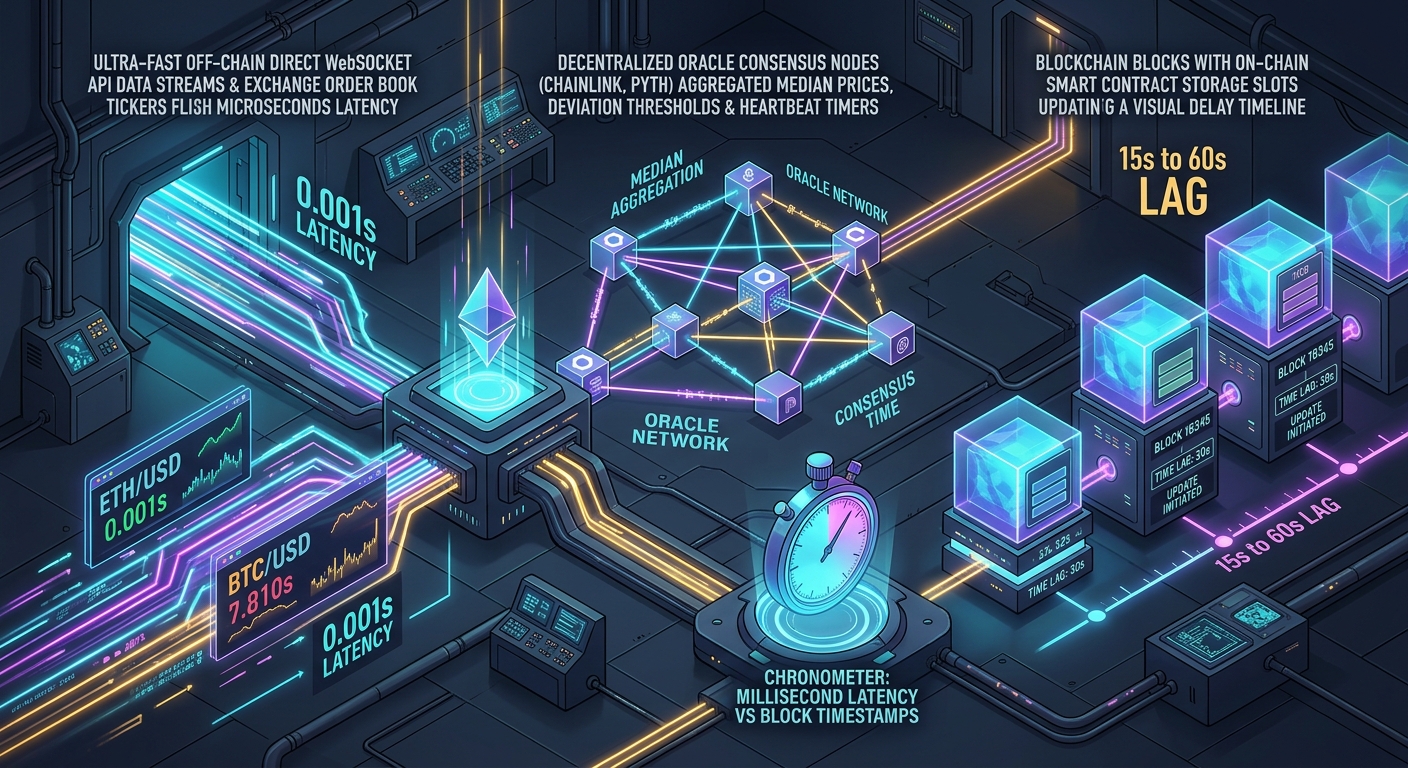
If you open a high-frequency trading terminal connected directly to Binance, Coinbase, and Bybit, you will see a relentless, blazing stream of thousands of price ticks per second.
Now, look at the price stored inside an Ethereum lending smart contract like Aave or a decentralized options vault.
That on-chain number might not have updated in forty-seven minutes.
Why does this massive latency chasm exist? Why can’t blockchains simply "listen" to live real-world prices the same way a browser or trading app does?
And more importantly: What is the exact lag time between an off-chain price event and its on-chain reflection—and how do quantitative traders exploit that window?
In this forensic deep dive, we unpack the mechanics of price feeds, compare the physical latency of WebSockets against blockchain oracles, and examine the high-stakes game of oracle latency arbitrage.
1. The Core Dilemma: The Blockchain Oracle Problem
Blockchains are deterministic state machines. By cryptographic design, a smart contract running on Ethereum or Solana has no internet connection, cannot make HTTP requests, and cannot open a WebSocket connection to an exchange.
[ THE ORACLE LATENCY PIPELINE ]

  OFF-CHAIN REALITY (5ms - 50ms)           ON-CHAIN SMART CONTRACT (500ms - 3600s)
  ┌──────────────────────────────┐        ┌──────────────────────────────┐
  │ 1. Spot Exchange Matching    │        │ 4. Off-Chain Consensus (OCR) │
  │    Engine (Binance/Coinbase) │        │    21+ Nodes Sign Median     │
  │              │               │        │              │               │
  │ 2. Direct WebSocket Feed     │───────►│ 5. Mempool Transaction Push  │
  │    (5ms - 30ms latency)      │        │              │               │
  │              │               │        │ 6. Block Inclusion & State   │
  │ 3. Market Maker Order Books  │        │    Storage Write (SSTORE)    │
  └──────────────────────────────┘        └──────────────────────────────┘
To get off-chain data onto a blockchain, a privileged external entity (an Oracle Node) must format the price into a transaction, sign it with a private key, pay a network gas fee, broadcast it to the mempool, and wait for validators to pack it into a finalized block.
Every single step in that pipeline adds physical, cryptographic, and economic latency.
2. The 3 Physical Causes of On-Chain Feed Lag
Why don’t oracle networks update smart contracts on every single price tick? The constraint is not technological—it is economic and consensus-driven:
[ THE 3 LATENCY DRIVERS ]

  1. THE GAS COST OF STORAGE WRITES (SSTORE)
     • Writing a new price to Ethereum storage costs ~20,000 gas (~$15 to $50).
     • Pushing every tick (10,000/sec) would cost $300,000,000 per day in gas!

  2. DEVIATION THRESHOLDS & HEARTBEAT TIMERS
     • Feeds only update if price moves by >0.5% (Deviation Threshold),
       OR if 3,600 seconds (1 hour) elapse without deviation (Heartbeat).

  3. MULTI-NODE CONSENSUS ROUND-TRIPS (OCR)
     • 21+ independent nodes across the world must query exchanges, generate
       signatures, and reach Byzantine Fault Tolerant threshold consensus.
1. The Storage Cost Barrier
On Ethereum Layer-1, modifying an on-chain storage variable via the SSTORE opcode consumes approximately 20,000 gas.
If an oracle pushed every millisecond price tick from Binance, it would consume 100% of Ethereum's block space and cost hundreds of millions of dollars in transaction fees every day.
2. Deviation Thresholds & Heartbeats
To make gas costs economically viable, legacy push oracles (like Chainlink Price Feeds) use Deviation Parameters:
3. Threshold Cryptography & Consensus Rounds
Oracles cannot rely on a single server. Chainlink's Off-Chain Reporting (OCR) protocol requires a decentralized committee of 21+ independent node operators (such as T-Systems, Deutsche Telekom, and Swisscom) to fetch prices, sign cryptographic payloads, and aggregate a median signature before broadcasting.
3. Quantitative Latency Benchmark: Off-Chain vs. On-Chain Feeds
The following matrix benchmarks the real-world latency across every major tier of cryptocurrency price delivery:
| Feed Architecture | Type | Typical Latency | Primary Use Case | Staleness Risk |
|---|---|---|---|---|
| Direct Exchange WebSocket | Off-Chain | 5 ms – 30 ms | High-Frequency CEX Market Making | Zero (Sub-second real-time) |
| Aggregated Market API (CCXT) | Off-Chain | 50 ms – 250 ms | Cross-Exchange Arbitrage Bots | Extremely Low |
| Pyth Network (Pull Oracle) | High-Speed On-Chain | 400 ms – 1,200 ms | Perpetual DEXs (Drift, Hyperliquid) | Low (Updated on-demand per trade) |
| Chainlink Data Streams | Low-Latency Push/Pull | 500 ms – 2,000 ms | Next-Gen Lending & Perps | Low |
| Chainlink Classic (Arbitrum/Optimism L2) | Push (0.1% / 0.5% Deviation) | 10 s – 60 s | L2 Lending Protocols (Aave, Radiant) | Moderate during rapid flash moves |
| Chainlink Classic (Ethereum L1) | Push (0.5% Deviation / 1h Heartbeat) | 1 min – 60 mins | L1 Collateralized Debt (MakerDAO, Aave) | High during low-volatility drift |
| Uniswap v3 TWAP Oracle (30-min window) | On-Chain AMM Geometric Mean | 30 Minutes (Fixed Lag) | Manipulation-Resistant Lending | Very High (Intentionally delayed) |
4. Push vs. Pull Oracles: The Architectural Revolution
The blockchain industry is undergoing a massive shift from Push Oracles to Pull Oracles to eliminate latency lag:
[ PUSH vs. PULL ORACLE ARCHITECTURE ]

  PUSH ORACLE (Legacy Model - Chainlink Classic):
  Node Network ──► Pays Gas ──► Continuously Writes to On-Chain Storage ──► User Reads Storage
  (Result: Expensive, updates only on >0.5% deviation, introduces 10s to 1hr lag.)

  PULL ORACLE (Modern Model - Pyth Network / RedStone):
  Node Network ──► Publishes Signed Off-Chain Cryptographic Price Attestation (~400ms)
  User Transaction ──► Attaches Signed Price Payload + Trade Action in ONE Transaction
  (Result: 0 latency lag, smart contract verifies signature on-chain instantly!)
In a Pull Oracle (On-Demand Oracle), the protocol does not pay to keep a storage slot updated 24/7.
Instead, when a trader opens a perpetual swap or liquidates a loan, their own wallet fetches the latest sub-second cryptographic price certificate from off-chain validator nodes and submits it directly inside the execution transaction.
The smart contract validates the cryptographic signature and executes the trade using a price that is less than 1 second old.
5. High-Stakes Case Studies: When Oracle Lag Causes Chaos
When on-chain price feeds lag behind off-chain reality, the consequences can be catastrophic:
Case Study 1: The GMX Avalanche AVAX Oracle Arbitrage (2022)
In September 2022, GMX operated a zero-slippage decentralized perpetual exchange on Avalanche that priced trades using a Chainlink push oracle with a 5-second to 15-second latency delay.
A quantitative trader noticed that whenever AVAX made a violent $0.50 price jump on Binance, the GMX smart contract was still quoting the old price for another 8 seconds.
The trader executed massive $5,000,000 long positions on GMX at the stale lower price, waited 8 seconds for the Chainlink oracle to update to the new higher price, and closed the position with guaranteed zero-slippage profit.
The trader extracted over $565,000 in risk-free profits directly from the GMX liquidity pool before the protocol modified its execution rules.
Case Study 2: MakerDAO / Compound Flash Crash Bad Debt
During extreme market flash crashes (such as March 12, 2020), Ethereum gas prices spiked to 500+ Gwei, causing transactions to sit unconfirmed in the mempool for 30 minutes.
Off-chain crypto prices dropped 40%, but on-chain oracle transactions could not get mined.
By the time the oracle updates finally landed on-chain, collateral debt positions had fallen far below the 100% liquidation threshold, leaving decentralized lending protocols with millions of dollars in unbacked bad debt.
6. Quantitative Takeaways & Execution Rules
When evaluating price data for trading, arbitrage, or DeFi protocol design, keep these core principles in mind: