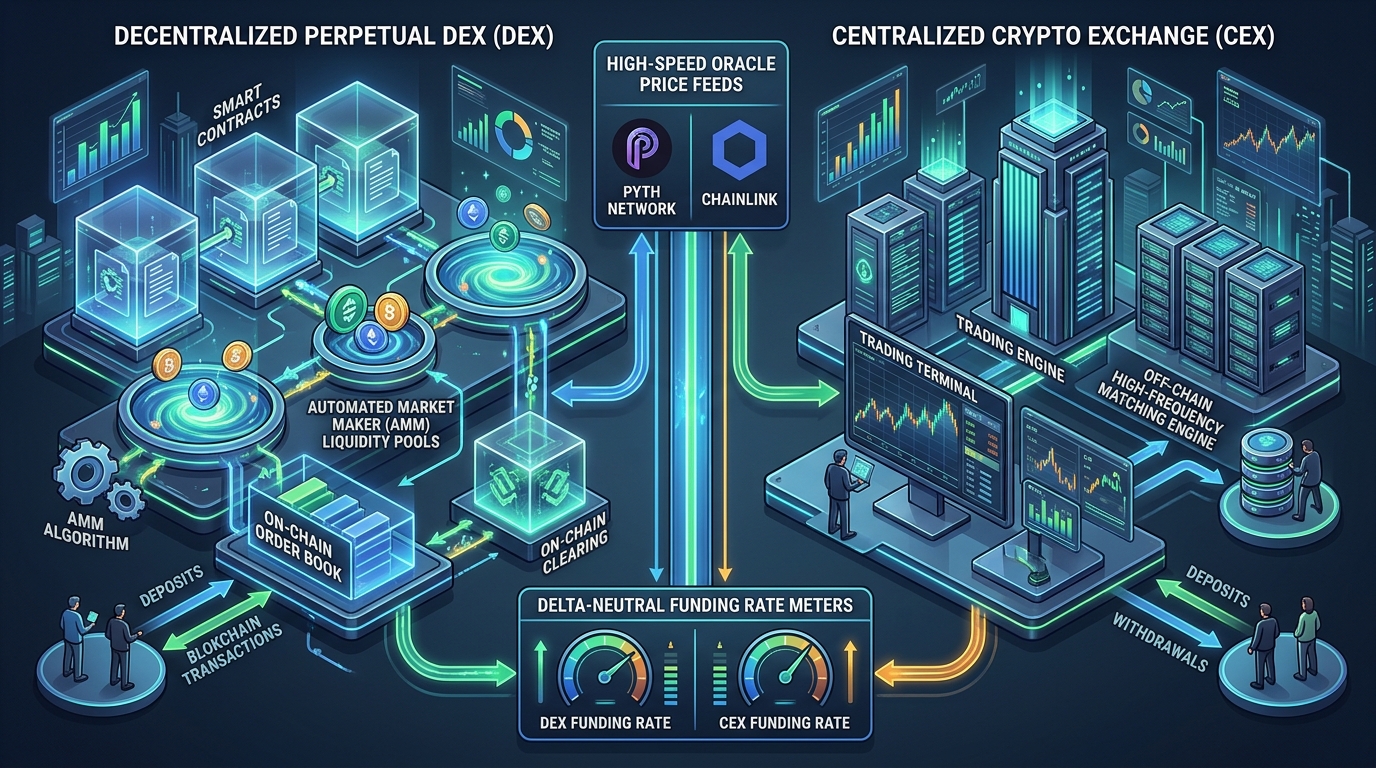
In traditional finance, derivative contracts operate with fixed expiration dates—settling monthly or quarterly through physical delivery or cash settlement.
In cryptocurrency, however, the overwhelming majority of trading activity takes place in Perpetual Futures (Perps): contracts that never expire, allowing traders to hold leveraged long or short positions indefinitely.
To prevent the perpetual contract’s price from drifting endlessly away from the underlying spot asset, crypto exchanges utilize an elegant economic mechanism known as the Funding Rate.
When the perpetual contract trades at a premium to spot (bullish sentiment), longs pay shorts a periodic fee. When perps trade at a discount (bearish sentiment), shorts pay longs. In recent years, the explosive growth of high-performance decentralized perpetual platforms—most notably Hyperliquid, dYdX v4, GMX v2, and Jupiter—has created a multi-billion dollar decentralized derivatives market that trades side-by-side with centralized titans like Binance, OKX, and Bybit.
Yet, because these platforms utilize fundamentally different matching engines, settlement latency rules, and oracle architectures, funding rates on the same asset regularly diverge by 20% to 80% annualized. For quantitative desks, this divergence represents one of the most profitable delta-neutral cash-and-carry frontiers in digital assets.
In this exhaustive master guide, we break down the mechanics of cross-venue perpetual trading, analyze oracle latency dynamics, and present an institutional execution blueprint for funding rate arbitrage.
1. Centralized vs. Decentralized Perp Microstructure
To exploit cross-exchange derivative spreads, one must understand how order matching and price discovery function across architectures:
- Centralized Exchanges (CEX CLOBs): Platforms like Binance and Bybit run off-chain Central Limit Order Books (CLOBs) deployed in collocated financial data centers (Tokyo and Dublin). They process millions of orders per second with execution latencies under 5 milliseconds. Price discovery happens purely through participant order matching.
- Decentralized Perpetual Exchanges (Perp DEXs): Protocols like Hyperliquid and dYdX operate custom Layer-1 consensus engines built specifically for trading, achieving sub-second block times. Other platforms, like GMX v2, utilize pooled liquidity models (virtual AMMs) where trades execute against a liquidity pool at the current oracle index price.
2. The Mathematical Formula of Funding Rates
The funding rate is calculated periodically (typically every 8 hours on CEXs, or continuously every hour/second on DEXs) and consists of two core components:
Funding Rate (F) = Premium Index (P) + clamp\big(Interest Rate (I) - P,\, -0.05%,\, +0.05%\big)
Where the Premium Index (P) measures the percentage deviation between the perpetual contract price ($P_{\text{perp}}$) and the underlying spot index price ($P_{\text{spot}}$):
P = \frac{P_{perp} - P_{spot}}{P_{spot}}
When enthusiastic retail traders heavily leverage long positions on a decentralized platform like Hyperliquid, the DEX’s premium index spikes, driving the funding rate to +0.05% per hour (equivalent to +438% annualized). Meanwhile, institutional market makers on Binance may keep the Binance funding rate at a modest +0.01% per 8 hours (+10.9% annualized).
3. Delta-Neutral Funding Rate Basis Arbitrage Execution
When a wide funding rate disparity opens between two venues, an arbitrageur can capture the yield differential with zero directional price exposure:
[ THE DELTA-NEUTRAL CROSS-VENUE CASH & CARRY SPREAD ]

  SCENARIO:
  • Asset: Solana (SOL)
  • Hyperliquid SOL Perp Funding Rate: +45.0% Annualized (Longs Pay Shorts heavily)
  • Binance SOL Perp Funding Rate:       +10.0% Annualized (Longs Pay Shorts modestly)

  EXECUTION BLUEPRINT:
  1. SHORT $100,000 SOL on Hyperliquid Perp (Collect +45.0% APR from longs).
  2. LONG  $100,000 SOL on Binance Perp      (Pay -10.0% APR to shorts).

  DELTA STATUS:
  • Directional Exposure: Net Delta = $0 (Completely Market Neutral).
  • Gross Cash-Flow Yield: +45.0% - 10.0% = +35.0% Net Annualized Yield.
  • Daily Dollar Return: $100,000 × (35.0% / 365) = ~$95.89 per day in pure cash carry.
If Solana’s price doubles or drops by 50%, the gains on one exchange precisely offset the losses on the other. As long as the funding rate differential persists, the desk collects daily cash flow.
4. Oracle Latency & Price Feed Disconnects
On decentralized perpetual exchanges that rely on external oracle feeds (such as GMX or synthetic perp protocols), price discovery does not happen on the platform itself—it is imported from external exchanges via oracle providers like Pyth Network or Chainlink.
This introduces Oracle Latency Arbitrage vectors:
- When Bitcoin drops violently by $1,000 in 2 seconds on Binance, the on-chain oracle feed may take 3 to 10 seconds to submit and confirm its price update transaction on the blockchain.
- During those few seconds, the price quoted on the decentralized perp exchange is stale (higher than the real-world market price).
- High-frequency bots detect this lag, opening short positions against the stale on-chain price and closing them the instant the oracle updates, locking in immediate profits.
Modern DEXs mitigate this with dynamic price impact fees and pull-based oracles (such as Pyth’s low-latency on-demand attestation model), yet minor cross-market basis spreads during peak network volatility remain widespread.
5. Managing Liquidation and Margin Risks
While delta-neutral basis trading eliminates directional exposure, it introduces cross-margin liquidation risk that must be rigorously managed:
- Divergence of Unrealized PnL: If the underlying asset surges 100%, the short leg on Hyperliquid will accrue heavy unrealized losses while the long leg on Binance will accrue identical unrealized gains. If the trader does not actively transfer capital to rebalance margin buffers, the short leg risks liquidation.
- Borrow Rate Spikes: On pooled DEXs (like GMX), traders pay a separate borrowing fee that fluctuates with pool utilization. If utilization reaches 95%, the borrow fee can exceed the funding yield.
- De-Pegging of Margin Collateral: If a trader uses liquid staked tokens (e.g. stETH or kstSOL) as collateral on one exchange, any temporary discount on that asset can trigger premature margin calls.
6. Quantitative Strategy: Optimizing the Trade
- Screen for Real-Time Price & Basis Gaps: Use our Live Arbitrage Scanner to spot cross-exchange price leads and perpetual basis divergence across top crypto pairs.
- Calculate Net Break-Even Holding Periods: Input exchange maker/taker fees, funding intervals, and rebalancing costs into our Profit & Break-Even Calculator to calculate your exact breakeven duration.
- Monitor Depth Ladders: Check order book resilience across major spot and derivative hubs using our Ethereum Order Book Depth monitor before executing large sizing.