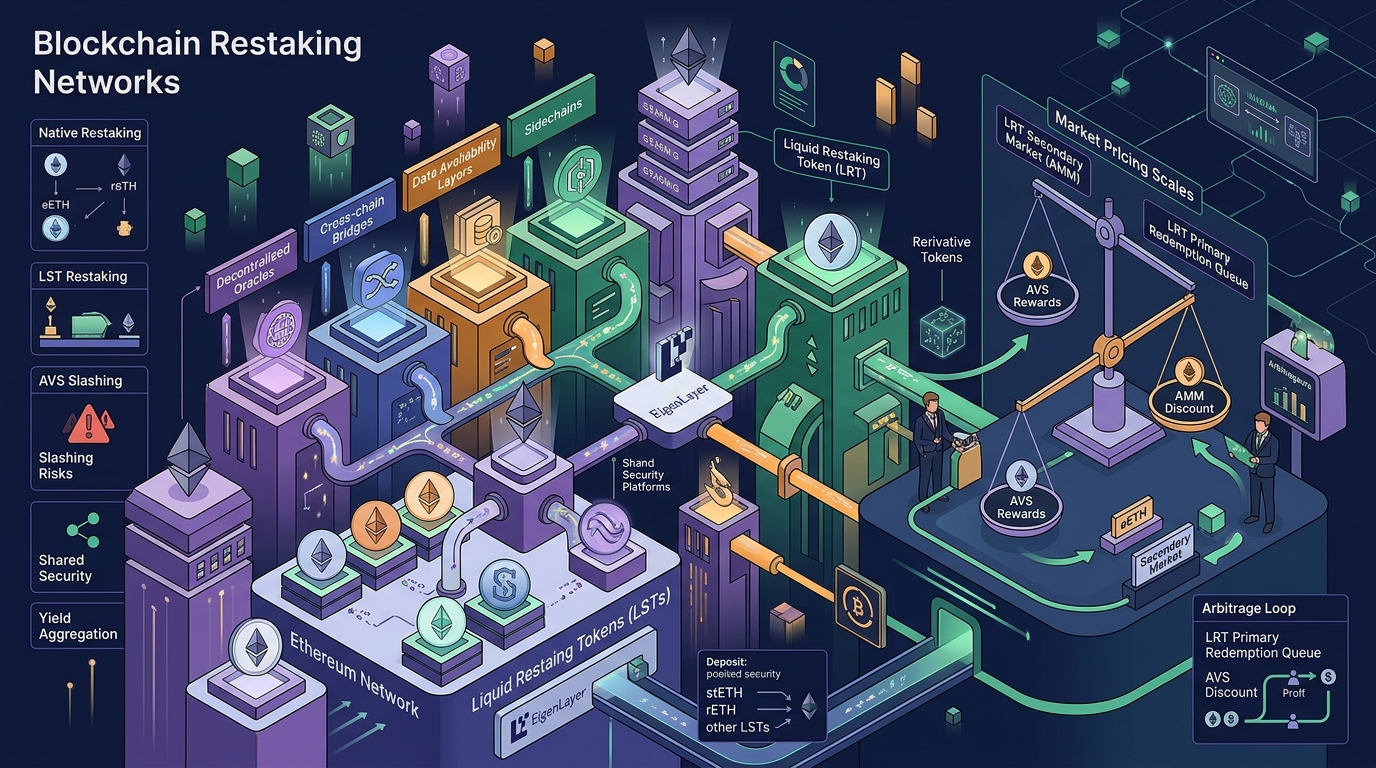
When Ethereum transitioned to Proof-of-Stake in 2022, it established the most economically secure decentralized validator set in existence—with over $100 billion in capital actively securing the consensus layer.
Yet for years, any new blockchain protocol requiring decentralized validation—such as an oracle network, a cross-chain bridge, a sequencer network, or a zero-knowledge prover—had to bootstrap its own validator network from scratch by launching a new token, suffering extreme inflationary dilution and security vulnerabilities.
The emergence of Restaking (spearheaded by EigenLayer, Symbiotic, and Karak) fundamentally altered this dynamic.
Restaking allows Ethereum validators and stakers to repurpose their staked ETH to secure secondary protocols—known as Actively Validated Services (AVS)—in exchange for additional validation fees. To prevent this capital from becoming illiquid, protocol developers created Liquid Restaking Tokens (LRTs), which issue liquid ERC-20 tokens representing the user’s underlying restaked position.
However, because LRTs combine multiple layers of smart contract wrapping, withdrawal queue delays, and speculative leverage on lending markets, LRT prices on decentralized secondary exchanges regularly decouple from their underlying 1:1 ETH value during market stress.
In this master guide, we explore the mechanical architecture of restaking, analyze why LRT liquidity de-pegs occur, and explain how quantitative traders capture annualized returns exceeding 40% through systematic redemption arbitrage.
1. The Cryptoeconomic Architecture of Restaking
How does restaking repurpose Ethereum’s consensus security without requiring validators to sell or unbond their ETH?
Restaking works by altering the validator’s withdrawal credentials on the Ethereum Beacon Chain:
- A validator sets their withdrawal address to point to an EigenLayer smart contract (an EigenPod).
- The validator agrees to follow additional validation rules for specific Actively Validated Services (such as data availability networks or coprocessors).
- If the validator acts maliciously on the AVS (for instance, by withholding data or signing invalid state transitions), the AVS smart contract triggers a slashing condition that burns a portion of the validator’s underlying staked ETH.
- In return for bearing this additional slashing risk, the validator receives staking rewards from both the Ethereum base layer and the individual AVS networks.
2. The Liquid Restaking Token (LRT) Supply Chain
Because native restaking requires operating a full 32-ETH validator node and managing complex AVS operator software, retail and DeFi investors use Liquid Restaking Protocols (such as ether.fi (eETH), Renzo (ezETH), Kelp DAO (rsETH), and Swell (rswETH)).
[ THE LIQUID RESTAKING PROTOCOL SUPPLY CHAIN ]

     USER DEPOSITS ETH / stETH
                 │
                 ▼
  [ LIQUID RESTAKING PROTOCOL ] ──► MINTS 1:1 LIQUID RESTAKING TOKEN (e.g. ezETH)
                 │
     ┌───────────┴───────────┐
     ▼                       ▼
  STAKE ON BEACON CHAIN   RESTAKE ON EIGENLAYER / SYMBIOTIC
  (Base 3.0% Consensus)   (Delegate to AVS Node Operators for +3.5% AVS Yield)
The minted LRT is fully liquid and can be deployed across decentralized finance: used as collateral on money markets (Aave, Morpho, Spark), paired in liquidity pools (Curve, Uniswap), or leveraged through yield-looping strategies.
3. Why LRT Secondary Market De-Pegs Occur
Under normal market conditions, an LRT trades at a tight 1:1 parity with spot ETH (or slightly higher if it is a value-accruing token). However, during violent market downturns or leverage unwinds, severe secondary market de-pegs occur due to three structural factors:
- DeFi Lending Liquidation Cascades (Looping Unwinds): Many aggressive traders deposit ezETH on Morpho or Aave, borrow spot ETH, deposit it back into the LRT protocol, and repeat the loop 5 to 10 times to multiply their yield and airdrop points. When ETH drops rapidly, these leveraged positions hit their liquidation thresholds. Automated liquidation bots seize the ezETH collateral and dump it immediately into decentralized AMM pools (Curve and Uniswap), causing the secondary price to collapse.
- Withdrawal Queue Latency: When panic strikes, traders cannot instantly redeem their LRT for native ETH from the protocol. They must enter a multi-tiered withdrawal queue: waiting for the protocol’s internal unbonding buffer (3 to 7 days) plus the Ethereum Beacon Chain validator exit queue (which can stretch to several weeks during mass unstaking).
- Asymmetric AMM Pool Depletion: As retail users rush to exit through secondary DEX pools, the pools run completely out of paired ETH liquidity, forcing the LRT price down to 0.94 to 0.98 ETH (a 2.0% to 6.0% discount).
4. Case Study: The Great ezETH De-Peg of April 2024
In April 2024, following the conclusion of a major points campaign, Renzo Protocol opened its governance token claim while maintaining an uncompleted native withdrawal queue contract.
- Within hours, thousands of users attempted to exit their ezETH positions simultaneously through secondary DEX markets.
- Liquidity on Curve and Balancer was instantly depleted.
- The secondary price of ezETH plummeted to 0.91 ETH on Uniswap and dipped to 0.68 ETH on decentralized lending markets before liquidators stepped in.
- Arbitrageurs who bought ezETH at a 5% to 9% discount and waited for the native redemption contract to open captured guaranteed double-digit returns in under three weeks.
5. The Quantitative Playbook for LRT Redemption Arbitrage
For institutional and quantitative traders with risk capital, secondary LRT discounts present a highly profitable, mathematically modeled arbitrage opportunity:
[ THE LRT REDEMPTION ARBITRAGE BLUEPRINT ]

  1. IDENTIFY DISLOCATION:
     ezETH trades on Curve at 0.965 ETH (a -3.50% discount to primary NAV).

  2. CAPITAL ALLOCATION:
     • Buy 100 ezETH on Curve for 96.50 ETH.
     • Lock in the discounted entry price.

  3. SUBMIT PRIMARY UNSTAKING REDEMPTION:
     • Initiate official unstaking request on the Renzo / ether.fi protocol interface.
     • The protocol guarantees 1:1 redemption of 100.00 ETH upon queue completion.

  4. HEDGING ETH VOLATILITY (Optional Delta-Neutral Leg):
     • If the trader does not want exposure to Ethereum’s price drop during the 7-day queue,
       short 100 ETH on Binance Perps or Hyperliquid.

  5. SETTLEMENT & PROFIT REALIZATION:
     • After 7 days, protocol disburses 100.00 native ETH.
     • Close the short hedge on Binance.
     • Net Profit: +3.50 ETH (+3.63% absolute return in 7 days = ~189% Annualized APR).
6. Assessing Structural Risks Before Entering
| Risk Vector | Impact on Trade | Risk Mitigation |
|---|---|---|
| Operator Slashing Risk | If a delegated AVS operator is slashed during the unstaking period, the principal ETH balance is reduced | Diversify across multi-operator protocols with audited slashing protection |
| Extended Queue Delay | If thousands of validators exit simultaneously, the Beacon Chain queue can extend from 7 days to 25+ days, lowering annualized yield | Model annualized returns across multiple queue duration scenarios (7d, 14d, 30d) |
| Smart Contract Exploit | An exploit in the LRT redemption contract during the queue could freeze funds | Restrict trades to top-tier protocols with multiple Tier-1 audits and active bug bounties |
7. Execution Tools & Next Steps
- Track Real-Time Token Spreads: Use our Live Arbitrage Scanner to spot live price differentials between synthetic staking assets and spot order books.
- Calculate Net APR After Queue Delays: Model holding durations, borrowing costs, and gas fees using our Profit & Break-Even Calculator.
- Monitor Ethereum Market Liquidity: Inspect order book depth and exchange resilience on our Ethereum Order Book Depth monitor before executing large secondary swaps.