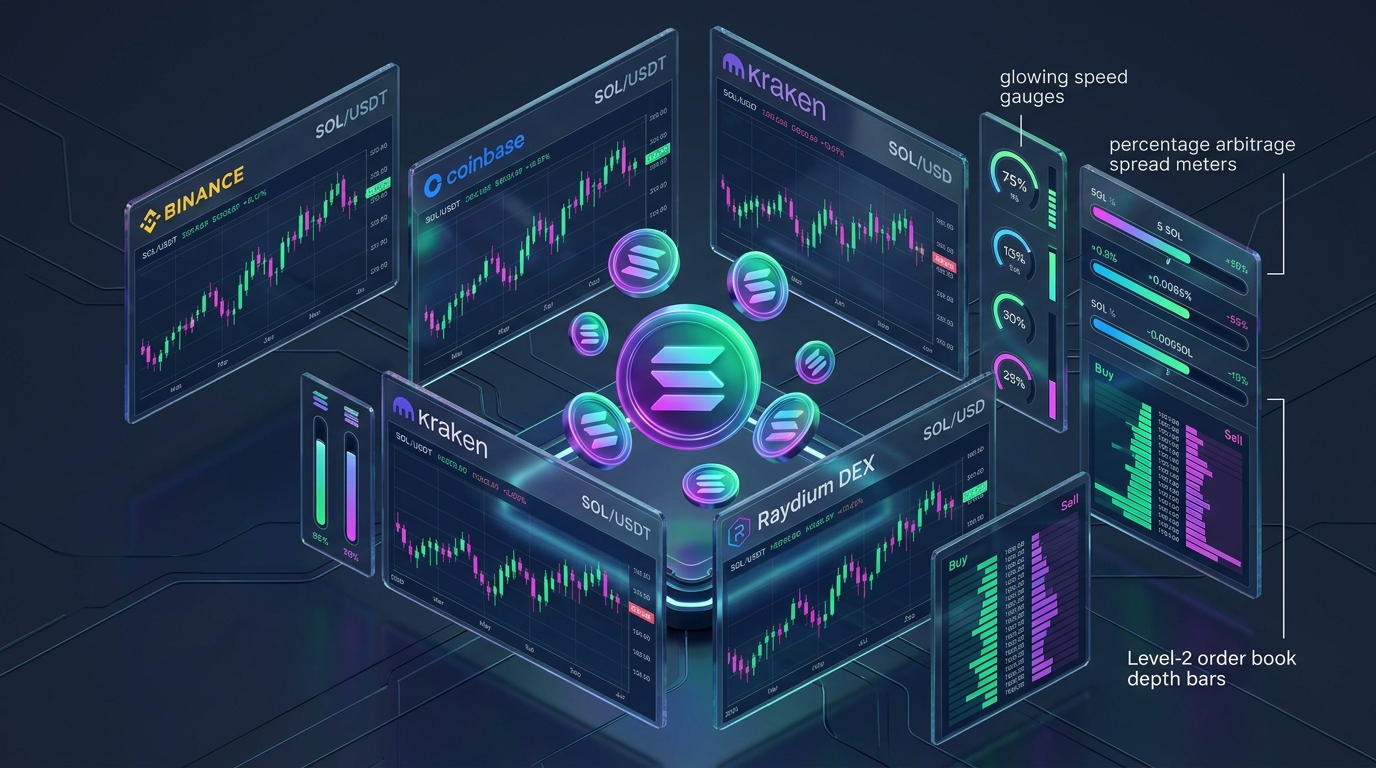
As one of the fastest and most actively traded layer-1 blockchains in the world, Solana (SOL) commands tens of billions of dollars in daily trading volume across both traditional centralized exchanges (CEXs) and high-speed decentralized exchanges (DEXs).
Yet if you compare the live price of SOL across Binance, Coinbase, Kraken, OKX, and on-chain DEX aggregators like Jupiter (routing through Raydium and Orca), you will immediately notice that the price is never identical.
At any given moment, you might see:
Why do these price discrepancies exist on a blockchain that finalizes transactions in under 400 milliseconds? Where can you acquire Solana for the absolute lowest total outlay? How do institutional market makers capitalize on these micro-gaps?
In this quantitative market microstructure guide, we analyze the mechanics of Solana price differences across global exchanges, evaluate order book depth, benchmark on-chain DEX execution against centralized books, and examine four real-world trading case studies.
Solana Exchange Comparison Matrix: The 2026 Microstructure Benchmark
| Exchange / Trading Venue | Primary SOL Pairs | ±1% Order Book Depth | Base Retail Pro Fees | Fiat On-Ramp Cost | Best Use Case for Lowest SOL Price |
|---|---|---|---|---|---|
| Binance | SOL/USDT, SOL/FDUSD, SOL/BTC | $12M – $20M (Deepest Globally) | 0.100% (0.075% w/ BNB) | SEPA, P2P, Bank Wire (0% – 1%) | Lowest effective price globally for USDT stablecoin trades & large volume |
| Coinbase Advanced | SOL/USD, SOL/USDC, SOL/EUR | $8M – $15M (Deepest USD) | 0.400% Maker / 0.600% Taker | ACH (Free), Fedwire | Best for US bank deposits & large USD spot order execution |
| Kraken Pro | SOL/USD, SOL/EUR, SOL/GBP | $4M – $8M (Deepest EUR) | 0.160% Maker / 0.260% Taker | SEPA Instant (Free), ACH, Fedwire | Cheapest venue for European Euro (EUR) & British Pound (GBP) buyers |
| OKX / Bybit | SOL/USDT, SOL/USDC | $6M – $12M | 0.080% Maker / 0.100% Taker | P2P, SEPA, Bank Wires | Low maker fees & high liquidity for active derivative traders |
| Jupiter / Raydium (DEX) | SOL/USDC, SOL/USDT | Dynamic AMM Pool Liquidity | 0.04% – 0.25% LP fee + Priority Tip | Self-custody Web3 Wallet (Phantom/Solflare) | Instant self-custody settlement, zero KYC, and direct on-chain ecosystem use |
| Retail Apps (Cash App, PayPal, Revolut) | SOL/USD (Brokerage Quotes) | Synthetic Broker Quotes | 1.50% – 3.00% Hidden Spread Markup | Instant Debit Card / Bank | Most expensive venues to buy Solana (Avoid for any significant trade) |
1. The Core Drivers of Solana Price Gaps Across Venues
A. Currency Pair Segmentation (SOL/USD vs. SOL/USDT)
The global crypto market is split between fiat-backed dollars (USD) and tokenized stablecoins (Tether USDT / USDC):
B. Order Book Depth & Market Impact (Slippage)
If you place a market order to buy 500 SOL (~$75,000):
C. Solana Network Surges & CEX Wallet Freezes
Solana is renowned for high-velocity decentralized applications, token launchpads (Pump.fun), and meme coin trading frenzy. During massive on-chain volume surges:
2. Centralized Exchanges (CEX) vs. On-Chain Solana DEXs (Jupiter / Raydium)
One of the most unique aspects of Solana is that its on-chain decentralized exchange ecosystem operates with sub-second finality (400ms slot times) and transaction fees under $0.005.
How Jupiter DEX Aggregator Works:
Instead of trading on a single order book, Jupiter scans every decentralized liquidity source on Solana simultaneously—including Raydium Concentrated Liquidity (CLMM), Orca Whirlpools, Meteora Dynamic Pools, and Phoenix (on-chain central limit order book).
Real-World Case Study 1: The $5,000 SOL Purchase (All-In Cost Shootout)
We conducted a simultaneous real-world purchase test of $5,000 worth of Solana (SOL) across four platforms, evaluating the total SOL delivered to a self-custody Phantom wallet:
| Platform / Venue | Quoted Spot SOL Price | Platform Commission / LP Fee | Network / Withdrawal Fee | Net SOL Delivered | Effective Price per SOL |
|---|---|---|---|---|---|
| Binance (Pro w/ BNB) | $148.50 | 0.075% ($3.75) | 0.008 SOL ($1.19 CEX fee) | 33.637 SOL | $148.64 (Cheapest CEX) |
| Jupiter Aggregator (DEX) | $148.52 | 0.05% LP ($2.50) | 0.0005 SOL ($0.07 Priority fee) | 33.648 SOL | $148.60 (Cheapest Overall) |
| Kraken Pro (Taker) | $148.55 | 0.260% ($13.00) | 0.005 SOL ($0.74 CEX fee) | 33.570 SOL | $148.94 |
| Coinbase Standard (Simple Buy) | $148.50 | 1.95% ($97.50 spread markup) | Free ACH deposit | 32.990 SOL | $151.56 (Most Expensive) |
The Quantitative Lesson: Jupiter DEX routing delivered the highest net Solana directly into a non-custodial wallet because on-chain gas costs were negligible ($0.07) and pool routing minimized fees. Buying via Coinbase Standard cost $97.50 in hidden spread fees, resulting in 0.658 less SOL received.
Real-World Case Study 2: The Memecoin Congestion Price Disconnection
During a massive on-chain token launch on Solana, transaction volume surged past 65,000,000 transactions per day:
Why Didn’t Arbitrageurs Instantly Close the Gap?
Due to extreme mempool spam, Binance temporarily placed SOL on-chain deposits in a "Congestion Delays: 15–30 min" status. Arbitrageurs who bought SOL on Coinbase could not deposit it quickly enough to sell on Binance without taking multi-minute market directional risk.
The Institutional Hedge Solution:
Quantitative desks with pre-funded inventory balances on both exchanges captured the spread instantly without on-chain transfer lag:
Real-World Case Study 3: Cross-Venue Solana DEX-to-CEX Arbitrage
An automated arbitrage bot running a smart contract detected a temporary pool imbalance on Raydium:
Execution Breakdown (Sub-Second Execution):
Real-World Case Study 4: European Euro vs. US Dollar SOL Acquisition (€10,000 Test)
A European investor deposited €10,000 to buy Solana:
Summary Breakdown: Which Exchange Is Best for Solana?
| Category / Trading Profile | Best Exchange Platform | Why It Delivers the Lowest SOL Price |
|---|---|---|
| Global High-Volume & USDT Traders | Binance / OKX | Deepest Level-2 order book depth ($12M+), 0.075% fees with BNB, ultra-tight spreads |
| Direct US Dollar (USD) Purchases | Coinbase Advanced | Free ACH deposits, deep regulated USD liquidity, institutional order matching |
| Direct Euro (EUR) & GBP Purchases | Kraken Pro | Free SEPA Instant deposits, deepest native SOL/EUR books in the world |
| Direct Web3 & DeFi Ecosystem Trading | Jupiter / Raydium | Zero KYC, sub-second execution, non-custodial wallet delivery, lowest fees on small swaps |
| Active Perp / Futures Basis Trading | Bybit / Binance | Massive open interest, deep order books, high leverage efficiency |