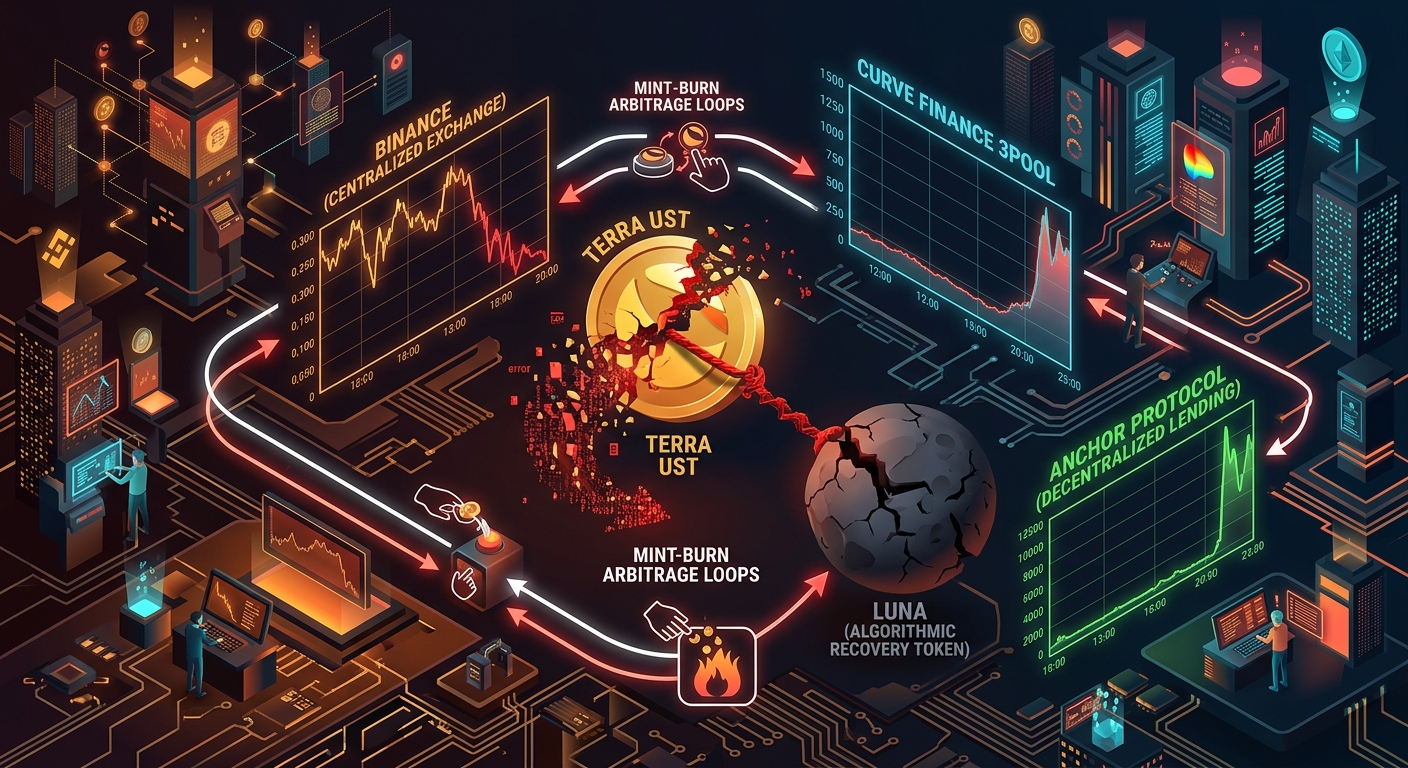
In the entire history of digital finance, no collapse was faster, more catastrophic, or more mathematically predictable than the May 2022 implosion of Terra (UST) and LUNA.
Over the course of just four days, a top-10 global cryptocurrency ecosystem boasting $45 billion in market capitalization disintegrated to zero, sparking an industry-wide credit crisis.
To the general public, the event seemed like an unpredictable black swan.
To quantitative market makers and microstructure analysts, however, the order books and cross-exchange price gaps were screaming red alerts days before the final crash.
Long before the mainstream financial press reported the depeg, the widening spread between Curve Finance, Binance, and the on-chain Terra Station minting portal revealed the fatal mathematical contradiction at the heart of the algorithmic peg.
In this forensic case study, we reconstruct the hour-by-hour market microstructure of the Terra collapse, examine the mechanics of the algorithmic death spiral, and unpack what cross-exchange price discrepancies reveal during systemic financial panics.
1. The Algorithmic Engine: How the Peg Was Supposed to Work
Unlike fiat-backed stablecoins (such as USDC or USDT) backed by real US dollars in commercial bank accounts, TerraUSD (UST) was an algorithmic stablecoin maintained purely by programmatic arbitrage incentives:
[ THE THEORETICAL TERRA/LUNA ARBITRAGE MECHANISM ]

SCENARIO A: UST Trades at a Premium ($1.02 on Binance)
  1. Arbitrageur buys $1.00 worth of LUNA on the open market.
  2. Arbitrageur sends LUNA to the Terra protocol smart contract to "burn" it.
  3. Protocol mints 1 new UST.
  4. Arbitrageur sells the 1 UST on Binance for $1.02.
  5. Profit: +$0.02 (Supply of UST increases -> Price falls back to $1.00).

SCENARIO B: UST Trades at a Discount ($0.98 on Binance)
  1. Arbitrageur buys 1 UST on Binance for $0.98.
  2. Arbitrageur sends 1 UST to the Terra protocol to "burn" it.
  3. Protocol mints $1.00 worth of brand-new LUNA tokens.
  4. Arbitrageur sells the LUNA on Binance for $1.00.
  5. Profit: +$0.02 (Supply of UST decreases -> Price rises back to $1.00).
The entire $18 billion UST market relied on a single heroic assumption: That the market cap and liquidity of LUNA would always be large enough to absorb unlimited UST redemptions without causing LUNA to crash faster than arbitrageurs could sell it.
2. The First Crack: The Curve 3pool Liquidity Drain (May 7, 2022)
The initial tremor began on a Saturday night (May 7, 2022).
Terraform Labs withdrew $150 million of UST from the Curve Finance UST/3Crv pool as part of a planned migration to a new 4pool. Minutes later, an unknown whale address dumped 85 million UST into the now-thinned Curve pool, swapping it for USDC and USDT.
[ CURVE 3POOL LIQUIDITY RATIO COLLAPSE ]

Normal Healthy State:     50% UST  /  50% Real 3Crv (USDC/USDT/DAI)
After $85M Dump:          85% UST  /  15% Real 3Crv
May 9 Panic State:        96% UST  /   4% Real 3Crv (Complete Pool Drain)
Within minutes, the price of UST on Curve dipped from $1.000 to $0.985.
While a 1.5% discount sounds minor, on a decentralized automated market maker (AMM), a 1.5% price gap in a stablecoin pool signifies a catastrophic collapse in real collateral. The pool was now stuffed with unbacked UST while real dollars had been drained.
3. The On-Chain Bottleneck: Why Arbitrage Failed
As UST dropped to $0.95 and then $0.85 on centralized exchanges, thousands of retail traders and bots attempted to execute the textbook arbitrage: buy UST at $0.85 on Binance, burn it on-chain, and sell the resulting $1.00 of LUNA.
They immediately ran into the protocol's fatal architectural limitation: the BasePool Minting Cap.
To prevent flash-loan attacks, the Terra protocol capped the maximum amount of UST that could be burned for LUNA to roughly $293 million per day.
[ THE CAPACITY MISMATCH: IMMINENT RUN ON THE BANK ]

UST Panic Selling Volume (Binance + Curve + Anchor):  >$4,500,000,000 / Day
Maximum On-Chain Protocol Arbitrage Capacity:          ~$293,000,000 / Day

Result: 93% of selling pressure COULD NOT be absorbed by the peg algorithm!
Because on-chain arbitrage capacity was capped at $293M, the remaining billions in panicked selling had nowhere to go except dumping directly into centralized exchange order books.
4. Cross-Exchange Price Divergence During the Freefall
Between May 9 and May 11, 2022, the global market fractured into disconnected pricing silos as blockchain latency and exchange withdrawal throttles broke parity:
| Date & Time | Anchor Protocol (Terra) | Curve Finance (DEX) | Binance Spot (CEX) | KuCoin Spot (CEX) | Peak Dislocation Spread |
|---|---|---|---|---|---|
| May 8, 12:00 UTC | $1.00 (Deposit par) | $0.985 | $0.992 | $0.994 | +0.9% (First peg stress) |
| May 9, 22:00 UTC | $0.92 (Collateral run) | $0.680 | $0.795 | $0.840 | +23.5% (Extreme Curve drain) |
| May 10, 16:00 UTC | $0.78 (Network stalled) | $0.420 | $0.550 | $0.610 | +45.2% (Cross-venue desync) |
| May 11, 14:00 UTC | $0.30 (Chain halted) | $0.180 | $0.220 | $0.260 | +44.4% (Hyperinflation phase) |
During this window, a trader looking at KuCoin saw UST at $0.84, while Curve quoted $0.68. However, anyone attempting to buy on Curve and transfer to KuCoin got stuck in a 14-hour Terra blockchain mempool backlog.
5. The "Phantom Arbitrage" Death Trap
The most tragic victims of the crash were traders who thought they were executing a risk-free 30% arbitrage:
[ THE PHANTOM ARBITRAGE DEATH SPIRAL ]

  1. Trader buys 100,000 UST on Binance at $0.70 (Cost: $70,000).
  2. Trader submits an on-chain transaction to burn 100,000 UST for $100,000 of LUNA.
  3. But burning 100,000 UST creates millions of new LUNA tokens, flooding the market.
  4. While the blockchain takes 45 minutes to process the batch, LUNA's price drops from $10.00 to $2.00 (-80%).
  5. The trader finally receives their LUNA, but it is now worth only $20,000 on Binance!
  6. Realized Outcome: Loss of -$50,000 (-71.4% Net Loss on a "Risk-Free" Arbitrage).
Because every UST burned minted exponential quantities of new LUNA, the total supply of LUNA hyperinflated from 340 million tokens to 6.5 trillion tokens in under 96 hours.
LUNA collapsed by 99.9999%, rendering the redemption backing completely worthless.
6. Microstructure Lessons for Modern Crypto Traders
The Terra/LUNA collapse taught quantitative trading desks essential rules for evaluating stablecoin stability and arbitrage spreads:
BasePool, oracle update latency, gas limits).