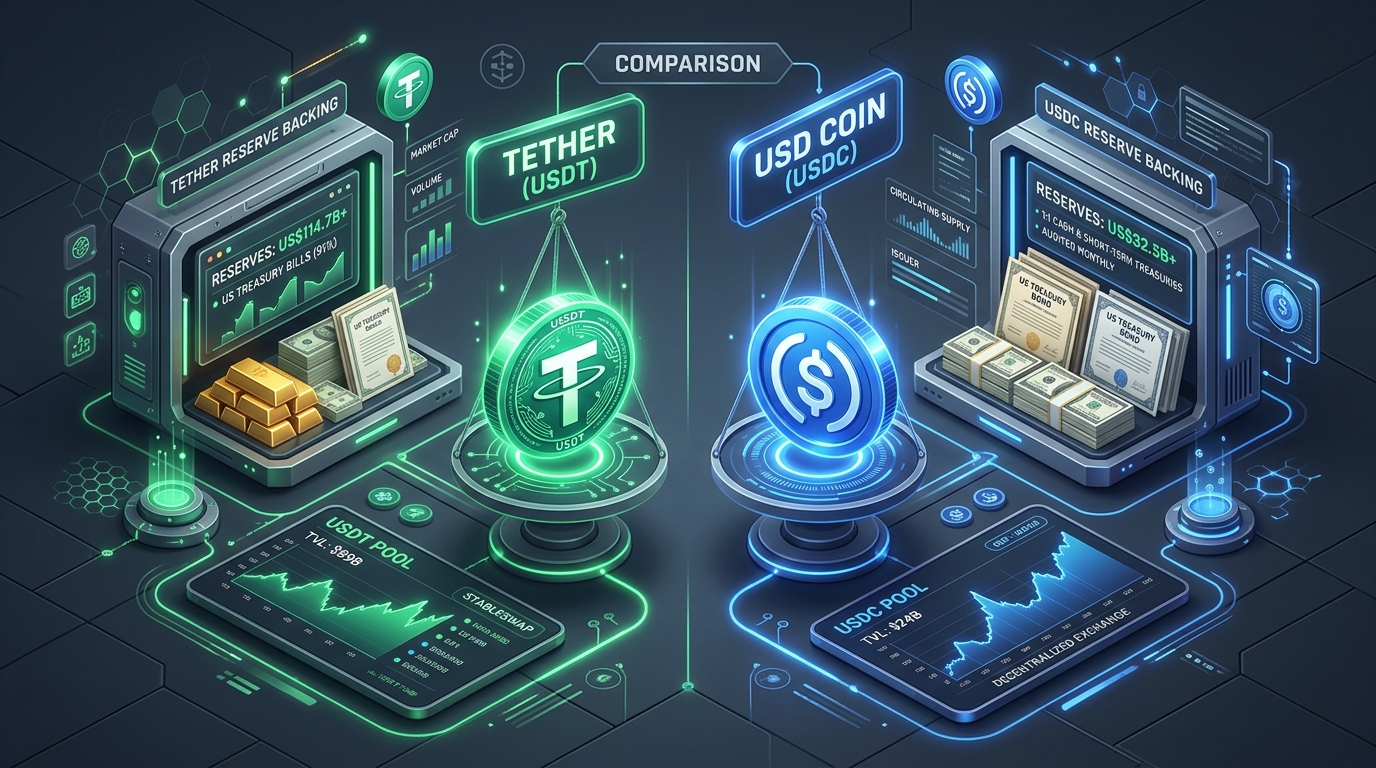
In the modern digital asset economy, stablecoins are the lifeblood of global liquidity. Over $180 billion in fiat value circulates on public blockchains as tokenized representations of the United States Dollar, settling trillions in annual trading volume, peer-to-peer remittances, and decentralized finance transactions.
At the apex of this market stand two titans: Tether (USDT) and USD Coin (USDC).
Together, USDT and USDC account for over 90% of the entire stablecoin market. To the casual observer, they appear identical: both trade around $1.00 USD, both claim 100% reserve backing, and both allow instant global settlement.
Yet beneath the surface, USDT and USDC represent two completely different architectures, regulatory philosophies, and risk profiles:
Which stablecoin should you hold? Which is safer during a banking crisis? Where do you get lower trading fees and deeper liquidity? In this masterclass guide, we provide an exhaustive, evidence-based breakdown of USDT vs. USDC across reserves, liquidity, de-pegging history, network gas costs, and practical use cases.
Side-by-Side Comparison: USDT vs. USDC at a Glance
| Feature / Parameter | Tether (USDT) | USD Coin (USDC) |
|---|---|---|
| Issuing Entity | Tether Holdings Ltd. (El Salvador / BVI) | Circle Internet Financial, LLC (Boston, USA) |
| Market Capitalization Share | ~70% – 74% of total stablecoins | ~20% – 24% of total stablecoins |
| Reserve Composition | ~85% US Treasuries/Cash, plus Gold, Bitcoin, Secured Loans | ~90% US Treasuries (Circle Reserve Fund / BlackRock), ~10% Cash |
| Attestation / Audit Firm | BDO Italia (Quarterly Attestations) | Deloitte & Touche LLP (Monthly Attestations) |
| EU MiCA Regulatory Status | Non-compliant / Unlicensed in EU | Fully Compliant (Licensed as EMI in France) |
| Dominant Blockchain Networks | Tron (TRC-20), Ethereum (ERC-20), Solana | Ethereum (ERC-20), Base, Solana, Arbitrum, Polygon |
| Centralized Exchange Pairs | #1 Dominant (Over 80% of all crypto trading volume) | Primary on Coinbase, Kraken, and US Regulated Venues |
| Cross-Chain Bridge Standard | Third-party bridges & multi-chain mints | Native Cross-Chain Transfer Protocol (CCTP) |
1. Reserve Backing & Transparency: What Actually Backs Your Token?
The foundational question for any stablecoin is: "If everyone redeems their tokens tomorrow, is there real money in the vault?"
USDC Reserve Quality: The Institutional Gold Standard
Circle operates with extreme reserve conservatism:
USDT Reserve Quality: The High-Yield Fortress
Historically, Tether faced intense scrutiny for holding commercial paper and non-transparent assets. However, Tether has drastically restructured its balance sheet:
Verdict on Reserves: If you prioritize pure, vanilla US Treasury backing without exposure to commodities or credit loans, USDC is objectively cleaner. If you prioritize massive sovereign-scale scale and balance sheet overcollateralization, USDT is exceptionally well-funded.
2. De-Pegging Stress Tests: The Real-World Historical Evidence
Theoretical reserve safety is tested during real-world market panics. Both stablecoins have experienced extreme stress tests:
Case Study 1: The May 2022 Terra UST Crash (USDT Stress Test)
When the $40 billion algorithmic stablecoin TerraUSD (UST) collapsed to zero in May 2022, panic swept the crypto market. Short-sellers and frightened retail holders attacked Tether, driving secondary market prices on centralized exchanges down to $0.9480.
What Happened Next?
Case Study 2: The March 2023 Silicon Valley Bank Collapse (USDC Stress Test)
On March 10, 2023, Silicon Valley Bank (SVB)—the 16th largest bank in the US—suffered a sudden bank run and was seized by the FDIC.
Circle disclosed that $3.3 billion of its cash reserves (roughly 8% of total USDC reserves at the time) were trapped in uninsured deposits at SVB.
What Happened Next?
The Key Takeaway: USDC’s vulnerability was its reliance on the traditional US regional banking system. Ironically, the unregulated offshore stablecoin (USDT) held up better during the US banking crisis than the regulated onshore stablecoin (USDC).
3. Liquidity Depth & Exchange Dominance
Where is liquidity actually concentrated when you want to buy or sell crypto?
Centralized Exchanges (Binance, Bybit, OKX)
US-Regulated Exchanges & Decentralized Finance (DeFi)
4. Blockchain Networks & Transfer Fees Compared
When transferring stablecoins between wallets or exchanges, network selection dictates your transaction speed and gas fees:
| Network | USDT Availability | USDC Availability | Typical Transfer Fee | Transfer Finality Time |
|---|---|---|---|---|
| Tron (TRC-20) | Dominant ($60B+ Supply) | Rare / Low Liquidity | $1.00 – $2.50 | ~15 – 30 seconds |
| Ethereum (ERC-20) | High ($45B+ Supply) | High ($25B+ Supply) | $2.50 – $35.00 (Gas volatile) | ~12 – 60 seconds |
| Solana (SPL) | Very High | Very High | <$0.01 | ~400 milliseconds |
| Base (Coinbase L2) | Low | Dominant (Native USDC) | <$0.01 – $0.05 | ~1 – 2 seconds |
| Arbitrum One (L2) | High | Dominant (Native CCTP) | <$0.02 – $0.10 | ~1 – 2 seconds |
| Polygon PoS | High | High (Native USDC) | <$0.01 – $0.03 | ~2 – 5 seconds |
The Practical Rule: If you are transferring funds internationally for retail payments or P2P, USDT on Tron (TRC-20) is the undisputed global standard in Asia, Latin America, and Africa. If you are interacting with DeFi, DEXs, or Ethereum L2s, USDC on Base or Arbitrum is significantly cheaper and more efficient.
4 Real-World Case Studies: Which Stablecoin Wins in Practice?
Case Study 1: The $1,000 Cross-Border Retail Remittance
A user in London wants to send $1,000 USD equivalent to a recipient in Southeast Asia who uses a local P2P cash-out exchange:
Case Study 2: The $100,000 Corporate Treasury Reserve
A software company in Silicon Valley raises $100,000 from investors and wants to hold it in digital dollars for operational expenses and payroll:
Case Study 3: The Active Multi-Exchange Crypto Trader
A trader actively trades Bitcoin, Solana, and mid-cap altcoins across Binance, OKX, and Bybit with $25,000 capital:
Case Study 4: The On-Chain DeFi Yield Farmer ($50,000 Capital)
A DeFi participant wants to supply stablecoins into Aave v3 on Arbitrum and provide liquidity on Uniswap v3:
Regulatory Outlook: The European MiCA Revolution
The regulatory landscape is shifting dramatically with the enforcement of the European Union’s Markets in Crypto-Assets (MiCA) regulation:
If you trade or hold stablecoins inside the European Union, USDC is the legally protected, future-proof choice.
The Decision Matrix: When to Choose USDT vs. USDC
Choose Tether (USDT) if:
Choose USD Coin (USDC) if:
Summary
The battle between USDT and USDC is not a zero-sum game. Rather than one replacing the other, both stablecoins have evolved into specialized pillars of the digital economy.
USDT is the supreme transactional currency of active crypto trading and global commerce, while USDC is the gold standard for institutional finance, corporate custody, and compliant DeFi integration.
Savvy cryptocurrency market participants hold both: using USDT as their trading weapon on exchange order books and USDC as their safe harbor for institutional settlement and self-custody reserves.