Imagine running a multi-billion dollar bank where none of the loan officers have internet access, newspapers, or phones.
Every time a customer walks in to pledge 1,000 Bitcoin as collateral to borrow $50 million in cash, the bank has no native way of verifying whether Bitcoin is trading at $60,000, $100,000, or $10.
This bizarre reality is the everyday world of Decentralized Finance (DeFi).
Blockchains like Ethereum, Solana, and Arbitrum are deterministic, self-contained virtual machines. By design, a smart contract running inside the Ethereum Virtual Machine (EVM) cannot send an HTTP GET request to Binance, Kraken, or Coinbase to ask: "What is the current price of ETH?"
To solve this fundamental limitation, decentralized protocols rely on Price Oracles—cryptographic data pipelines that fetch, verify, and deliver real-world asset prices onto the blockchain.
However, price oracles do not just report a single static number. They operate in a chaotic global market where prices constantly diverge across exchanges.
When Bitcoin trades at $64,000 on Binance, $64,250 on Coinbase, and $63,800 on Uniswap, which price should an automated lending protocol like Aave or a perpetual exchange like GMX believe?
In this comprehensive guide, we dissect the inner workings of DeFi price oracles, explore why cross-exchange price discrepancies are the number one attack vector in decentralized finance, and explain how modern quantitative risk architectures defend against multi-million dollar exploits.
1. The Oracle Problem: Why Smart Contracts Are "Blind and Deaf"
To understand why price oracles are essential, you must first understand the concept of consensus determinism.
A blockchain works because thousands of independent validator nodes around the world execute the exact same transactions in the exact same order, arriving at the identical state.
[ THE DETERMINISTIC CONSENSUS DILEMMA ]

Scenario: A smart contract executes `fetch("https://api.binance.com/btc_price")`

  Node 1 (New York) queries at 12:00:00.010 -> Gets $64,010.50
  Node 2 (Tokyo)    queries at 12:00:00.050 -> Gets $64,022.00 (Price moved!)
  Node 3 (Frankfurt) queries at 12:00:00.120 -> Receives HTTP 504 Gateway Timeout!

Outcome: Every validator gets a different result. Consensus breaks. Blockchain halts.
Because off-chain web requests are non-deterministic and subject to network latency, smart contracts are strictly forbidden from initiating external network connections.
Instead, external data must be formatted into a cryptographically signed transaction and "pushed" or "pulled" onto the blockchain state by an external agent. That external agent is a Price Oracle.
2. How Price Oracles Synthesize Cross-Exchange Market Data
A naive oracle might just take the price from Binance and write it to Ethereum. But what if Binance undergoes an API outage, gets hacked, or experiences a sudden flash crash?
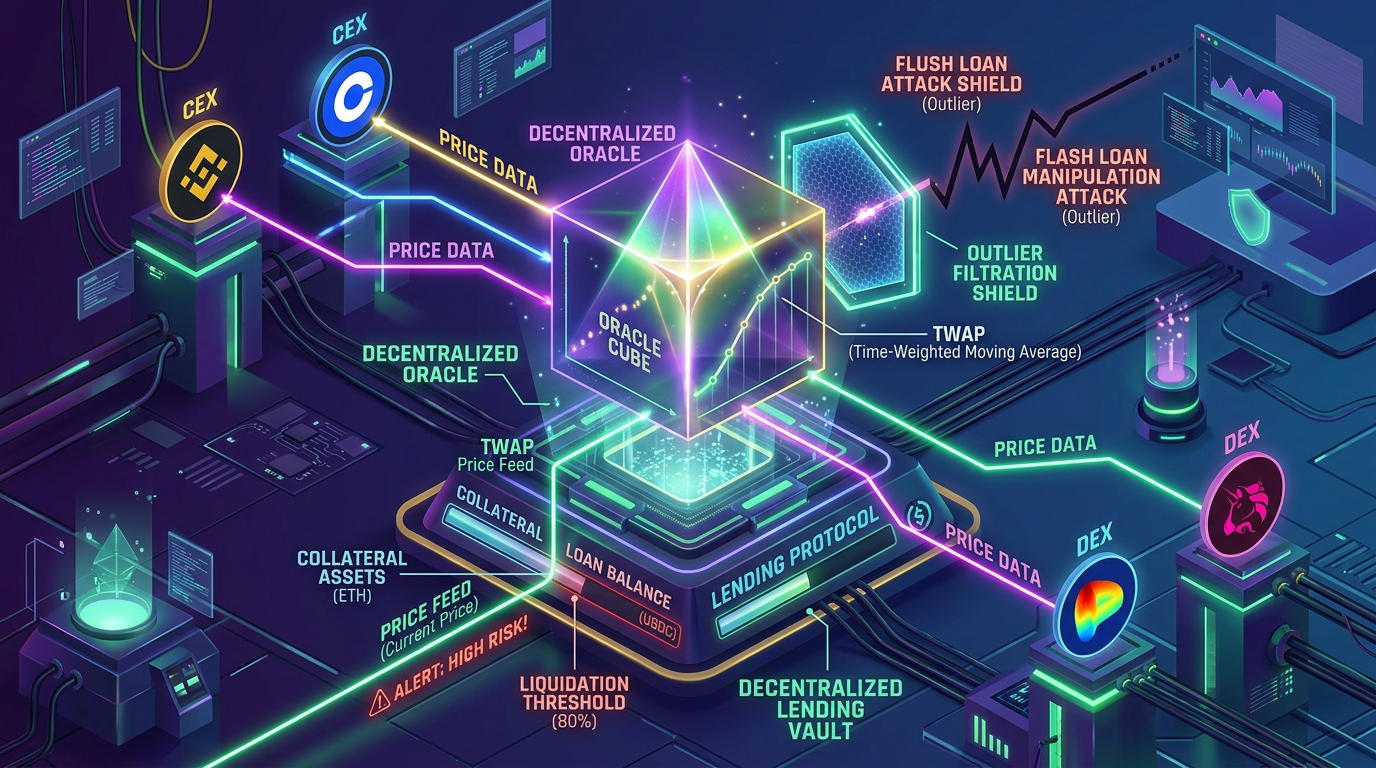
To protect billions of dollars in locked value (TVL), decentralized oracle networks (like Chainlink, Pyth Network, and Chronicle) use a multi-tiered aggregation pipeline:
[ THE MULTI-TIER ORACLE AGGREGATION PIPELINE ]

  [ CEX Feeds: Binance, Coinbase, Kraken, OKX, Bybit ]
  [ DEX Feeds: Uniswap v3, Curve 3pool, Raydium, Aerodrome ]
                         │
                         ▼
  [ TIER 1: Node-Level Volume-Weighted Medianization (VWAP) ]
     - Independent oracle nodes fetch data from 10+ distinct endpoints.
     - Outliers (flash wicks, bad ticks, stale APIs) are scrubbed.
                         │
                         ▼
  [ TIER 2: Decentralized Oracle Network Consensus (DON) ]
     - 20+ validator nodes submit their independent signed price estimates.
     - The network computes the 50th percentile (Median Price).
                         │
                         ▼
  [ TIER 3: On-Chain Cryptographic Verification ]
     - Threshold signature verified by smart contract.
     - Final price recorded in on-chain state for DeFi protocols.
By using volume-weighted medianization, if a single exchange crashes by 50% due to an errant market order or API glitch, the median calculation completely ignores the anomalous outlier, safeguarding downstream lending markets.
3. Why DeFi Protocols Care Deeply About Cross-Exchange Price Gaps
In traditional finance, stock prices across NASDAQ and NYSE are kept within fractions of a cent by high-frequency market makers. In crypto, however, fragmentation across dozens of centralized and decentralized exchanges creates frequent price discrepancies.
For DeFi protocols, these price gaps are not harmless market noise—they are existential threats:
A. Automated Liquidation Triggers (Lending Markets: Aave, Morpho, MakerDAO)
Lending protocols allow users to deposit collateral (e.g. ETH) to borrow stablecoins (e.g. USDC). If the value of the collateral falls below the liquidation threshold (e.g. 80% Loan-to-Value), the protocol automatically auctions off the borrower’s collateral to liquidators at a discount.
[ THE ORACLE PRICING RISK IN LENDING MARKETS ]

  Borrower Collateral: 100 ETH deposited at $3,000 ($300,000 value).
  Debt Borrowed:       $240,000 USDC (80% Health Factor - on the brink of liquidation).

  Real Global Market Price (Binance/Coinbase):  $3,020 (Borrower is SAFE)
  Anomalous DEX Price Wick (Illiquid Pool):    $2,850 (Borrower in DANGER)

  If Oracle uses DEX only:  Borrower gets unjustly liquidated -> Loses $30,000 in penalties!
  If Oracle lags by 15 min: Protocol accumulates bad debt during a real crash!
If the oracle relies on an exchange where prices lag or spike artificially, innocent borrowers get wiped out, or the protocol is left holding unbacked bad debt.
B. Toxic Flow & "Lag Arbitrage" in Perpetual DEXs (GMX, Hyperliquid, Synthetix)
Perpetual DEXs allow traders to trade futures contracts directly against a decentralized liquidity pool without an order book. The protocol fills trades at the exact current oracle price.
If Bitcoin surges on Binance from $64,000 to $64,500, but the on-chain oracle takes 10 seconds to update on Arbitrum, a high-frequency bot can submit a massive 50x long position at the stale $64,000 price, wait 10 seconds for the oracle to update, and instantly close the trade for guaranteed profit.
This predatory strategy—known as Oracle Lag Arbitrage or Toxic Latency Flow—can rapidly drain decentralized liquidity pools unless protocols enforce strict dynamic spreads or pull-based pricing.
4. Anatomy of a Flash-Loan Oracle Manipulation Exploit
To see why relying on a single exchange price is fatal, let us examine the textbook Flash-Loan Oracle Attack:
[ THE 1-BLOCK ORACLE MANIPULATION HEIST ]

  Target: "LendFi" protocol uses a Uniswap v2 WBTC/USDC pool as its sole price oracle.

  Step 1: Attacker takes a $100 Million Flash Loan of USDC from Aave (Zero upfront capital).
  Step 2: Attacker dumps $100M USDC into the Uniswap WBTC/USDC pool, artificially
          spiking the price of WBTC on that pool from $60,000 to $600,000.
  Step 3: Attacker deposits 10 WBTC into LendFi. LendFi queries its oracle (the manipulated
          Uniswap pool) and evaluates the 10 WBTC as being worth $6,000,000!
  Step 4: LendFi allows the attacker to borrow $5,000,000 in real USDC/ETH against the 10 WBTC.
  Step 5: Attacker swaps back on Uniswap, repays the $100M Aave flash loan in the same block,
          and walks away with $5,000,000 in stolen protocol funds.
The entire attack executes in a single 12-second Ethereum block. The only reason the exploit was possible was because the lending protocol trusted an illiquid spot pool instead of a robust, multi-venue aggregated oracle feed.
5. The Oracle Evolution: TWAP vs. Push vs. Pull Oracles
To eliminate single-pool vulnerabilities and minimize latency, DeFi architectures have evolved across three generations of price oracle designs:
| Oracle Architecture | Mechanism | Primary Examples | Pros | Cons |
|---|---|---|---|---|
| Time-Weighted Average Price (TWAP) | Calculates geometric mean price over a rolling time window (e.g. 30 min). | Uniswap v3 TWAP | Immune to single-block flash loans; fully decentralized on-chain. | Highly lagging during sudden market crashes; vulnerable to multi-block capital attacks. |
| Scheduled Push Oracles | Off-chain nodes write updates to the blockchain when price moves >0.5% or after heartbeat. | Chainlink Data Feeds | High reliability, battle-tested security, transparent historical logs. | High gas consumption; update delay can enable short-term latency arbitrage. |
| On-Demand Pull Oracles | Users/searchers fetch signed cryptographic price packets and submit them inside the transaction payload. | Pyth Network, Chainlink Data Streams | Sub-second latency, ultra-cheap gas, optimal for fast perpetual DEXs. | Requires front-end integration and gas-paying transaction bundling. |
6. Summary & Microstructure Checklist for DeFi Traders
Whether you are an active DeFi yield farmer, a perpetual futures trader, or a quantitative risk analyst, understanding how oracles interpret exchange price differences is vital: