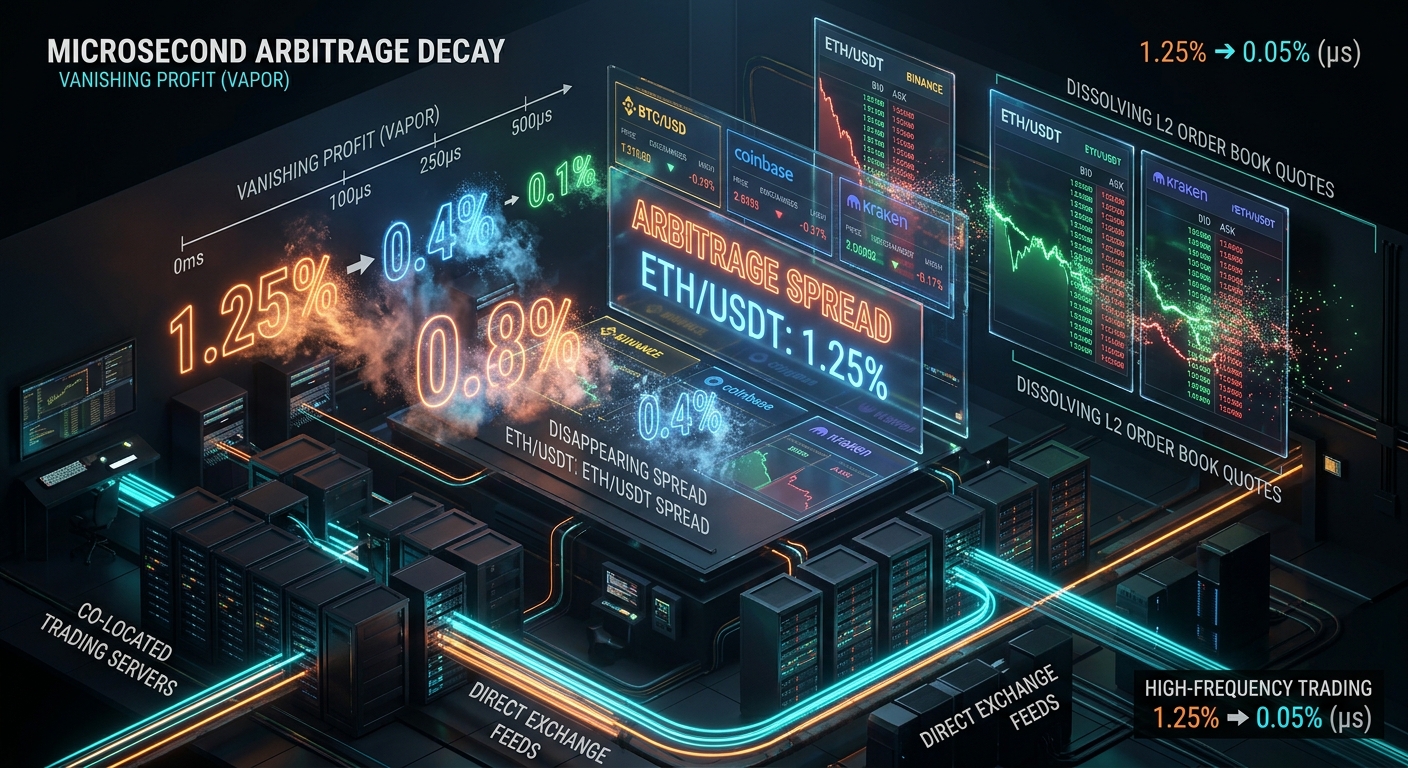
It is the most intoxicating moment in a cryptocurrency trader's career.
You open a multi-exchange price scanner. Your eyes lock onto an unbelievable number flashing on the screen:
Bitcoin is trading at $68,000.00 on Binance and $69,200.00 on Kraken.
A massive +$1,200.00 (+1.76%) risk-free price difference sitting right in front of you. The math seems indisputable: buy 2 BTC on Binance for $136,000, sell 2 BTC on Kraken for $138,400, and pocket an effortless +$2,400.00 profit in 10 seconds.
You hastily hit the execute button.
Ten seconds later, you check your balance expecting a celebratory windfall. Instead, your account shows a -$380.00 net loss.
What on Earth just happened? Where did the guaranteed free money go?
Welcome to the single most common rite of passage in quantitative trading: The Phantom Profit Paradox.
In this quantitative post-mortem, we forensically dissect the six mechanical reasons why theoretical arbitrage spreads evaporate in the real world, examine the physics of millisecond order queues, and explain how institutional desks actually execute profitable spatial arbitrage.
1. The Latency Illusion: You Are Trading Historical Ghosts
When you see a price quote on a web browser or a standard Python script running on your home broadband, you assume you are looking at the present.
You are actually looking at ancient history.
[ THE MILLISECOND EXECUTION RACE: YOUR SCREEN vs. REALITY ]

  Timeline (ms)      Event in the Global Exchange Mesh
  ----------------------------------------------------------------------------------------------------
  T + 0.0 ms         Whale market sells on Kraken -> BTC ask drops to $68,000.
  T + 1.2 ms         Co-located HFT Server in Tokyo/Dublin receives direct fiber binary packet.
  T + 2.8 ms         HFT algorithmic engine detects spread -> Sends automated FIX limit buy order.
  T + 4.1 ms         Kraken matching engine matches HFT order. The $68,000 quote is DEAD & CONSUMED.
  ----------------------------------------------------------------------------------------------------
  T + 45.0 ms        Kraken public WebSocket pushes snapshot to public internet.
  T + 110.0 ms       Your home browser receives the WebSocket packet & renders the green "+1.76%" badge.
  T + 3,200.0 ms     You click the "Buy" button.
  T + 3,350.0 ms     Your order reaches Kraken -> Fills at the NEXT available ask level: $69,280 (OVERPAID!).
By the time the human eye perceives a green arbitrage opportunity, co-located algorithmic market makers have already detected it, calculated risk parameters, executed the trade, and moved the order book over 3 seconds ago.
You did not miss the trade by a hair—you arrived at an empty crime scene 3,000 milliseconds after the bank vault was emptied.
The 6 Microstructure Traps That Vaporize Arbitrage
The table below summarizes the six structural barriers that destroy theoretical arbitrage profits in live production:
| Microstructure Trap | What You Saw (The Illusion) | What Actually Happened (The Reality) | Financial Damage |
|---|---|---|---|
| 1. The Latency Lag Trap | Live +1.50% price gap | The cheap quote was filled 80ms ago by an HFT | You get filled at the next level (+0.40% worse) |
| 2. The Depth Thimble Illusion | Price is $68,000 (Looks huge) | Only 0.004 BTC ($272) available at that price | 98% of your order sweeps through deep expensive asks |
| 3. Double Taker Fee Drag | Raw Spread: +0.60% | Taker fee on Exchange A (0.10%) + Exchange B (0.40%) + VIP tier mismatch | Fees consume 0.50% of the 0.60% spread |
| 4. Legging Risk (Single Leg Fail) | Both legs fill simultaneously | Leg 1 fills on Binance; Leg 2 gets rejected on Kraken | You are left holding an unhedged open position in a crashing market |
| 5. Adverse Selection (Winner's Curse) | "Great, my limit order filled!" | Market is dumping hard; you bought a falling knife | Immediate unrealized drawdown within 5 seconds |
| 6. Broken Blockchain Settlement Rails | Buy on A -> Transfer to B -> Sell on B | On-chain transfer takes 25 minutes; price drops 3% | Arbitrage collapses during transit window |
2. Trap #2: The Depth Thimble Illusion (Top-of-Book Trap)
Most beginner arbitrage bots look only at the Best Bid and Best Offer (BBO).
If Exchange A has Best Ask = $68,000 and Exchange B has Best Bid = $69,000, it looks like a clean $1,000 gap.
However, price without quantity is meaningless in trading.
[ LEVEL-2 ORDER BOOK DEPTH DISASTER EXAMPLE ]

  EXCHANGE A (Where you want to BUY $50,000 of BTC):
  --------------------------------------------------------------------------
  Level 1 (Best Ask): $68,000.00  | Size: 0.005 BTC ($340.00)  <- What your scanner saw!
  Level 2:            $68,450.00  | Size: 0.020 BTC ($1,369.00)
  Level 3:            $68,900.00  | Size: 0.100 BTC ($6,890.00)
  Level 4:            $69,300.00  | Size: 0.800 BTC ($55,440.00)
  --------------------------------------------------------------------------
  Average Fill Price for $50,000: $69,185.40 (MASSIVE SLIPPAGE!)
Your scanner reported a $68,000 entry price based on a tiny $340 retail scrap. When you submitted your $50,000 market order, you swept the order book up to $69,300, instantly turning a theoretical $1,000 profit into a massive net loss.
3. Trap #3: Legging Risk (The Single-Leg Nightmare)
True arbitrage requires instantaneous, simultaneous execution on two distinct venues.
In reality, sending two separate API orders across the internet over HTTPS introduces non-deterministic asynchronous latency:
POST /api/v3/order to Binance and POST /0/private/AddOrder to Kraken.HTTP 429 Too Many Requests (Rate Limit Exceeded) or EOrder:Insufficient Margin.Real-World Case Study: The "Guaranteed" Polkadot Basis Collapse ($18,500 Loss)
An independent algorithmic trader deployed a spatial arbitrage bot targeting Polkadot (DOT) during a high-volatility upgrade:
What Went Wrong:
4. How Institutional Quant Desks Actually Win at Arbitrage
How do institutional high-frequency firms (Wintermute, Jump, Flow Traders) make consistent billions from arbitrage without falling into these traps?
They do not use standard retail methods. They operate under a completely different architectural paradigm:
[ THE INSTITUTIONAL CROSS-EXCHANGE EXECUTION FRAMEWORK ]

  1. PRE-FUNDED CAPITAL POOLS (Zero On-Chain Transfer Time):
     - 10 BTC + $680,000 USDT pre-positioned on Binance.
     - 10 BTC + $680,000 USD pre-positioned on Coinbase.
     - Trades execute SIMULTANEOUSLY in parallel internal balances with zero blockchain wait time.

  2. LEVEL-3 ORDER BOOK DEPTH-WEIGHTED CALCULATIONS:
     - The algorithm evaluates the integral of the order book (Volume vs. Price curve).
     - It only fires if the net spread is positive AFTER absorbing depth for the exact order size.

  3. VIP TIER 0-MAKER FEES (Maker-Taker Strategy):
     - Institutions pay -0.005% maker rebates and <0.02% taker fees.
     - They post passive maker orders on the slow venue and only cross the spread with an active taker order on the fast venue once the maker leg is 100% filled.