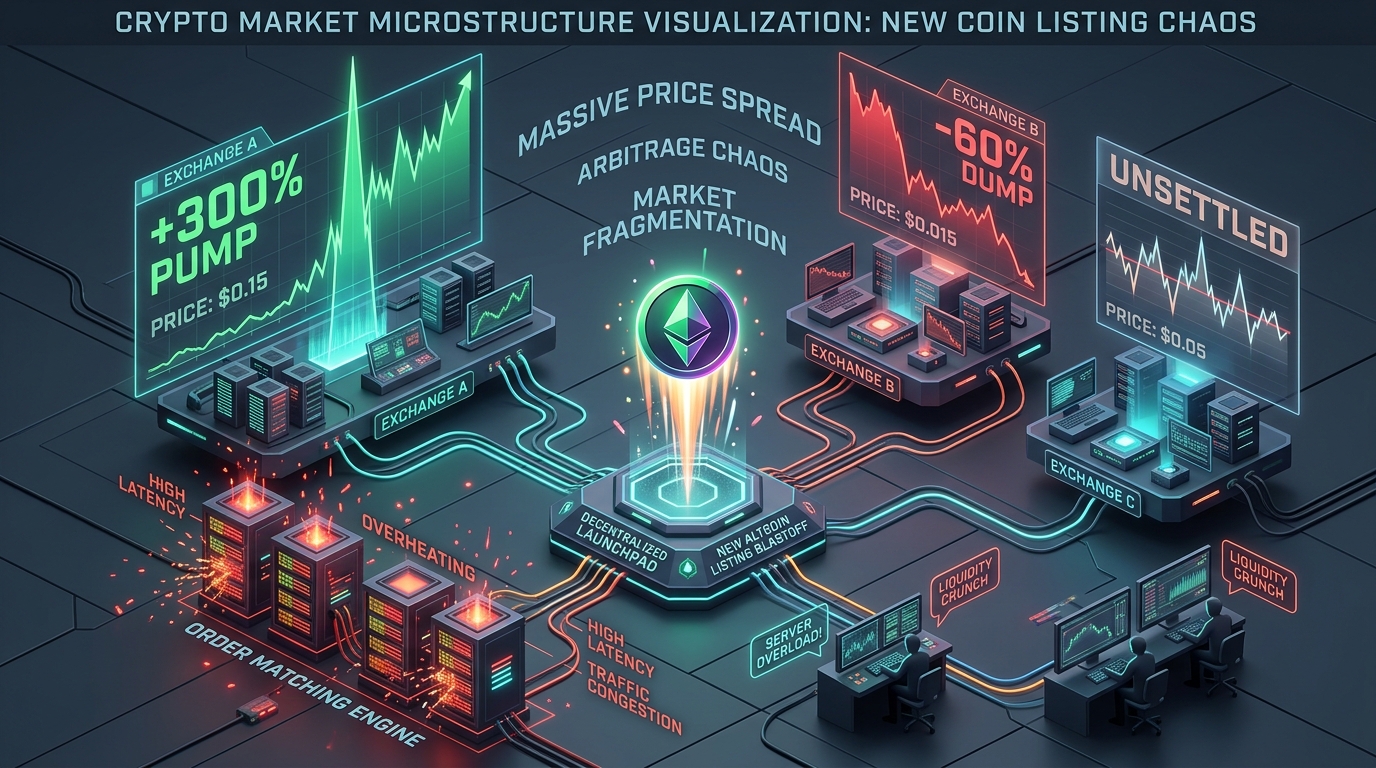
Picture this: It is 12:00:00 UTC on a Thursday.
A heavily hyped Layer-1 blockchain token—let’s call it NEXUS—is scheduled for a simultaneous global debut across Binance, OKX, Bybit, Coinbase, and Uniswap.
You open four browser tabs side-by-side, your eyes darting between four live order books.
The clock strikes 12:00:01 UTC.
Instantly, total pandemonium erupts:
For the next 25 minutes, the exact same digital asset trades with a +242% price discrepancy between venues.
To a retail observer, this looks like a glitch in the Matrix—or an unbelievable, once-in-a-lifetime arbitrage spread waiting to be harvested.
In reality, this is the standard, predictable microstructural physics of a Listing Day Liquidity Desynchronization.
In this quantitative breakdown, we explore why new token listings cause violent price chaos across exchanges, map the four mechanical bottlenecks that prevent instant price convergence, and explain the exact four-phase lifecycle of listing day price discovery.
1. The Core Paradox: Why Doesn't Arbitrage Fix It Instantly?
Under standard market conditions on mature assets like Bitcoin or Ethereum, a 0.15% price difference between Binance and Coinbase is eliminated in less than 15 milliseconds by high-frequency trading (HFT) algorithms.
Why, then, does a 150% price gap on a newly listed token survive for 30, 45, or even 90 minutes?
[ THE LISTING DAY ARBITRAGE BLOCKADE ]

  NORMAL ASSET (BTC / ETH):                    NEW LISTING (DAY 0, FIRST 30 MINS):
  --------------------------------------------------------------------------------------
  - Pre-funded inventory exists on all venues. - ZERO pre-funded token inventory on exchanges.
  - On-chain transfers are instant/frequent.   - Deposits are disabled or delayed in mempools.
  - Order book depth is deep and symmetric.    - Asymmetric books: 100% market buys, 0 sellers.
  - HFT bots active across both sides.        - Market makers handcuffed by capital locks.
  --------------------------------------------------------------------------------------
  RESULT: 0.01% Spread (Sub-second convergence) RESULT: +150% Spread (Persists for up to 90 mins!)
The reason arbitrage fails during the opening minutes of a token listing is that the physical pipes required to execute arbitrage do not exist yet.
Arbitrage requires two prerequisites: 1) Pre-positioned inventory on both exchanges, and 2) Functioning two-way deposit and withdrawal rails. On listing day, both of these rails are completely broken.
2. The 4 Mechanical Bottlenecks That Create Listing Chaos
The chaos on listing day is driven by four structural chokepoints in exchange and blockchain infrastructure:
[ THE 4 LISTING DAY MICROSTRUCTURE BOTTLENECKS ]

  1. ASYNCHRONOUS DEPOSIT GATE ACTIVATION:
     - Exchange A opens deposit addresses at 10:00 UTC (2 hours early).
     - Exchange B opens deposit addresses at 11:58 UTC (2 minutes before trading).
     - Result: Exchange A has 10M tokens ready to sell; Exchange B has ZERO tokens available.

  2. BLOCKCHAIN MEMPOOL GAS WARS & INDEXER LAG:
     - 50,000 airdrop recipients broadcast deposit transactions simultaneously.
     - Blockchain gas spikes 500x; centralized exchange indexers fall 2,000 blocks behind.
     - Deposits take 45 minutes to credit to spot wallets.

  3. DESIGNATED MARKET MAKER (DMM) INVENTORY FRAGMENTATION:
     - Market making firms receive token loan allocations from the foundation.
     - Splitting inventory across 10 global exchanges takes time and multiple multi-sig approvals.
     - If a venue burns through its MM ask buffer early, the ask book becomes a hollow vacuum.

  4. MATCHING ENGINE OVERLOAD & API RATE-LIMIT THROTTLING:
     - Millions of retail websocket connections flood the exchange matching engine.
     - Non-institutional API orders get dropped or throttled with 504 Gateway Timeouts.
     - Bids enter the book while cancels fail, creating artificial upward price momentum.
The Anatomy of Listing Day Price Discrepancies
The table below illustrates the microstructural friction across different venue types during the first 60 minutes of a major Tier-1 token listing:
| Venue Type | Typical Opening Price Action | Order Book Liquidity Source | Real Processing Latency | Primary Driver of Price Distortion |
|---|---|---|---|---|
| Primary CEX (Binance / OKX) | Extreme initial spike (+300% to +800%) | Foundation DMM loan only | 1 to 5 ms matching; 30 min deposits | Massive retail market buy order imbalance |
| Secondary CEX (KuCoin / Gate) | Lagging discount (-20% to -40% vs Binance) | Speculative deposits | 45 min deposit indexer delay | Lower retail taker demand; thin bid book |
| Decentralized AMM (Uniswap / Raydium) | Slow linear curve ($1.00 -> $2.50) | Algorithmic bonding curve / LP pool | 12 to 30 sec block confirmation | MEV sandwich bots draining liquidity |
| Pre-Market Perps (Aevo / Hyperliquid) | Front-run speculative peak ($5.50) | Pure synthetic leverage | Sub-millisecond order matching | Leverage-fueled speculative hype before spot delivery |
| Regional / Local CEX (Bithumb / Upbit) | Late explosive surge (+50% KRW Premium) | Strict localized KYC deposits | 2 to 24 hours after global launch | Korean retail liquidity explosion (Kimchi Effect) |
3. The 4 Phases of Listing Day: From T-Zero to Equilibrium
Every major cryptocurrency listing follows a remarkably consistent, four-stage microstructural lifecycle:
[ THE 4-STAGE LIFECYCLE OF LISTING DAY PRICE DISCOVERY ]

  PHASE 1: THE T-ZERO OPENING SPIKE (0 to 3 Minutes)
  - Trading goes live. Zero sellers exist except the DMM's initial ask wall.
  - Thousands of pre-set market buy orders and aggressive taker bots fire simultaneously.
  - The order book sweeps upward through empty air, forming the infamous "Listing Day Upper Wick".
  - Price peaks at 5x to 15x fair value.

  PHASE 2: THE DEPOSIT FLOOD GATE OPENS (3 to 20 Minutes)
  - The first wave of on-chain deposits (airdrop claimants, seed investors, private sale holders)
    finally receives required block confirmations and exchange indexer credits.
  - Millions of tokens flood the sell side of the order book.
  - Price undergoes a violent, gut-wrenching -40% to -70% crash.

  PHASE 3: CROSS-EXCHANGE ARBITRAGE COMPRESSION (20 to 60 Minutes)
  - Market makers and quantitative desks receive their multi-venue on-chain rebalancing transfers.
  - Desks buy on discounted venues (e.g. Uniswap at $2.00) and sell on premium venues (Binance at $2.60).
  - The inter-exchange spread rapidly narrows from 100%+ down to under 1.5%.

  PHASE 4: EQUILIBRIUM & TWO-WAY VOLATILITY (60+ Minutes)
  - Real market depth establishes across all order book tiers (±2% depth exceeds $1M).
  - Standard Avellaneda-Stoikov market making algorithms take over.
  - Price transitions into standard two-way intraday price discovery.