If you have spent more than five minutes in decentralized finance (DeFi), you have undoubtedly used wrapped tokens.
You deposit Ethereum into Uniswap, and it asks you to convert your ETH into WETH (Wrapped Ether).
You want to earn yield on your Bitcoin in an Ethereum money market like Aave, so you supply WBTC (Wrapped Bitcoin).
To most DeFi users, wrapped tokens feel like a harmless UI abstraction—a simple technical checkbox that allows coins to move across smart contracts.
The prevailing assumption is simple: 1 WBTC = 1 BTC, and 1 WETH = 1 ETH. Always and forever.
That assumption is dangerous.
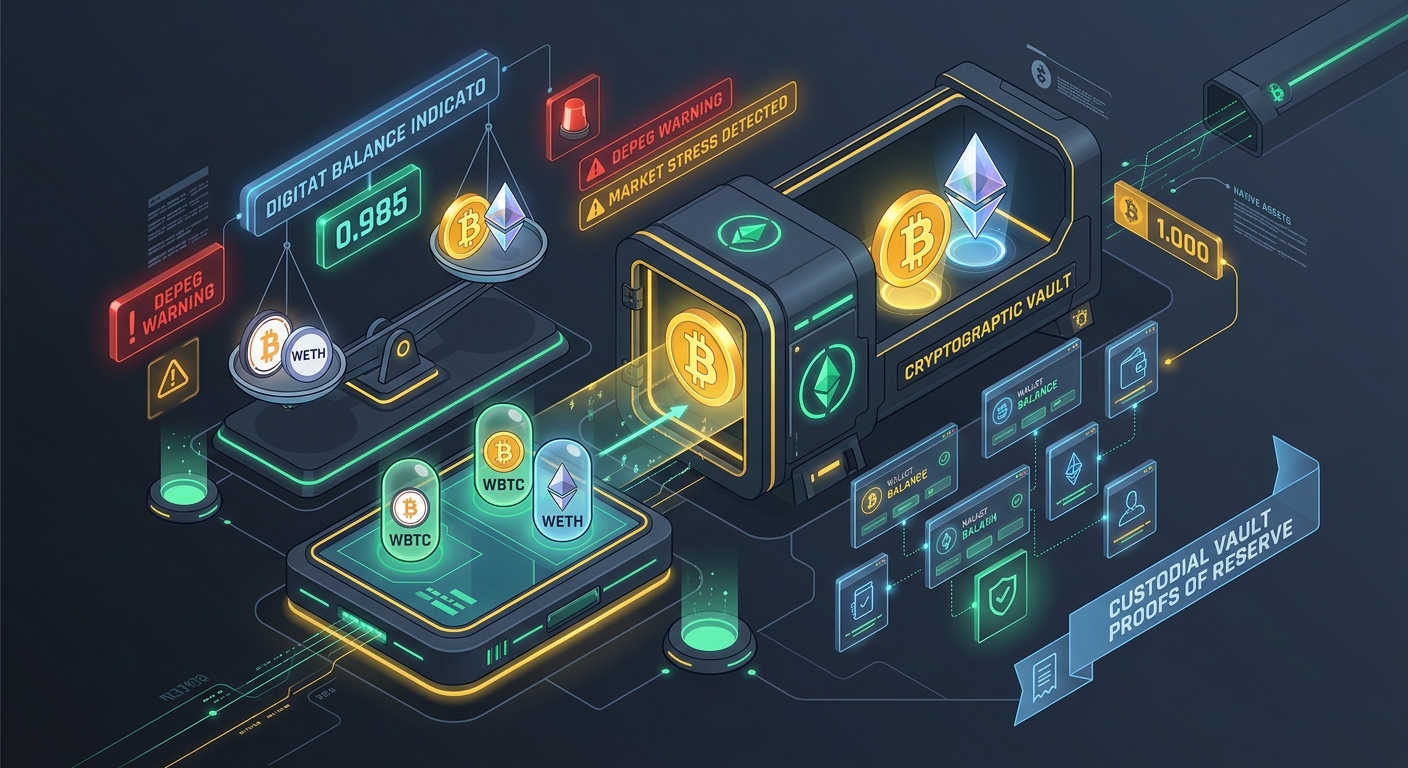
In reality, wrapped tokens are synthetic representations of value governed by code, bridge contracts, custodian vaults, and decentralized liquidity pools. Under calm market conditions, they trade at a microscopic basis to native assets. But when market volatility explodes, lending protocols experience liquidations, or custodian trust wavers, wrapped tokens can—and repeatedly have—broken parity.
In this institutional forensic guide, we examine the inner architecture of wrapped tokens, compare trustless programmatic wrappers with custodial IOUs, dissect real-world de-peg crises, and explain how quantitative desks exploit wrapped asset price divergence.
1. Why Do Wrapped Tokens Exist in the First Place?
To understand why wrapped tokens can de-peg, you must first understand why blockchains require them.
[ THE ARCHITECTURAL MISMATCH: NATIVE ASSETS vs. SMART CONTRACT STANDARDS ]

  1. THE ETH vs. WETH DILEMMA (Same Blockchain, Incompatible Standard):
     • Ethereum was created in 2015.
     • The ERC-20 token standard was created in late 2015 (ERC-20 token standard).
     • NATIVE ETH DOES NOT CONFORM TO ERC-20! ETH is the protocol-level gas currency.
     • Smart contracts (Uniswap, Aave) are written to handle uniform ERC-20 transferFrom() hooks.
     • SOLUTION: Wrap ETH into an ERC-20 compliant envelope (WETH) via a 1:1 smart contract.

  2. THE BTC vs. WBTC DILEMMA (Completely Separate Blockchains):
     • Bitcoin exists on the UTXO-based Bitcoin network with no EVM smart contract logic.
     • Ethereum smart contracts cannot verify, hold, or manipulate UTXO Bitcoin directly.
     • SOLUTION: Lock native Bitcoin in a custodial vault, and mint an ERC-20 IOU token (WBTC) on Ethereum.
Notice the fundamental difference: WETH is an intra-chain wrapper, while WBTC is an inter-chain custodial bridge derivative.
2. The Mechanics of Parity: How the 1:1 Peg is Maintained
Wrapped tokens do not magically stay pegged to native assets through some cosmic gravitational pull. Parity is maintained purely by Redemption Arbitrage:
[ THE WRAPPED TOKEN REDEMPTION ARBITRAGE LOOP ]

  SCENARIO: Panicking traders dump WBTC on Uniswap, pushing WBTC price down to $63,700.
            Native BTC on Binance & Coinbase is trading at $65,000.
            (WBTC is trading at a -2.0% de-peg discount!)
  ─────────────────────────────────────────────────────────────────────────────────────────────
  STEP 1: ARBITRAGEUR BUYS CHEAP WBTC ON-CHAIN
          Buys 100 WBTC on Uniswap/Curve for $6,370,000 (paying $63,700 per WBTC).

  STEP 2: ARBITRAGEUR INITIATES CUSTODIAL BURN
          Sends 100 WBTC to an authorized merchant (e.g., FalconX, Galaxy Digital, CoinList).
          Merchant burns 100 WBTC on Ethereum via the WBTC smart contract.

  STEP 3: CUSTODIAN RELEASES NATIVE BITCOIN
          Custodian vault (BitGo/BiT Global) releases 100 native BTC on the Bitcoin network.

  STEP 4: ARBITRAGEUR SELLS NATIVE BTC ON SPOT EXCHANGE
          Sells 100 native BTC on Coinbase at $65,000 for $6,500,000.

  GROSS ARBITRAGE PROFIT: $6,500,000 - $6,370,000 = +$130,000 in risk-free profit!
As long as authorized merchants can freely mint and burn wrapped tokens for native assets with low friction and trusted custodians, arbitrageurs will greedily buy discounted wrapped tokens and burn them, pulling the price back to $65,000 parity.
3. Trust Models: WETH (Trustless) vs. WBTC (Custodial Multi-Sig)
Why is WETH virtually immune to existential de-pegging, while WBTC carries real structural tail risk? It comes down to the Trust Architecture:
| Feature | Wrapped Ethereum (WETH) | Wrapped Bitcoin (WBTC) |
|---|---|---|
| Asset Type | Intra-chain smart contract wrapper | Cross-chain custodial synthetic IOU |
| Custody Model | 100% Trustless Code (Canonical WETH9 contract) | Centralized / Multi-jurisdictional Custody (BiT Global / BitGo) |
| Mint / Burn Mechanism | Instant on-chain EVM function calls (deposit() / withdraw()) | Requires KYC-verified institutional merchants & manual batch processing |
| Counterparty Risk | Zero counterparty risk (pure smart contract math) | Legal, jurisdictional, insolvency, and key-custody risk |
| Redemption Latency | 12 seconds (1 Ethereum block) | 1 hour to 24+ hours (Multi-sig Bitcoin confirmations + KYC checks) |
| Historical De-Peg Risk | Extremely rare (isolated to flash-loan pool illiquidity) | Substantial during structural market insolvencies (FTX, 3AC) |
Why WETH is Bulletproof (The Canonical WETH9 Contract)
The canonical WETH contract (0xC02aaA39b223FE8D0A0e5C4F27eAD9083C756Cc2) has no admin keys, no owner, no upgradeability proxies, and no pause buttons. It simply contains two deterministic functions:
deposit(): Sends native ETH, contract increments your WETH balance by exact same msg.value.withdraw(uint wad): Burns your WETH, contract sends you exact same amount of native ETH.Because anyone can execute withdraw() permissionlessly in a single transaction, any WETH price discount on a DEX can be atomically arbitraged within the same block using flash loans.
4. Real-World Crises: When Wrapped Assets Lost Parity
Despite economic theory, wrapped tokens have repeatedly suffered significant de-peg events during historic crypto panics:
[ HISTORIC WBTC DE-PEG INCIDENTS ]

  1. THE THREE ARROWS CAPITAL (3AC) & CELSIUS CRASH (June 2022):
     • Insolvent lenders desperately liquidated hundreds of millions in WBTC on Curve.
     • The Curve WBTC/renBTC/sBTC pool became 85% imbalanced.
     • WBTC traded at a ~1.8% discount to native Bitcoin for over 72 hours.

  2. THE ALAMEDA RESEARCH & FTX COLLAPSE (November 2022):
     • Alameda Research was the single largest WBTC minting merchant in history.
     • When FTX went bankrupt, rumors spread that Alameda had minted unbacked WBTC.
     • Terrified DeFi participants dumped WBTC on decentralized exchanges.
     • WBTC plunged to $15,800 while native BTC was trading at $16,250 (a 2.5% discount).
     • Arbitrageurs eventually verified BitGo’s on-chain Proof of Reserve and restored the peg.

  3. THE SOLANA SOETH & SOBTC CATASTROPHE (November 2022):
     • Wrapped tokens bridged from FTX to Solana (soETH, soBTC) were 100% custodial IOUs from FTX.
     • When FTX collapsed, the underlying collateral was frozen in bankruptcy proceedings.
     • soETH and soBTC permanently de-pegged to $0.00, destroying hundreds of millions in user funds.
5. Why Does a De-Peg Happen During Panics?
If arbitrageurs exist, why doesn’t the peg instantly recover in a crisis? There are three structural bottlenecks:
6. Parity Arbitrage: How Traders Capitalize on Wrapped Discrepancies
For quantitative and retail traders, wrapped token de-pegs represent either a major portfolio hazard or a lucrative arbitrage opportunity:
[ IDENTIFYING A WRAPPED ARBITRAGE OPPORTUNITY ]

  1. SCAN CROSS-VENUE DISCREPANCIES:
     Check native BTC spot prices on Binance/Coinbase vs WBTC pool prices on Curve/Uniswap.

  2. CALCULATE NET SPREAD AFTER GAS & REDEMPTION FEES:
     Spread (%) = [(Native BTC Price - WBTC Price) / Native BTC Price] * 100
     If Spread > 0.75% (covering merchant mint/burn fees + Ethereum gas), arbitrage is viable.

  3. EXECUTE EITHER ON-CHAIN OR CROSS-EXCHANGE:
     • Strategy A (Merchant Redemption): Buy WBTC at discount -> Burn for native BTC -> Sell on CEX.
     • Strategy B (Mean Reversion Hold): Buy high-conviction WBTC at 2% discount -> Wait for peg restoration.