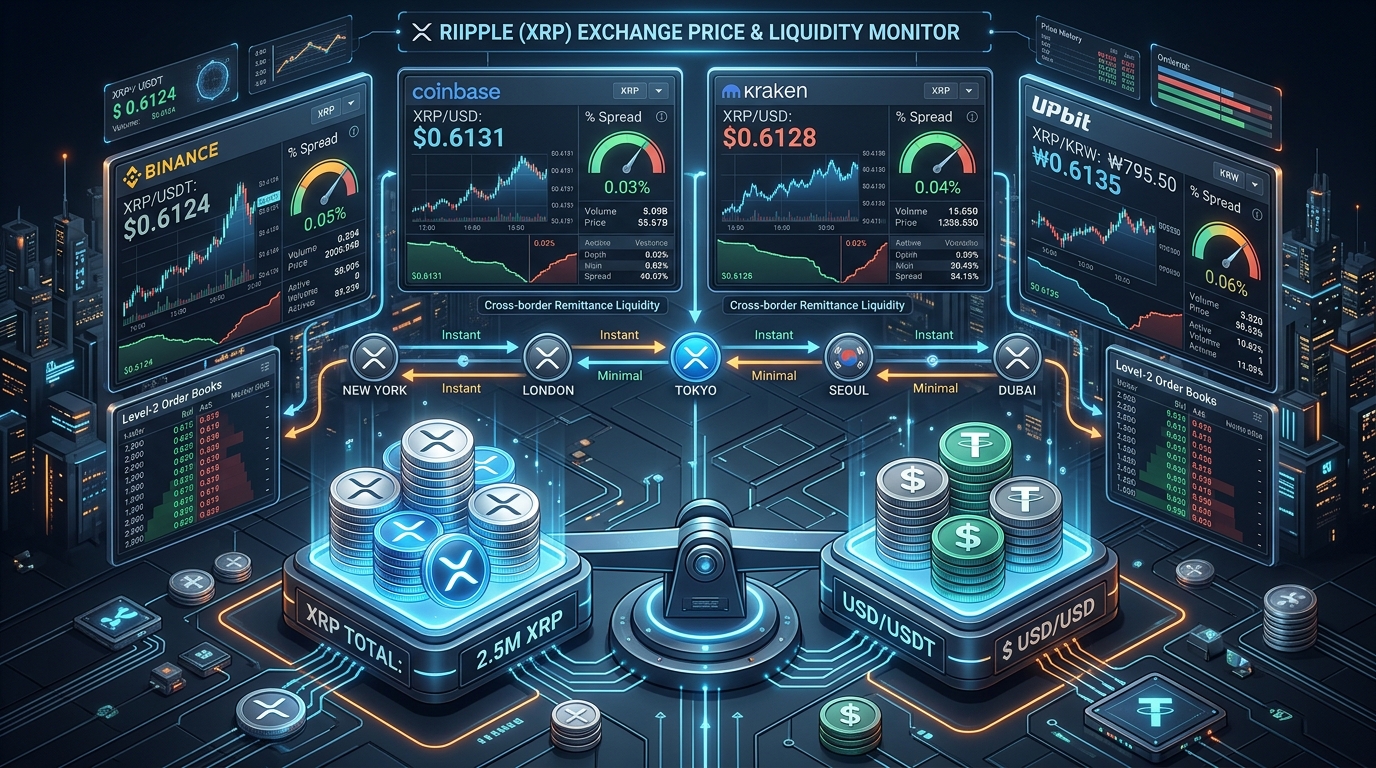
Among major high-cap cryptocurrencies, XRP (Ripple) occupies one of the most intriguing and structurally fragmented market positions in digital asset history.
Unlike Bitcoin or Ethereum—where major exchange prices rarely diverge by more than a fraction of a percent under normal market conditions—XRP regularly exhibits dramatic price gaps of 2%, 5%, and even 12%+ between global exchanges.
On any given trading day, a price scan across global exchanges might reveal:
Why does XRP trade at such wildly different valuations in different parts of the world? Can ordinary traders profit from these price gaps, or are they trapped by legal and banking barriers? How do Ripple’s institutional payment corridors influence real-world liquidity?
In this quantitative market microstructure breakdown, we dissect the mechanics behind XRP price differences across exchanges, decode the famous Kimchi Premium, examine the impact of Ripple’s On-Demand Liquidity (ODL), and evaluate four real-world trading case studies.
Global XRP Exchange Benchmark Matrix
| Exchange & Region | Primary XRP Trading Pairs | Typical ±1% Depth | Base Retail Pro Fees | Fiat Settlement Rail | Unique Microstructure Role |
|---|---|---|---|---|---|
| Binance (Global) | XRP/USDT, XRP/FDUSD, XRP/BTC | $15M – $25M (Deepest Globally) | 0.100% (0.075% w/ BNB) | SEPA, P2P, SWIFT | Global liquidity anchor & primary perpetual futures venue |
| Upbit (South Korea) | XRP/KRW, XRP/BTC | $10M – $20M (Massive KRW Volume) | 0.050% (Flat) | K-Bank (KRW Only) | Epicenter of the Kimchi Premium & heavy retail speculation |
| Coinbase Advanced (USA) | XRP/USD, XRP/USDT | $6M – $12M | 0.400% Maker / 0.600% Taker | ACH (Free), Fedwire | Primary US-regulated fiat on-ramp for US institutions |
| Bitstamp (Europe) | XRP/EUR, XRP/USD, XRP/GBP | $3M – $7M | 0.300% Maker / 0.400% Taker | SEPA Instant, Wire | Key European institutional partner for Ripple Payments/ODL |
| Bitso (Latin America) | XRP/MXN, XRP/USD, XRP/BRL | $1M – $4M | 0.100% Maker / 0.150% Taker | SPEI (Mexico Instant), Pix (Brazil) | Primary cross-border remittance gateway for US-to-Mexico ODL |
| SBI VC Trade (Japan) | XRP/JPY | $2M – $5M | 0.000% Maker / 0.050% Taker | Zengin System (JPY Bank) | Japanese banking corridor partner with high domestic volume |
1. The 4 Primary Drivers of XRP Price Differences
A. The South Korean "Kimchi Premium" and Capital Controls
South Korea has long been the world’s most passionate retail market for XRP. On Upbit and Bithumb, daily XRP trading volume frequently exceeds Bitcoin and Ethereum volume combined.
This explosive domestic buying demand drives the price of XRP in Korean Won (KRW) well above international market rates. Under normal economic theory, international arbitrageurs would instantly buy XRP on Binance, deposit it onto Upbit, sell it for KRW, convert the KRW to USD, and repeat—crushing the premium back to zero.
Why Doesn’t the Kimchi Premium Disappear?
B. Ripple On-Demand Liquidity (ODL) and Remittance Corridors
Unlike purely speculative tokens, XRP is actively utilized as a bridge currency for enterprise cross-border settlements via Ripple Payments (formerly ODL).
C. The Speed of the XRP Ledger vs. Banking Settlement Lag
The XRP Ledger (XRPL) is exceptionally fast, reaching consensus finality in 3 to 5 seconds with transaction fees of 0.000015 XRP ($0.00001).
D. Regulatory Landscape & US Relisting Dynamics
Following the landmark US federal court ruling by Judge Analisa Torres clarifying that programmatic sales of XRP on secondary exchanges do not constitute investment contracts, US exchanges (Coinbase, Kraken, Gemini) relisted XRP with substantial liquidity rebuilds.
However, Binance and Bybit still maintain substantially deeper derivatives order books, meaning high-volatility news events trigger rapid price discovery on Binance before cascading to US-regulated venues.
Real-World Case Study 1: The Upbit vs. Binance Kimchi Premium ($20,000 Test)
During a retail speculative surge in Seoul, the following prices were recorded simultaneously:
How a Dual-Inventory Trader Captures the Spread (The Closed-Loop Strategy):
An international trader with legitimate Korean residency holding pre-funded inventory (USDT on Binance and KRW on Upbit):
(Note: Without Korean bank access, foreign traders cannot repatriate the KRW, making the apparent 8% premium inaccessible to general offshore retail).
Real-World Case Study 2: The Cross-Border ODL Remittance Corridor ($10,000 USD to MXN)
A fintech payment company wants to transfer $10,000 USD from a bank in Los Angeles to a corporate supplier in Guadalajara, Mexico:
| Execution Method | Exchange / Rail | Processing Time | Total Fees & Spread Friction | Delivered Mexican Pesos (MXN) |
|---|---|---|---|---|
| Traditional SWIFT Wire | Commercial Bank to Bank | 2 to 4 Business Days | $45 wire fee + 2.5% FX spread ($295 total) | 174,690 MXN |
| Ripple ODL Corridor | Coinbase (USD) $\rightarrow$ XRPL $\rightarrow$ Bitso (MXN) | Under 15 Seconds | 0.40% Coinbase fee + 0.15% Bitso fee ($55 total) | 179,010 MXN (+$250 Value) |
The Economic Lesson: Using XRP as an instantaneous bridge asset bypassed expensive intermediary correspondent banking fees and eliminated multi-day forex volatility risk, delivering +4,320 more Mexican Pesos to the recipient within seconds.
Real-World Case Study 3: The 100,000 XRP Block Purchase (Binance vs. Coinbase)
An institutional family office wanted to buy a 100,000 XRP block (~$62,500 value) across Binance Pro vs. Coinbase Advanced:
| Parameter / Metric | Binance (XRP/USDT Book) | Coinbase Advanced (XRP/USD Book) |
|---|---|---|
| Top-of-Book Mid Price | $0.6250 | $0.6252 |
| ±0.5% Order Book Depth | $3,450,000 | $890,000 |
| Order Slippage on 100k XRP | +$0.00008 (0.013%) | +$0.00045 (0.072%) |
| Platform Trading Fee | 0.0750% with BNB ($46.88) | 0.6000% Taker fee ($375.30) |
| Total Effective Capital Outlay | $62,554.88 | $62,920.30 |
| Net Cost Difference | Binance saved $365.42 | Paid $365.42 extra due to higher taker fee & thinner book |
The Quantitative Lesson: Binance’s deeper order book and 8x lower retail taker commission delivered an immediate $365.42 cost savings on a single medium-sized block order.
Real-World Case Study 4: Flash Volatility Court Ruling Surge Arbitrage
When breaking legal news regarding XRP was published on a Friday afternoon:
Automated Delta-Neutral Arbitrage Execution:
A quantitative arbitrage fund maintaining pre-allocated EUR balances on Bitstamp and USDT balances on Binance:
Summary Breakdown: Where Should You Buy or Trade XRP?
| Trader Profile / Goal | Best Exchange Platform | Key Advantage |
|---|---|---|
| Global Low-Cost & High-Volume Trading | Binance / Bybit | Deepest liquidity in the world ($15M+), lowest taker fees (0.075%), tightest spreads |
| US Regulated Bank ACH Deposits | Coinbase Advanced / Kraken Pro | Direct USD fiat clearing, institutional compliance, instant ACH bank funding |
| European SEPA Instant EUR Trading | Kraken Pro / Bitstamp | Direct native XRP/EUR order books, free SEPA Instant transfers, established European presence |
| Latin American & Remittance Trading | Bitso | Direct Mexican Peso (MXN) and Brazilian Real (BRL) instant clearing rails |
| Kimchi Premium Monitoring | Upbit / Bithumb | Highest domestic retail volume, ideal benchmark for Korean market sentiment |